
Boat Detailing Guide: Compare
What Drives the Cost of Boat Detailing
Ask what a boat detail costs and the honest answer is: it depends on the boat. Two 21-foot bowriders can be completely different jobs if one lives in a covered slip and gets waxed every spring, and the other sat uncovered on a trailer for three summers.
Boat detailing is almost all labor, so the price follows the hours. This guide explains what adds hours, why reputable detailers quote each boat individually, and how to describe your boat so the quote you get is the price you pay.
The short answer
Boat detailing cost is driven by labor, and labor is driven by the boat's size and type, the condition of the gelcoat (light oxidation polishes out; heavy oxidation needs compounding first), the condition of the interior, the scope you choose (exterior, interior or both), any protection added, and where the boat is kept. That is why most detailers, including The Auto Show, quote each boat individually rather than publish a price list.
Key points
- Size sets the baseline: more hull, deck and seating means more hours, and height, towers and rails add access time.
- Gelcoat condition is the biggest swing factor; heavy oxidation adds a compounding stage before polishing.
- Interior condition (mildew, stains, carpet) can cost as much time as the exterior.
- Scope and protection choices are yours: exterior only, interior only, both, and wax, sealant or coating.
- Accurate photos and details are what turn an estimate into a firm quote.
Factor 1
Length and Boat Type
Length is the starting point because it roughly tracks surface area: hull sides, deck, non-skid, seating and glass. But type matters as much as length. A pontoon has aluminum tubes and fence panels instead of a gelcoat hull, plus a large floor and lots of furniture. A wake boat has a tower, a big swim platform and acres of vinyl. A center console has a T-top, rod holders and hatches. A bass boat has metalflake gelcoat and carpet.
Height and access count too. Tall freeboard, towers, hardtops and bimini frames all take more time to reach and work around than a low runabout. Lots of stainless rails, cleats and brightwork add polishing time, and so does a big windshield or clear vinyl enclosure that has to be cleaned without scratching.
Factor 2
Gelcoat Condition
This is usually the biggest variable. BoatUS describes the ladder: a clean, sound surface just needs wax; mild dullness needs polish, which is a fine abrasive that removes the pitted surface; badly weathered gelcoat needs rubbing compound first, then polish, then wax. Each rung adds a full pass over every square foot of hull.
Several things push a hull up that ladder. Years in open sun without wax. Colored gelcoat, which builders such as Formula say is more susceptible to fading and chalking than white. And previous heavy compounding, which leaves less gelcoat to work with, so the detailer has to go slower and test more.
- Light oxidationSlight dullness
- Clean, polish lightly and protect. The fastest exterior job. Grade your oxidation
- Moderate oxidationChalk on your hand
- Needs more cut, often a compound or heavy polish, then a finishing polish and protection.
- Heavy oxidationChalky, color washed out
- Compound, then polish, then protect, with test spots first. The slowest exterior job, and the one where results depend most on how much gelcoat is left.
Factor 3
Interior Condition
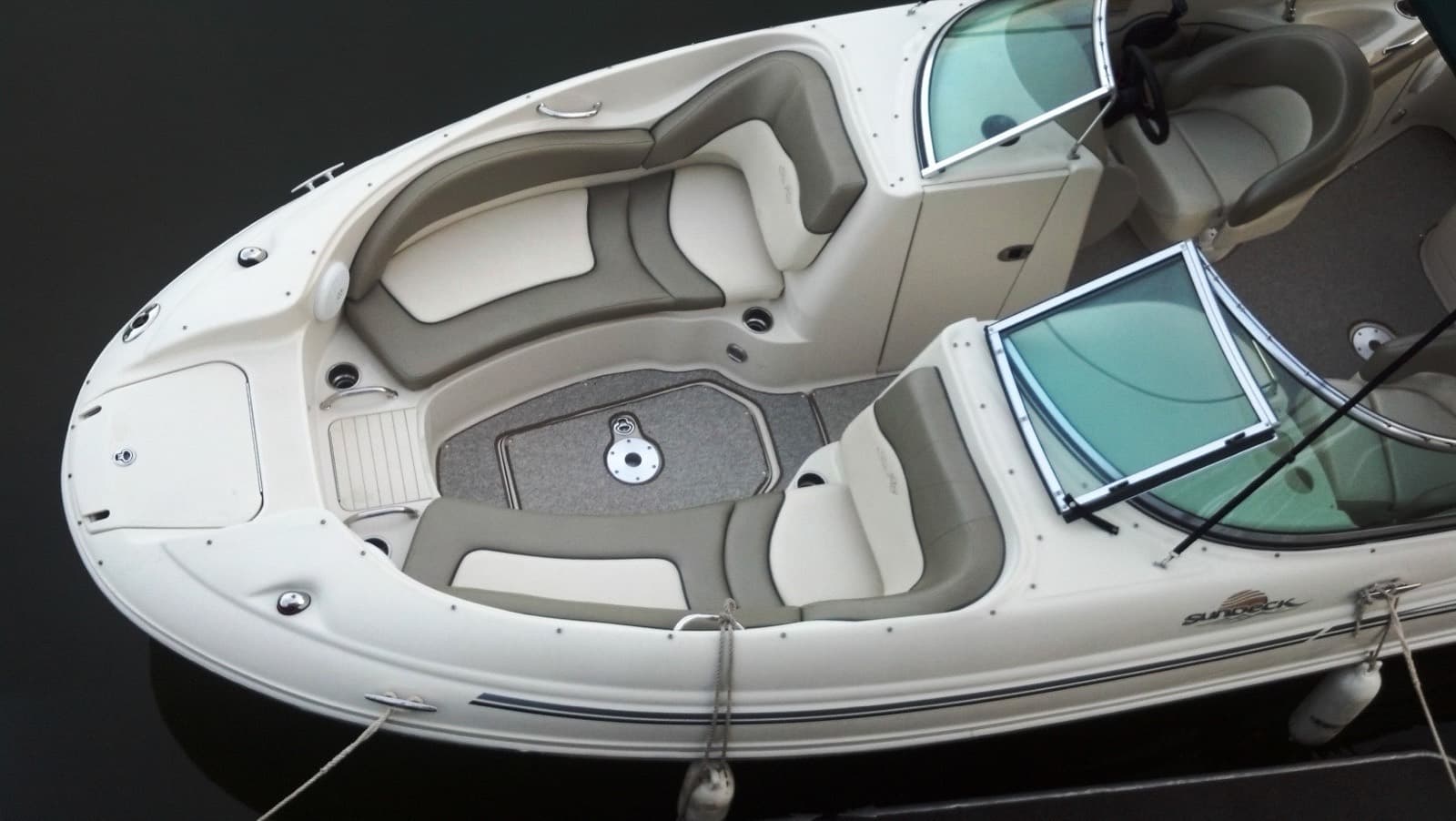
A tidy interior gets cleaned; a neglected one gets restored, and the difference in hours is large. Mildew in seat seams, pink staining, sunscreen and food stains, mildewed carpet, filthy non-skid, rusty cup holders and storage compartments full of leaves all add time.
Vinyl has to be cleaned with products made for it, not bleach or harsh household cleaners, which Sea Ray warns strip its UV inhibitors. Doing that carefully, seam by seam with soft brushes, is slower than blasting it, but it is the only way that doesn't shorten the life of the seats.
A cuddy cabin adds a whole extra space: cushions, headliner, lockers and often carpet, in a small, hot area where everything must dry before it is closed up.
Factor 4
Scope: What You Ask For
- Exterior only: hull, deck, waterline, metal and glass.
- Interior only: seats, cockpit, storage, carpet or mats, helm and gauge faces.
- Both: the full detail, which is how many owners start a season.
- Waterline brown line removal from lake water.
- Metal and brightwork polishing (rails, cleats, stainless and chrome).
- Protection on top of the correction: wax, sealant, or a coating if one is recommended.
- The tow vehicle as well, which can be quoted alongside the boat.
Factor 5
Protection Choice
Protection adds both product and time, and the more durable the protection, the more preparation it needs. A coat of wax over polished gelcoat is quick. A sealant takes similar effort. A coating demands a fully cleaned, decontaminated and corrected surface, careful application and cure time, which makes the prep stage longer.
The trade-off works the other way over time: longer-lasting protection can reduce how often the hull needs correcting again. Whether it makes sense depends on how the boat is stored and used, which is why a coating is something to ask about rather than assume.
Factor 6
Where the Boat Is Kept
Storage changes condition. Boats in wet slips grow heavier waterline stains; uncovered boats oxidize faster and collect pollen, clay and bird droppings; boats closed up under tight covers grow mildew. A trailered boat in a garage is usually the easiest detail to quote.
Storage also affects logistics. Whether the boat is on a trailer, on a lift or in a slip determines how the work gets done and scheduled. At The Auto Show, the reply to your quote request confirms whether the boat needs to come to the shop and how the work will be scheduled.
Factor 7
How Often It's Done
Frequency is the factor owners control most. A boat detailed before launch and again before storage stays in the light-oxidation, light-cleaning range, and each visit is shorter. A boat detailed once every few years starts from heavy oxidation and deep interior cleaning every time.
Simple habits between details stretch the interval: rinse after use, wash with marine soap, dry the vinyl, cover the boat, and keep protection on the gelcoat. BoatUS notes regularly waxed gelcoat can keep its gloss for 15 years or more.
Quotes
Why Boats Are Quoted Individually, and How to Get an Accurate One
A flat per-foot price can't account for oxidation level, interior condition or scope, so it either overcharges the well-kept boat or underprices the neglected one and leads to surprises. A per-boat quote based on real information avoids both.
The Auto Show quotes every boat individually and publishes no boat price list. When you request a quote on the boat detailing page or by phone at (864) 202-6934, include the make, model and length; what you want done; the condition (oxidation, water spots, mildew, stains); and where the boat is kept and whether it is on a trailer. The form can't take attachments, so email photos after the shop replies.
Photograph the hull in daylight
Shoot the hull sides and transom at an angle so chalkiness and fading show, plus a close-up after wiping a finger across the gelcoat.
Photograph the problem areas
Waterline, seats (especially seams), carpet, cup holders, metal and glass.
Be clear about scope
Exterior, interior or both, and whether you want protection or want to ask about a coating.
| Factor | Lower-effort end | Higher-effort end |
|---|---|---|
| Size and type | Small runabout, low freeboard | Large pontoon, wake boat with tower, T-top |
| Gelcoat | Glossy, waxed regularly | Chalky, faded, colored gelcoat |
| Interior | Clean vinyl, dry mats | Mildew, stains, wet carpet, cuddy cabin |
| Scope | Exterior wash and protect | Full interior and exterior with correction |
| Protection | Wax | Coating with full prep |
| Storage | Covered, dry, trailered | Uncovered wet slip, tight cover with no venting |
| Frequency | Twice a season | Every few years |
No dollar figures here on purpose: boats are quoted one at a time based on these factors.
Get a Quote Based on Your Boat
Send us the make, model and length, what you want done, the condition and where the boat is kept. We'll reply with a quote and confirm where and when the work happens.
Common questions
Why don't boat detailers publish a price per foot?
Because length is only one factor. Two boats of the same length can differ hugely in oxidation, interior condition, type and scope, so a per-foot price ends up wrong for most boats. Many detailers prefer to quote each boat from photos and a description. Some use a per-foot base and add charges for condition, so ask exactly what a per-foot figure includes.
Is it cheaper to detail a boat every year?
Usually, per visit. A boat that is cleaned and protected regularly stays in the light-oxidation, light-cleaning range, so each detail takes fewer hours. A boat left for years needs compounding and deep interior work every time. Regular protection on the gelcoat and good habits between trips are what keep the maintenance details short.
Does a dark or colored hull cost more to detail?
It often takes more care. Builders such as Formula note colored gelcoat is more susceptible to fading and chalking than white, and dark finishes show polishing marks more readily, so the final polishing stage needs more attention. Faded color may also need more correction. The exact effect depends on the hull's condition, which is why photos of the color in daylight help.
What makes a boat detailing quote change after inspection?
Usually something photos didn't show: heavier oxidation than expected, gelcoat that is thin from past compounding, mildew inside seat seams or under carpet, or extra areas such as a cabin. Sending clear daylight photos of every area and being specific about scope reduces surprises. A good detailer explains any change before starting work.
Sources
- Restoring The Shine To Fiberglass, BoatUS (https://www.boatus.com/expert-advice/expert-advice-archive/2019/february/restoring-the-shine-to-fiberglass), accessed October 2026
- Formula Limited Warranty, Model Year 2022, Formula Boats (https://www.formulaboats.com/wp-content/uploads/2022/12/Formula-Limited-Warranty-ModelYear-2022.pdf), accessed October 2026
- How to keep your Sea Ray looking sharp (vinyl maintenance tips), Sea Ray (https://searay.com/us/en/blog/vinyl-maintenance-tips), accessed October 2026
- Preventing Mold And Mildew, Charles Fort, BoatUS Magazine (https://www.boatus.com/expert-advice/expert-advice-archive/2016/january/preventing-mold-and-mildew), accessed October 2026
Boat detailing is quoted per boat, so this guide does not list boat prices. Product directions and warranty terms come from the manufacturer: follow your boat builder’s care instructions where they differ from general advice here.