
Boat Detailing Guide: Understand
What Lake Hartwell Does to Your Boat
Lake Hartwell is easy on boats in one way: it is fresh water, so you are not fighting salt crystals and fast corrosion the way coastal owners are. In every other way, the Upstate asks a lot of a finish. The water carries organic stain and fine clay, the shoreline is lined with pines that dust everything yellow each spring, the summer sun is about as strong as it gets in the eastern United States, and the nights stay damp enough to grow mildew under a cover.
This guide walks through what the lake and the climate actually do to gelcoat, vinyl, canvas, metal and carpet, using figures from the U.S. Army Corps of Engineers, SCDNR and NOAA, and turns that into a routine you can keep through a Hartwell season.
The short answer
Lake Hartwell is a fresh-water Corps of Engineers reservoir, so salt is not the problem. The damage comes from four local forces: tannin and clay in the water that leave a brown waterline, iron-rich red clay from ramps and runoff, a heavy pine pollen season in late March and April, and very high summer UV combined with humid nights. Rinsing after every trip, protecting gelcoat and vinyl from sun, and drying the boat before covering it handle most of it.
Key points
- Hartwell is a 56,000-acre Corps of Engineers lake with 962 miles of shoreline, more private docks than any other Corps lake, and a lot of boats sitting in the water all season.
- Brown waterline stain and orange clay stain are the two marks almost every Hartwell boat carries, and both come off with the right acid cleaner, used carefully.
- Pine pollen arrives in late March and April; rinse it off rather than wiping it dry, and keep it from sitting wet under a cover.
- July UV in the Upstate averages 9 to 10 on the EPA scale, which is why gelcoat chalks and vinyl hardens fastest on boats that live uncovered.
- Summer dew points in the high 60s mean a closed, damp boat grows mildew quickly; drying and ventilation matter more than any cleaner.
The lake
Hartwell by the Numbers
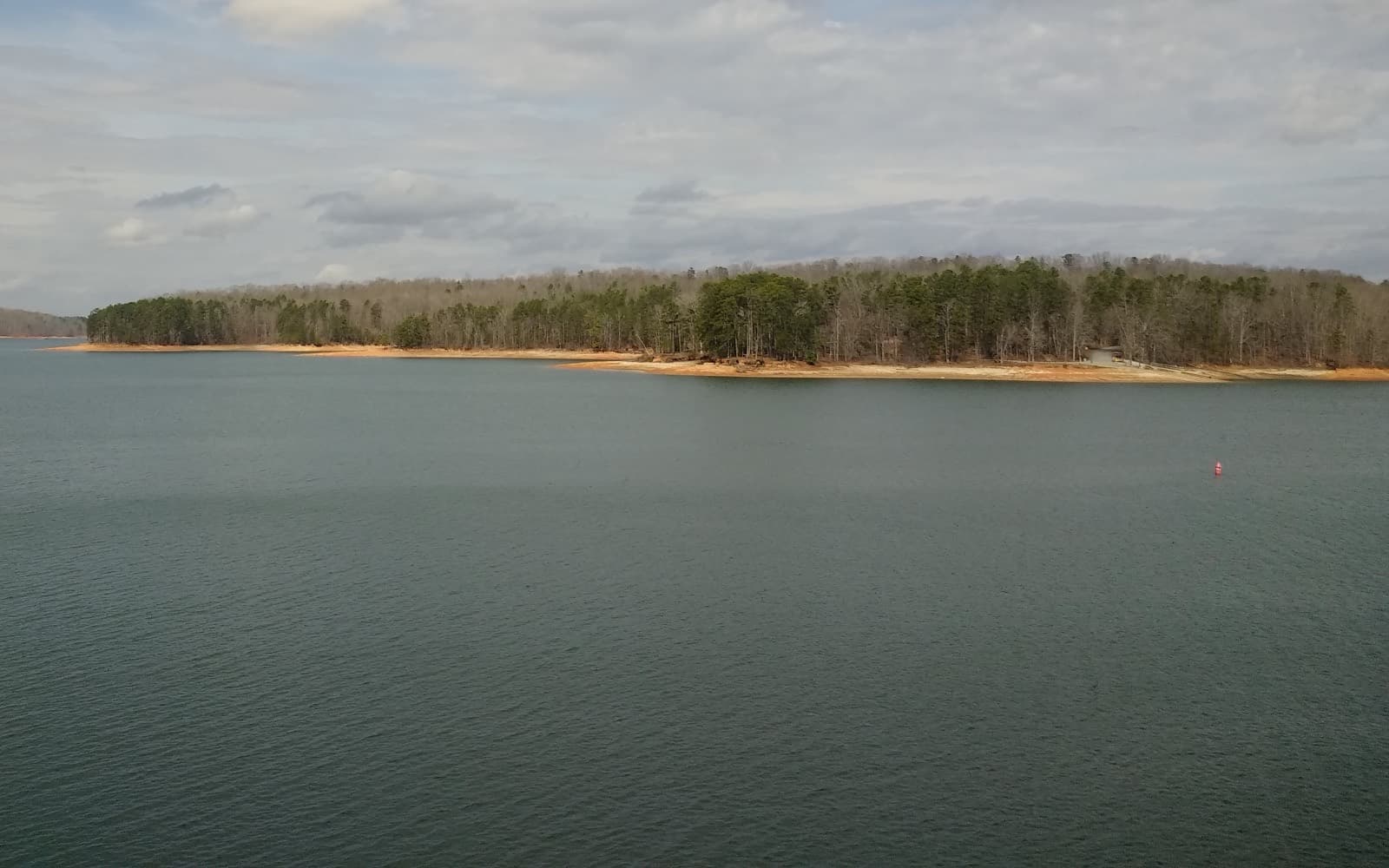
SCDNR describes Lake Hartwell as one of the most popular lakes in the Southeast, sitting on the South Carolina and Georgia line. It has about 56,000 acres of water and 962 miles of shoreline, an average depth of about 45 feet, and reaches into Anderson, Oconee and Pickens counties on the South Carolina side. The Corps of Engineers built it between 1955 and 1963 as the second of its three dams on the upper Savannah River, and the reservoir filled between February 1961 and March 1962.
Two Corps facts matter for your finish. First, Hartwell has the most private boat docks of any Corps lake in the country, with about half its shoreline zoned for limited development, so a large share of local boats live on lifts or in wet slips rather than on trailers. Second, the lake level moves with the seasons: summer full pool is 660 feet above sea level, and the Corps lowers the top of the conservation pool by about 4 feet through fall and winter, then refills it with winter and spring rain by April. A boat on a fixed lift or in a slip sits at a slightly different height on the water through the year, which is part of why waterline stains rarely form one neat line.
The water
Brown Waterlines and What Lake Water Leaves Behind
Fresh water is not clean water. Lake water carries dissolved organic matter from leaves and pine needles (the tannins that tint water like tea), and fine suspended clay that carries iron from the surrounding soil. When a hull sits in it for days, those deposits build up in the porous surface of gelcoat right where the water meets the air, and the result is the familiar brown or yellow band at the waterline. Boats that live in the water get it heavily. Trailered boats get a lighter version from each day out.
The stain sits in and on the gelcoat rather than being part of it, which is why it responds to acid hull cleaners (oxalic or phosphoric acid products made for boats) and not to soap. The same chemistry means it comes back each season, because the lake keeps supplying it. Protection does not stop the stain, but a slick, sealed surface takes it up more slowly and gives it up more easily.
- Waterline stainTannin, clay and iron at the water line
- A brown or yellow band along the hull where it sits in the water. Comes off with a marine acid hull cleaner used in short dwell times and rinsed well, then the gelcoat should be protected again. Waterline stains in depth
- Hard water spotsMinerals left when water evaporates
- Spots on gelcoat, glass and stainless where lake spray, well water or sprinkler water dried in the sun. Fresh spots wipe off; old ones can etch and need polishing. Water spots on gelcoat and glass
The soil
Red Clay: The Upstate's Signature Stain
The Upstate sits on Piedmont soils like the Cecil series, which the USDA describes as a kaolinitic clay subsoil colored red. Soil scientists attribute that red to hematite, an iron oxide. Clay particles are small enough to work into the texture of non-skid, the fibers of boat carpet, the seams of vinyl and the pores of gelcoat, and the iron in them leaves an orange tint that soap alone will not lift.
Clay reaches a boat from wet ramps, muddy shoes, trailer tires flinging spray onto the hull, and runoff that clouds the lake after summer storms. Rinse it before it dries. Dried clay is abrasive, so scrubbing a dusty, dry deck grinds it in. The orange shadow that remains after washing is iron, and it responds to the same type of acid cleaner used on waterline stains, applied sparingly and kept off aluminum and anodized parts unless the label allows it.
The trees
Pine Pollen Season
Clemson Extension notes that most of the yellow-green coating on cars, decks and outdoor furniture from late March through April is pine pollen. Pines are wind pollinated, so they release it in sheer volume, and each grain has two small air bladders that let it travel far from the tree. A lake lined with loblolly pines delivers a lot of it to every boat, dock and cover.
Dry pollen is mostly a nuisance. The trouble starts when it gets wet: morning dew and spring showers turn it into a sticky film that settles into textured surfaces, feeds mildew on canvas and vinyl, and can leave a faint yellow shadow on light gelcoat if it bakes on. Rinse pollen off with plenty of water before you wipe anything, and wipe only after it is floated away.
The sun
Very High UV From April to September
The EPA's July climatological map (2006 to 2023) puts the Upstate in the 9 to 10 band of the UV Index, which the EPA classes as very high. NOAA's Climate Prediction Center tracks Atlanta, the nearest city it graphs and at a similar latitude, where the 2025 UV forecast reached very high on 94 days and extreme on another 14. Clear-sky values there stay near or above 10 from late May into August.
That ultraviolet is what breaks down the resin at the surface of gelcoat (the chalky oxidation every older boat shows), dries out the plasticizers in marine vinyl until it hardens and cracks, fades canvas and bimini fabric, and clouds clear vinyl windows. Shade and covers do more than any product; a fresh coat of protection on gelcoat and a UV protectant made for marine vinyl come next.
The air
Humidity, Dew and Mildew
NOAA's 1991 to 2020 normals for the Anderson airport put July's normal high at about 90 degrees and its normal low at about 70. At Greenville-Spartanburg, the normal dew point in July and August is about 67 to 68 degrees, and the relative humidity worked out from the normal hourly temperature and dew point sits in the high 80s percent around dawn from July through September. That is why seats, carpet and covers are wet with dew on summer mornings even when it has not rained.
Mildew needs moisture, warmth and something organic to eat: pollen, sunscreen, skin oil, food spills and dust all qualify. A boat covered while damp and left closed in that air is close to ideal for it. BoatUS points out that mold is accelerated by warmth and humidity and that a cover which keeps water out but blocks airflow can still leave you with mildew. Dry the boat, prop cushions on edge, open lockers and give air a path through the cover.
The routine
A Hartwell Season, Step by Step
Before the first launch (March)
Wash, decontaminate and inspect. Deal with last year's oxidation and waterline stain while the boat is dry and the pollen has not started, and protect the gelcoat before the high-UV months.
Pollen weeks (late March and April)
Keep the boat covered with a breathable cover, rinse pollen off before wiping, and hose the cover itself so pollen does not wash onto the boat the next time it rains.
After every trip (May to September)
Rinse the hull, deck and seats with fresh water, wipe sunscreen off vinyl, dry standing water, open lockers for an hour, then cover. Do it before you leave the ramp or dock, not days later.
Monthly in summer
Check the waterline and remove stain before it sets, clean the non-skid, clean and protect vinyl, and look at canvas and clear vinyl for mildew spots.
Before storage (October and November)
Deep clean, remove waterline stain, protect gelcoat, dry the interior completely and store cushions and gear somewhere dry. Leave mechanical winterization to a marine mechanic.
| Surface | Main local threat | What it looks like | First line of defense |
|---|---|---|---|
| Hull gelcoat | UV, lake water | Chalky dullness, brown waterline | Rinse, protect, remove waterline stain early |
| Non-skid deck | Red clay, pollen | Orange or gray dirt in the texture | Rinse before drying; scrub, do not polish |
| Marine vinyl | UV, humidity, sunscreen | Hardening, cracks, mildew dots, pink or orange stains | Wipe after use, dry, cover, UV protectant |
| Canvas and bimini | UV, pollen, mildew | Fading, green or black spots | Hose monthly, dry before folding |
| Carpet | Clay, damp | Orange tint, musty smell | Shake out, rinse, dry fully |
| Stainless and chrome | Water spots, grime | Spots and light rust bloom | Rinse, dry, polish |
Hartwell is fresh water, so salt corrosion is not on this list. If you trailer to the coast, add a thorough fresh-water rinse and flush after each salt trip.
Get a Hartwell Season Head Start
The Auto Show in Anderson quotes boat detailing one boat at a time: gelcoat oxidation, waterline stain, non-skid, vinyl, metal and glass. Send your make, model, length, where it is kept and what you are seeing, and we reply with a quote and how the work would be scheduled.
Common questions
Is Lake Hartwell water hard on gelcoat?
It is gentler than salt water, because there are no salt crystals or rapid corrosion. The issues are organic tannins, fine clay and dissolved iron that stain the waterline, plus mineral spots where lake spray dries in the sun. Rinsing with fresh water after each outing and keeping the gelcoat protected slows both. A boat kept in the water all season will still need its waterline cleaned periodically.
Why does my boat's waterline sit higher or lower on the stain at different times of year?
Hartwell's level changes. The Corps holds summer full pool at 660 feet above sea level and lowers the top of the conservation pool by about 4 feet through fall and winter, refilling by April. Drought and heavy rain move it further. Boats on fixed lifts and in slips sit at different heights over the year, so stain bands often look smeared or doubled.
Do I need to worry about hydrilla on Lake Hartwell?
The Corps of Engineers states that hydrilla has not been located in Hartwell, but it is present upstream in Lake Keowee and downstream in Lake Thurmond. If you move a boat between lakes, remove every plant fragment from the hull, trailer, prop and livewell at the ramp, drain all water and let the boat dry before launching somewhere else.
Is it better to keep a Hartwell boat on a lift or in the water?
For the finish, out of the water is better. A lift keeps the hull out of the tannin and clay that build the waterline stain and lets the gelcoat dry, though the boat still needs a canopy or cover against UV and pollen. Boats left floating all season usually need more frequent waterline cleaning and a closer eye on the bottom.
When is pollen season worst around the lake?
Clemson Extension puts the heavy pine pollen coating in late March through April, and South Carolina Public Radio's Clemson Extension host notes that trees shed for about two months, mostly on sunny, breezy mornings. Plan your spring detail either before it starts, then rinse often, or right after it ends.
Sources
- Lake Hartwell, South Carolina Department of Natural Resources (https://dnr.sc.gov/lakes/hartwell/description.html), accessed October 2026
- Corps Lakes on the Savannah River (lake comparison brochure), U.S. Army Corps of Engineers Savannah District, archived copy (https://web.archive.org/web/2026/https://www.sas.usace.army.mil/Portals/61/docs/lakes/hartwell/HartwellUploads1/HartwellUploads1/Lake_Compare.pdf), accessed October 2026
- Hartwell Dam and Lake: History, U.S. Army Corps of Engineers Savannah District, archived copy (https://web.archive.org/web/2026/https://www.sas.usace.army.mil/About/Divisions-and-Offices/Operations-Division/Hartwell-Dam-and-Lake/History/), accessed October 2026
- Hartwell Dam and Lake: Natural Resources, U.S. Army Corps of Engineers Savannah District, archived copy (https://web.archive.org/web/2026/https://www.sas.usace.army.mil/About/Divisions-and-Offices/Operations-Division/Hartwell-Dam-and-Lake/Natural-Resources/), accessed October 2026
- Official Soil Series Description: Cecil Series, USDA Natural Resources Conservation Service (https://soilseries.sc.egov.usda.gov/OSD_Docs/C/CECIL.html), accessed October 2026
- Why Pine Pollen Covers Everything in Spring (The "Pollening" in the South), Clemson Cooperative Extension Home & Garden Information Center (https://hgic.clemson.edu/why-pine-pollen-covers-everything-in-spring-the-pollening-in-the-south/), accessed October 2026
- Sun Safety: Monthly Average UV Index 2006 to 2023, U.S. Environmental Protection Agency (https://www.epa.gov/sunsafety/sun-safety-monthly-average-uv-index-2006-2023), accessed October 2026
- UV Index: Annual Time Series, Atlanta GA 2025, NOAA Climate Prediction Center (https://www.cpc.ncep.noaa.gov/products/stratosphere/uv_index/uv_annual.shtml), accessed October 2026
- U.S. Climate Normals 1991 to 2020, Anderson County Airport (USW00093846) monthly and Greenville-Spartanburg (USW00003870) hourly, NOAA National Centers for Environmental Information (https://www.ncei.noaa.gov/access/services/data/v1?dataset=normals-monthly-1991-2020&stations=USW00093846&format=csv), accessed October 2026
- Preventing Mold and Mildew, BoatUS (https://www.boatus.com/expert-advice/expert-advice-archive/2016/january/preventing-mold-and-mildew), accessed October 2026
Boat detailing is quoted per boat, so this guide does not list boat prices. Product directions and warranty terms come from the manufacturer: follow your boat builder’s care instructions where they differ from general advice here.