
Ceramic Coating & PPF Guide: Understand
How to Wash a Car With Paint Protection Film
Paint protection film is tough on the face and vulnerable at the edges. The flat surface shrugs off stone chips and light scratches, but the cut edge where the film ends, along a hood, a bumper or a headlight, is where water, dirt and a careless pressure washer can get underneath.
Washing a filmed car is mostly the same as washing any well-kept car, with a few specific rules. Follow them and the film stays clear, glossy and stuck down for years. Ignore them and you can lift an edge in a single wash.
The short answer
Wait at least 72 hours after installation before the first wash, as LLumar recommends. After that, hand wash with a pH-neutral car shampoo, plenty of water and a soft, clean microfiber mitt. LLumar discourages pressure washers and automatic car washes because they can lift the film, especially at edges. If you rinse with a pressure washer, use a wide fan, stay well back and never aim at film edges. Skip abrasive polishes and remove droppings promptly.
Key points
- Give new film three days (72 hours) before washing, per LLumar.
- Hand washing with soap, water and a soft, clean cloth is the film maker's preferred method.
- Edges are the weak point: no close-range pressure washing, no picking, no aggressive towel work along them.
- Avoid compounds, abrasive polishes and cleaner waxes on gloss film; on matte film, avoid any wax or gloss product.
- Bird droppings and other staining hazards should come off quickly, even though film protects the paint underneath.
Why it's different
What makes washing a filmed car different
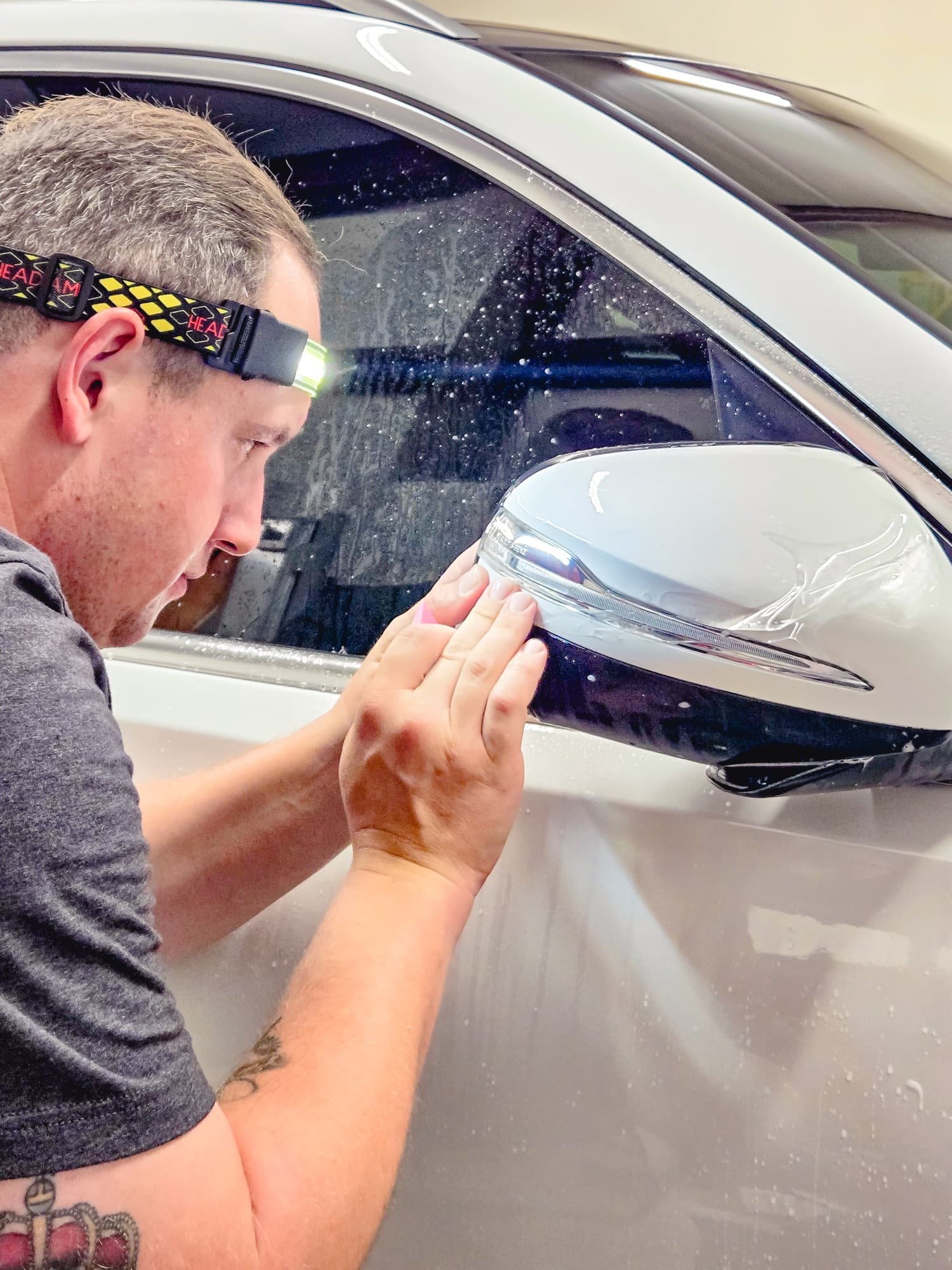
Paint protection film is a clear urethane layer with a pressure-sensitive adhesive on the back and a protective top coat on the front. Its face is designed to take abuse. Its edges are where the adhesive meets the open air, and that is where problems start: water forced underneath, dirt packed into the seam, or a towel snagging a corner.
LLumar, which makes the film many installers use, puts it plainly in its care guidance: pressure washing and automatic car washes are discouraged because they can cause lifting, especially around the edges, and that damage is not covered by its limited warranty. The rest of the routine is about keeping the top coat clean and clear.
The good news is that film handles the same Upstate threats paint does, often better. LLumar says its film can handle excessive heat with proper care, and its top coat lets light surface scratches level out when warmed by the sun, warm water or a warm engine.
First week
Before the first wash
LLumar recommends not washing a vehicle for three days (72 hours) after film is installed. The adhesive needs that time to grip, and the installation solution needs time to dry out from under the film.
During the first days and sometimes weeks, you may see small water bubbles, a slight haze or a faint milky look in some areas. That is usually leftover moisture working its way out through the film, and it typically clears on its own as the film cures, faster in warm, sunny weather. Do not press on bubbles or try to push them out, and do not pick at edges. If something still looks wrong after a few weeks, or an edge visibly lifts, call your installer.
The routine
Step-by-step: washing a car with PPF
Wash in the shade on a cool surface
Soap and water drying on hot film leave spots just like they do on paint. Morning or evening, or in the shade, is best.
Clean wheels first with separate tools
Use a dedicated bucket and brushes for wheels and tires so brake dust never reaches the film or paint.
Rinse gently and thoroughly
Use a hose with a spray nozzle, or a pressure washer on a wide fan tip held well back. Rinse with the water flowing across edges rather than straight into them, and keep the spray moving.
Hand wash with two buckets
Use a pH-neutral car shampoo, a soft microfiber or wool mitt and a separate rinse bucket. LLumar's preferred method is soap, water and a soft, clean cloth. Wash with light pressure, moving along edges, not into them.
Rinse again, edges included
Make sure no soap is left in the seams around headlights, badges and panel edges, where it can dry into a white line.
Dry carefully
Lay a plush microfiber drying towel flat and pat or drag it gently. Wipe along edges in the direction that would press them down, not peel them up. A blower works well, but keep it moving and do not hold it right at an edge.
Inspect the edges
Once dry, take a quick look along the film's edges and corners. Dirt lines or slightly lifted corners are easiest to deal with when caught early.
Pressure washers
Pressure washer rules for film
LLumar discourages pressure washing filmed cars. Many owners still use one for the pre-rinse and wheels, and if you do, technique matters more than the machine. A narrow, high-pressure jet held close to an edge can drive water under the film and lift it, sometimes in a single pass.
- Use a wide fan tip, never a narrow or rotating zero-degree nozzle.
- Keep the nozzle well back from the surface; closer is not cleaner, it is riskier.
- Never aim directly at a film edge, seam or corner. Spray at an angle so water flows over the edge, not into it.
- Be extra careful around headlights, mirror caps and the leading edge of the hood, where film is wrapped or trimmed.
- Skip the pressure washer entirely for the first weeks after installation.
- If a corner has already started to lift, keep all spray away from it and have it looked at.
Products
Products to use and products to avoid
- pH-neutral car shampooUse
- Gentle on the top coat, the adhesive at the edges and any coating applied over the film. Why pH-neutral matters
- Non-abrasive wax or sealantOptional on gloss film
- LLumar lists non-abrasive waxes as part of proper care. Avoid cleaner waxes, which contain abrasives, and keep products from building up as a white line along edges.
- Compounds and abrasive polishesAvoid
- They can haze or wear the top coat. If film looks scuffed, warmth often levels light marks on its own; deeper marks are a question for your installer. How self-healing works
- Strong solvents and degreasersUse with care
- Harsh tar removers and solvent-heavy cleaners can attack the adhesive at the edges. If you need one for tar, apply it to a towel, not the film, and keep it off the edges.
- Ceramic coating over filmCompatible
- Film can be ceramic coated, and IGL lists its Ecocoat Kenzo coating as safe on PPF. A coating makes washing filmed panels faster. PPF and coating together
Stains
Droppings, bugs and sap on film
Film protects the paint underneath from etching, but the film's own top coat can still stain or mark if contamination bakes on. LLumar's definition of proper care includes prompt removal of staining hazards such as bird droppings. In an Upstate summer, treat droppings, bug splatter and sap as same-day jobs.
The technique is the same as on paint: soak the spot with a quick detailer or a wet microfiber for a minute or two, then lift it off gently. Do not scrape, and do not use a fingernail along an edge. For sap, a product labeled safe for film, applied to a towel and left to soften the sap, works better than force.
Matte film
Washing matte or satin film
Matte film, sometimes called stealth film, turns gloss paint satin or protects factory matte paint. Its textured top coat is what creates the look, so anything that fills or polishes that texture changes it. Avoid all waxes, gloss sealants, polishes and detail sprays that promise shine.
Use a car shampoo without gloss enhancers, ideally one made for matte finishes, and the same gentle two-bucket routine. Dry by blotting rather than buffing. A coating made for matte surfaces adds protection without adding gloss.
| Situation | Safe approach | Avoid |
|---|---|---|
| First 72 hours | Leave it alone, per LLumar | Washing, pressure, picking edges |
| Routine wash | Hand wash, pH-neutral soap, soft mitt | Brush or automatic washes |
| Rinsing | Hose or wide fan held well back | Close jets aimed at edges |
| Drying | Blot or gentle drag, along edges | Towel strokes that peel edges up |
| Light scuffs | Warmth from sun or warm water | Compounds and abrasive polishes |
| Matte film | Matte-safe shampoo, blot dry | Wax, gloss sprays, polishing |
Thinking about protecting the front end?
We are authorized LLumar installers. Ask us which film package fits your car and how you drive.
Common questions
Can I take a car with PPF through a touchless car wash?
LLumar discourages automatic car washes on filmed cars because high-pressure jets can lift edges. Touchless washes also tend to use strong detergents. An occasional touchless wash on a fully cured install is a judgment call, safer than a brush wash, but hand washing is the method the film maker recommends and the one least likely to cause problems.
What should I do if a PPF edge starts lifting?
Keep it clean and dry, do not press it down with your finger or pull at it, and keep pressure washers and towels away from it. Contact your installer soon. A slightly lifted edge caught early can often be cleaned and re-secured, while one left to collect dirt and water tends to get worse and may need that piece replaced.
Why is there a dirt line along the edge of my PPF?
The tiny step where film ends can catch dirt, wax and dried soap, which shows up as a dark or white line. A soft, wet microfiber or a soft detailing brush with car shampoo usually cleans it out. Rinse well so soap does not dry in the seam, and avoid building up wax along the edge.
Is it safe to use a clay bar on paint protection film?
Only gently and only when needed. Use a fine-grade clay or clay mitt with plenty of lubricant and light pressure, and work along edges rather than into them. On a film that is washed regularly, bonded contamination is rare. Many film owners never need to clay at all, especially with a coating on top.
Sources
- Paint Protection Film Frequently Asked Questions, LLumar (https://llumar.com/en/resources/paint-protection-film-frequently-asked-questions/), accessed October 2026
- Ecocoat Kenzo, IGL Coatings (https://iglcoatings.com/product/ecocoat/), accessed October 2026
- Ceramic Coating Wash Techniques, IGL Coatings (https://blog.iglcoatings.com/ceramic-coating-wash-techniques/), accessed October 2026
- Just got a Ceramic Coating Done and you're not sure how to maintain it?, IGL Coatings (https://blog.iglcoatings.com/how-to-maintain-ceramic-coatings/), accessed October 2026
Prices on this page are The Auto Show’s published starting prices and are confirmed after we inspect the vehicle. Product ratings and warranty terms come from the manufacturers.