
Ceramic Coating & PPF Guide: Understand
Paint Decontamination: Clay Bar, Iron Remover and Tar Remover
A car can look clean after a wash and still feel like fine sandpaper under your fingertips. What you are feeling is bonded contamination: particles stuck to or lodged in the clear coat that shampoo cannot lift. Decontamination is the set of steps that removes it.
It is the least glamorous part of a detail and the part most often skipped by cheap offers. It is also the reason a coating bonds properly, a polish finishes cleanly and film lies flat. This guide explains each step, what it removes and the order that works.
The short answer
Paint decontamination removes contaminants bonded to the clear coat that washing leaves behind. The usual order is a thorough wash, a tar and bug remover for sticky residue, an iron remover that dissolves embedded metal particles, then a clay bar or clay mitt on lubricant to lift whatever is still stuck. It is done before polishing, sealing, coating or film, so those steps work on clean paint.
Key points
- Washing removes loose dirt; decontamination removes what is stuck: iron, tar, sap mist, overspray and mineral deposits.
- Chemical steps go first, so the clay has less to do and drags fewer particles across the paint.
- Clay can leave light marring of its own, which is one reason it is followed by polishing before a coating.
- IGL's own coating instructions call for abrasive polishing, iron removal and a degreasing wipe before its coating goes on.
The problem
What Washing Leaves Behind
Car shampoo is designed to loosen and lift dirt that is resting on the surface, and to do it gently enough that it does not strip wax or damage paint. It is not designed to dissolve metal, melt tar or pull out particles lodged in the clear coat. Those need either a chemical that targets them or a mechanical step that lifts them.
You can check for bonded contamination with the bag test: after washing and drying, slide a thin plastic sandwich bag over your hand and glide your fingertips lightly over the hood, the lower doors and the rear bumper. Gritty or bumpy spots are bonded contamination. Most daily drivers that have never been decontaminated fail this test, often badly on the lower half of the car.
- Iron and brake dust
- Metal particles that lodge in the clear coat and rust into orange specks. Removed with an iron remover. Iron contamination explained
- Tar and road film
- Sticky black spots behind the wheels and along the rockers, from fresh asphalt and road oils. Removed with a solvent-based tar remover.
- Bug residue
- Dried protein and fluids on the front bumper, mirrors and windshield. Removed with a bug remover soak before the wash.
- Tree sap mist and pollen film
- Fine sticky dots and films from trees, especially under pines and in spring. Some lift with solvents; the rest with clay. Removing sap and pollen
- Overspray
- Tiny dots of paint or clear from nearby painting, often invisible but rough to the touch. Clay is the main tool.
- Mineral deposits
- Water spots from sprinklers and hard water. Fresh ones lift with a dedicated water spot remover; etched ones need polishing.
The order
A Full Decontamination, Step by Step
1. Pre-soak bugs and heavy grime
Spray bug remover on the front end and mirrors and let it dwell while you prepare. Rinse the car top to bottom to remove loose dirt before anything touches the paint.
2. Clean the wheels first
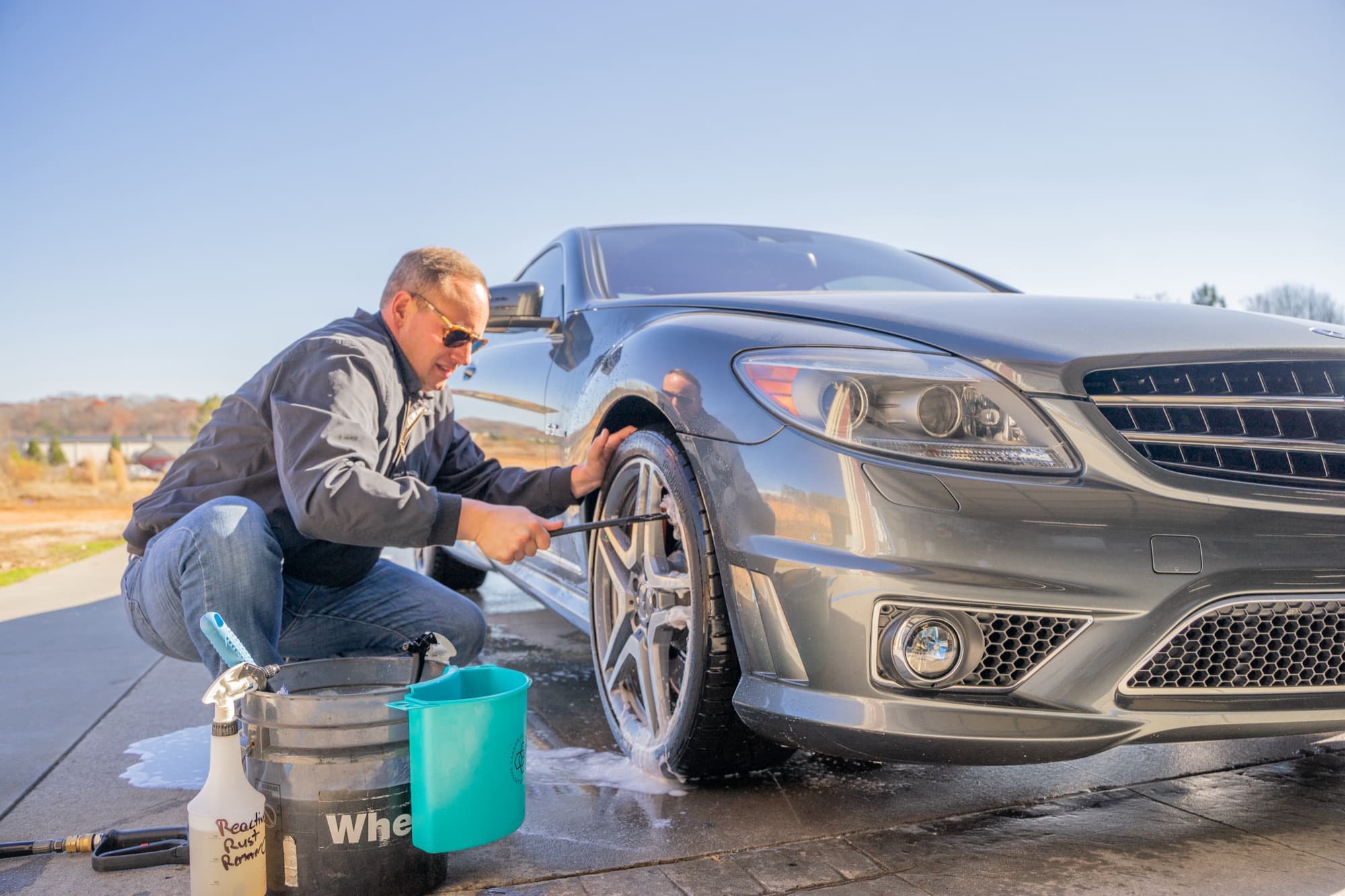
Wheels hold the most brake dust and grime. Doing them first keeps that splatter off paint you have already washed. Use separate brushes and mitts.
3. Contact wash
Wash with a pH-neutral shampoo and clean mitts, working from the roof down. A pre-wash foam helps loosen grime first. Rinse thoroughly.
4. Tar remover
Apply a tar remover to the lower panels, behind the wheels and on any black spots. Let it soften the tar, wipe gently with a dedicated towel and rinse.
5. Iron remover
Spray an iron remover on cool, wet or dry paint as the label directs. Let it dwell until it turns purple where iron is present, never let it dry, then rinse completely.
6. Clay with plenty of lubricant
Work a clay bar or clay mitt over each panel in straight lines, on a generous film of clay lubricant or soapy water, until it glides smoothly. Fold or rinse the clay often so you are not rubbing collected grit back into the paint.
7. Final wash and dry
Wash or rinse again to remove clay residue and lubricant, then dry with clean microfiber or forced air.
8. Polish, then panel wipe
If the car is being corrected or coated, polishing comes next, followed by a panel wipe or degreaser that removes polishing oils so the coating bonds to bare clear coat.
Work in the shade on cool panels. Chemicals that dry on hot paint in an Upstate summer can leave their own spots.
Why this order
Why Chemicals Come Before Clay
Clay removes contaminants by grabbing what sticks up above the surface as it glides. Every particle it picks up is then carried across the paint until you fold or rinse the clay. The more contamination on the paint when you start, the more debris is trapped in the clay and the higher the chance of light marring.
Chemical steps dissolve or loosen much of the contamination first without rubbing. Tar remover softens tar so it wipes away, and iron remover dissolves embedded metal so it rinses off. By the time the clay touches the paint, there is far less for it to catch. That is better for the paint and quicker for whoever is doing the work.
Even done carefully, claying can leave faint marring on soft paint, which is why serious prep for a coating includes a polishing step afterward. If you clay a car yourself and plan only to wax it, use a fine-grade clay or clay mitt and plenty of lubricant.
Tools
Clay Bar vs Clay Mitt vs Clay Towel
- Traditional clay barMost thorough
- A soft, putty-like bar in fine, medium or heavy grades. It conforms to the surface and is excellent at removing stubborn bonded contamination. If you drop it on the ground, throw it away; it will pick up grit that scratches.
- Clay mitt or padFaster
- A rubberized synthetic surface on a mitt or pad. It covers panels quickly and can be rinsed clean if dropped. Some versions are more aggressive than fine clay, so test on a small area first.
- Clay towelLarge areas
- A microfiber towel with a synthetic clay layer, used like a mitt. Convenient for big trucks and SUVs, with similar trade-offs.
- LubricantEssential
- A dedicated clay lube or a slick soapy solution keeps the clay gliding instead of grabbing. Never clay dry paint.
Coatings
Why Decon Matters Before a Ceramic Coating
A ceramic coating has to bond to the clear coat itself. IGL's technical data sheet for its Ecocoat EZ coating states that the surface must be carefully cleaned of all contaminants before application, that the durability of the coating depends on how well it has chemically bonded with the surface, and that the surface should be polished with an abrasive system to remove hard-bearing contamination, with Ecoclean Iron used to remove iron particles. It then calls for a degreasing step and for coating the cleaned surface immediately to prevent new contamination.
In practice, that means a car should never be coated straight after a wash. Anything left on the paint is sealed under the coating, where it can show as a bump or weak spot, and the coating's bond is only as good as the surface beneath it.
The same logic applies to paint protection film: a particle trapped under film becomes a visible bump, and adhesion around it is weaker.
How often
How Often to Decontaminate
- Before any polish, paint correction, ceramic coating or PPF install: every time.
- Unprotected daily driver: a full decon two or three times a year, or whenever the bag test feels gritty.
- Waxed or sealed car: before each new application of wax or sealant, so it bonds to clean paint.
- Coated car: gentle chemical decon as needed, with clay only when the coating maker or installer recommends it, since aggressive clay can wear a coating.
- After a road trip, construction zone or week parked near a job site or rail line.
| Step | Removes | Type |
|---|---|---|
| Bug remover pre-soak | Bug residue | Chemical |
| pH-neutral wash | Loose dirt, road film, pollen | Chemical and contact |
| Tar remover | Tar, road oils, adhesive residue | Solvent |
| Iron remover | Embedded iron, brake dust, rail dust | Chemical reaction |
| Clay bar or mitt | Overspray, sap mist, remaining bonded particles | Mechanical |
| Water spot remover | Fresh mineral deposits | Mild acid chemical |
| Polish and panel wipe | Light defects, oils, residues before coating | Abrasive, then solvent |
Want it done properly before protection?
Our Level 2 Detail includes iron remover on wheels and paint, bug and tar remover, clay bar and trim restorer. It is the minimum we do before any ceramic coating.
Common questions
Can I clay bar my car without polishing afterward?
Yes, if you use a fine clay or clay mitt, plenty of lubricant and a light touch, then follow with a wax or sealant. The paint will be smoother and the protection will bond better. On soft or dark paint you may see light marring in direct sun, which a polish would remove. For a coating, polishing afterward is strongly recommended.
Can I use dish soap as clay lubricant?
A few drops of car shampoo in water work as a lubricant in a pinch. Dish soap is a degreaser that strips wax and sealants and is not formulated for paint, so it is better avoided. A dedicated clay lubricant gives the most glide and the lowest risk of the clay grabbing and marring the surface.
Does decontamination remove wax or sealant?
Often, at least partly. Iron removers, tar removers and especially clay can thin or remove wax and many sealants. That is fine if you are about to polish and protect, which is the usual reason to decontaminate. Plan to apply a fresh layer of protection afterward rather than decontaminating a freshly waxed car.
How long does a full decontamination take?
On a clean sedan, a careful wash, chemical decon and clay usually takes a few hours by hand, and more on a large truck or a neglected car. The clay step alone can take an hour or more if the paint is heavily contaminated. That time is a big part of why a detail with real decontamination costs more than a quick wash.
Is a clay mitt safe on a ceramic coated car?
Use it sparingly. Clay and clay mitts are mildly abrasive, and regular use can wear a coating faster. Most coated cars only need gentle chemical decontamination, such as a coating-safe iron remover, a few times a year. Ask your installer what they recommend for your specific coating before claying it.
Sources
- Technical Data Sheet: IGL Coatings Ecocoat EZ, IGL Coatings (https://iglcoatings.com/wp-content/uploads/2023/09/tds_ecocoat_ez_154325.pdf), accessed October 2026
- Ecoclean Iron, IGL Coatings (https://iglcoatings.com/product/ecoclean-iron), accessed October 2026
- The Perfect Companion to Your Decontaminating Routine, IGL Coatings blog (https://blog.iglcoatings.com/the-perfect-companion-to-your-decontaminating-routine/), accessed October 2026
- Secrets to a Cleaner Car, Consumer Reports (https://pressroom.consumerreports.org/cars/car-maintenance/secrets-to-a-cleaner-car-a8868483543/), accessed October 2026
Prices on this page are The Auto Show’s published starting prices and are confirmed after we inspect the vehicle. Product ratings and warranty terms come from the manufacturers.