
Window Tint Guide: Understand
How Old Window Tint Is Removed
Old tint does not last forever. Film that has faded to purple, bubbled, or started to peel looks worse every month, and tint that is darker than South Carolina allows can become a problem when you sell the car or get pulled over. Before anything new goes on, the old film has to come off, and so does every trace of its adhesive.
Removal sounds simple, but it is slow, messy work, and the back glass can be damaged if it is done carelessly. Here is how it is done, what makes it hard, and the mistakes that cost people a working rear defroster.
The short answer
Old window tint is removed in two stages: first the film itself, then the adhesive it leaves behind. The adhesive is softened with heat, moisture or a remover solution so the film peels in large pieces, and the remaining glue is dissolved and wiped or scraped off. Side windows can be shaved with a razor blade, but the rear window's defroster lines must never be scraped, or the grid can stop working.
Key points
- Removing tint means removing the film and then its adhesive; the adhesive is usually the harder part.
- Softening the adhesive first lets the film come off in large sheets instead of tiny flakes.
- A razor blade is fine on plain side glass but can sever the printed defroster lines on rear glass.
- Eastman's Gila brand says to wait at least 24 hours after removing old film before applying new film.
- In South Carolina, once all after-factory film is gone, the law's light transmittance rules no longer apply to that window.
Why remove it
Common reasons old tint has to come off
- The film has faded or turned purple, which happens as dyes in older films break down.
- Bubbles or blisters have formed because the adhesive is failing.
- Edges are peeling or the film has been scratched or torn.
- The shade is too dark for South Carolina's 27% combined light transmission limit on regulated windows.
- You are replacing a basic film with a heat-rejecting ceramic one.
- You bought a used car with tint you do not like or cannot verify.
Stage one
Getting the film off the glass
Old film rarely peels cleanly. The polyester layers may come off but leave the adhesive and sometimes the dyed layer behind, and brittle, sun-baked film tends to tear into small pieces. The goal is to soften the adhesive enough that the film releases in one sheet.
Gila, the do-it-yourself film brand from Eastman, publishes removal instructions for its remover kit. The method is to spray the film with remover solution, cover it with plastic such as a garbage bag sealed with masking tape, and wait 30 minutes before testing whether a corner lifts with a fingernail. If it does not, you respray, reseal, and test again every 30 minutes. Once it releases, a razor blade lifts a top corner an inch or two and the film is pulled downward with steady pressure.
Professionals use the same principle with their own tools and methods. Warmth helps: Gila says its solution works best when the inside glass temperature is 65 to 75 degrees Fahrenheit. Whatever the method, patience is what keeps the film coming off in sheets rather than in hundreds of little flakes.
Stage two
Clearing the leftover adhesive
After the film is off, the glass is usually covered in a sticky, cloudy layer of glue. It must all go before new film is applied, because any adhesive left behind will show as streaks, haze or lumps under the new film.
Gila's instructions call for spraying the residue and letting it soak for 3 to 5 minutes, repeating until the adhesive turns milky white. On plain glass, the adhesive is then shaved off from the top down with a sharp razor blade while the glass is kept wet, wiping the blade clean as you go. Gila also suggests masking tape along the bottom of auto windows so dissolved glue does not run into the gap between the glass and the door.
Back glass
The rear defroster: where removal goes wrong
Most rear windows have a defroster grid: thin horizontal lines printed onto the inside of the glass that heat up to clear fog and frost. Those lines sit on the surface, the same side the tint is on. A blade, an abrasive pad or rough peeling can cut or lift them, and a single break stops current flowing along that line.
Car makers warn about this in their manuals. Mazda's owner's manual, for example, says not to use sharp instruments or window cleaners with abrasives on the inside of the rear window because they may damage the defogger grid. Gila's removal instructions say to use caution when removing film from glass with defroster wires because damage could occur, and that once the film is off, the adhesive should be resprayed and rubbed off briskly with paper towels or non-scratching nylon pads, not a razor blade.
Even with care, very old film can be stuck so firmly that it pulls at weak grid lines as it comes away. That risk is one reason some owners leave back glass removal to someone who does it often.
The process
Removal, step by step
Protect the interior
Cover door panels, speakers, seats and the rear deck. Remover solution and dissolved glue drip, and electronics in doors and the rear deck should stay dry.
Soften the adhesive
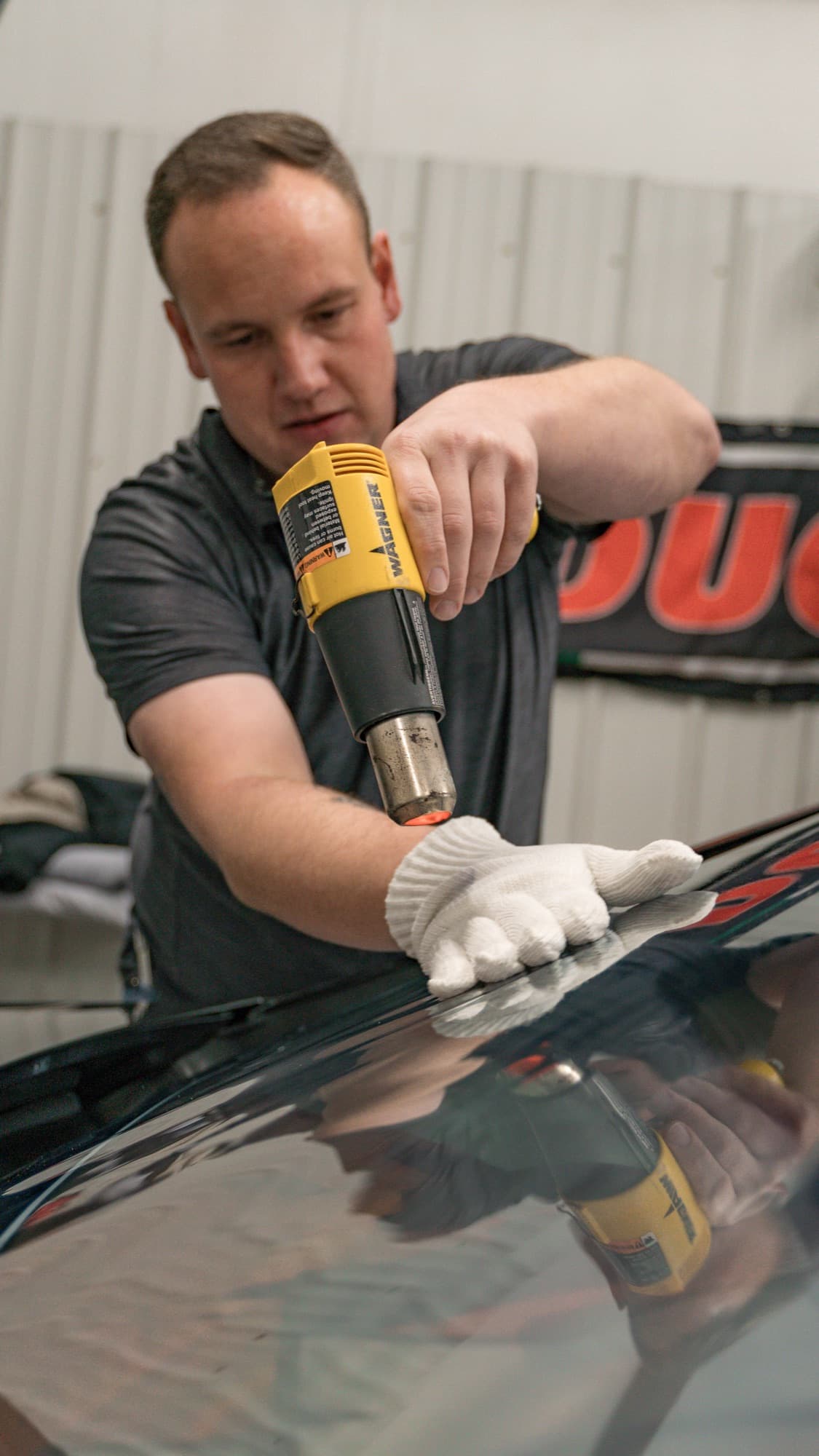
Apply heat, moisture or a remover solution and give it time to work. Rushing this step is the most common reason film shreds.
Peel slowly from a corner
Lift a top corner and pull the film down at a low angle with steady pressure. Stop and soften again wherever it resists.
Dissolve the leftover glue
Wet the residue and let it soak until it turns soft and milky, then remove it. Use a blade only on plain glass, never across defroster lines.
Clean and inspect
Clean the glass thoroughly and check it at an angle in daylight for any remaining adhesive. Test the rear defroster to confirm every line still clears.
Wait before new film
Gila advises waiting at least 24 hours after removing old film before applying new film, so the glass is fully clean and dry.
Legal side
Removal and South Carolina tint law
South Carolina's tint statute, S.C. Code Ann. § 56-5-5015, regulates after-factory sunscreening devices. Subsection (A) says that if no after-factory sunscreen device has been added to the window surface, the section's light transmittance provisions do not apply. In plain words: factory glass with nothing added is not judged by the 27% film rule.
So if your car has film darker than the law allows on the windshield, front side windows, or rear windows of a regulated vehicle such as a sedan or pickup, removing it puts that window back to factory condition. If you replace it, the new film must meet the limits, and subsection (E) requires a certificate of compliance on the inside lower right corner of each window with an after-factory sunscreen device. The old sticker should come off with the old film.
If you have been ticketed or told to remove tint, ask the court or a lawyer what proof of correction they want. This guide is not legal advice.
DIY or not
Should you remove tint yourself?
Side windows are the easiest place to try it yourself if the film is relatively fresh and peels well. Expect a few hours, a lot of paper towels and some patience. The back glass, very old film, and film that has broken into a crackled layer are where things get harder and the risk of damage rises.
If you plan to have new film installed, ask your installer before you start. They may prefer to handle removal themselves, since the condition of the glass and defroster grid affects how the new film goes on. If you have any doubt about the back glass, ask first rather than trying to fix a cut defroster line afterward.
| Method | How it works | Watch out for |
|---|---|---|
| Remover solution under plastic | Solution soaks into film and adhesive while sealed in | Slow; needs time and repeat applications |
| Heat | Warm film and glue soften so film peels in sheets | Uneven heating; too much heat on cold glass |
| Razor blade on adhesive | Shaves softened glue off wet glass | Never on defroster lines; keep glass wet |
| Paper towels or nylon pad | Rubs softened glue off delicate areas | Slower; best for rear glass with a grid |
| Pulling dry film | Peel without softening | Film tears into flakes; glue stays behind |
Replacing old tint?
Ask us before booking if your car has old film on it. We will look at the glass, check the legal shade for your vehicle, and explain the options for new LLumar film.
Common questions
Can I remove window tint with a hair dryer?
Gentle heat helps soften adhesive on small windows, and some people manage with a hair dryer on fresh film. It is slow on large glass and old, brittle film. Never combine heat with a razor blade on the rear defroster lines, and keep heat moving so no one spot gets very hot.
Is ammonia safe for removing tint?
Many do-it-yourself guides mention ammonia-based solutions. Ammonia fumes are harsh in an enclosed car, so ventilate well and never mix ammonia with bleach or other cleaners. A dedicated film remover, used as its label directs, is the simpler option. Keep any solution off leather, electronics and door speakers.
My rear defroster stopped working after tint removal. Can it be fixed?
Small breaks in a grid line can sometimes be repaired with a conductive repair kit sold for that purpose, following the kit's instructions. Several broken lines or damaged connection tabs may need professional glass repair or replacement. Test the defroster before removal so you know its starting condition.
Does removing tint leave the glass scratched?
It should not if the glass is kept wet, blades are sharp and clean, and nothing abrasive touches it. Scratches usually come from dry scraping, dull or rusty blades, or grit trapped under the blade. The rear defroster lines are the area most easily damaged.
Sources
- Window Film Removal Instructions (Window Film Adhesive Remover, 11/2024), Gila Window Film / Eastman Performance Films (https://gilafilms.com/content/dam/eastman/performance-films/gila-films/documents/installation-instructions/window-film-adhesive-remover-install-instructions.pdf), accessed October 2026
- Window Film Remover Kit, Gila Window Film / Eastman Performance Films (https://gilafilms.com/en/automotive-window-tint/products/remover-kit/), accessed October 2026
- Rear Window Defogger (2025 CX-5 Owner's Manual), Mazda North American Operations (https://www.mazdausa.com/static/manuals/2025/cx-5/contents/05030900.html), accessed October 2026
- S.C. Code Ann. § 56-5-5015, South Carolina Legislature (https://www.scstatehouse.gov/code/t56c005.php), accessed October 2026
- Window Film Frequently Asked Questions, LLumar / Eastman Performance Films (https://llumar.com/en/resources/architectural-film-frequently-asked-questions/), accessed October 2026
Prices on this page are The Auto Show’s published starting prices. Film ratings and warranty terms come from the manufacturer. This guide explains South Carolina law in plain words; it is not legal advice.