
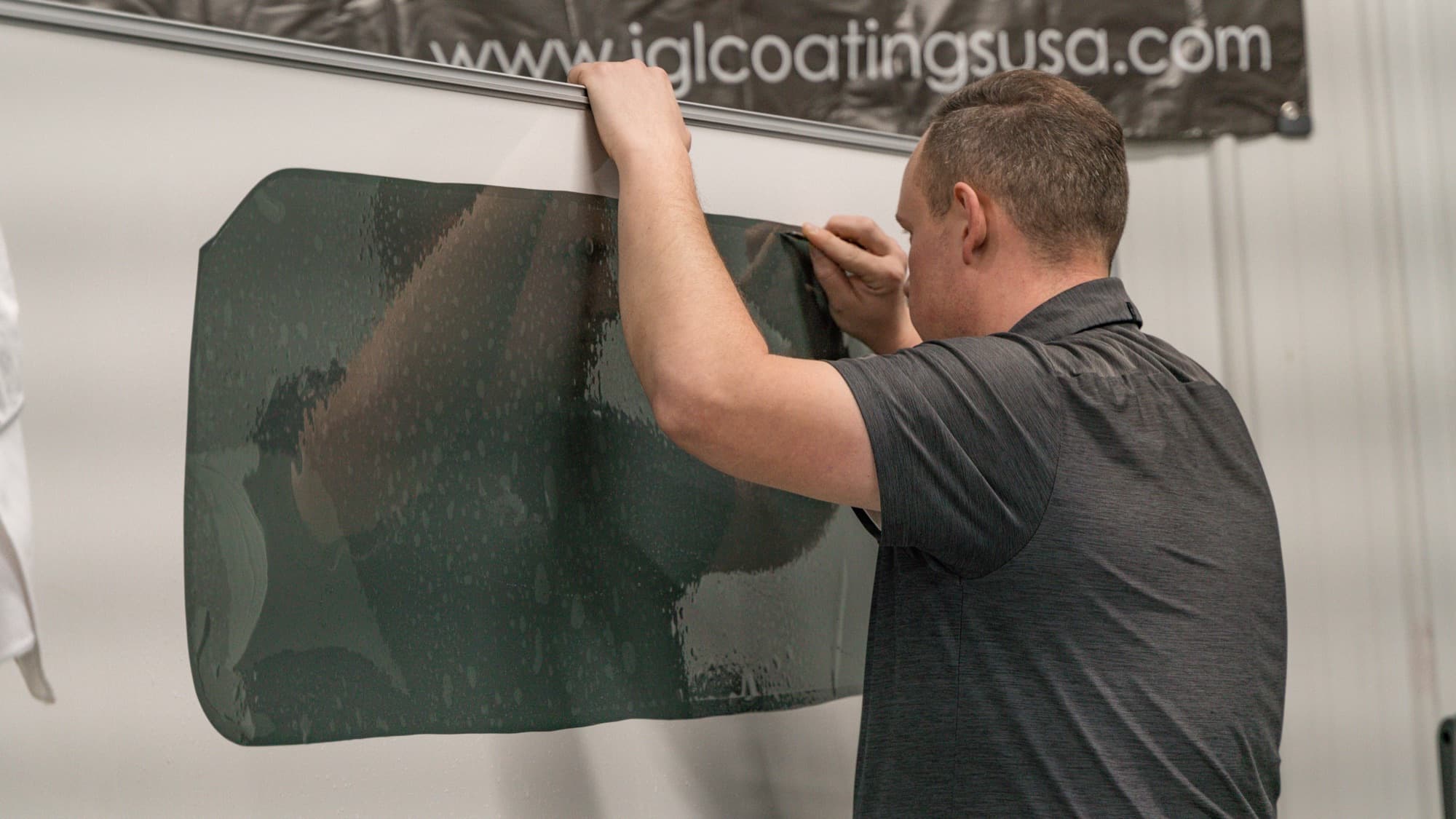
Window Tint Guide: Compare
Dyed vs Carbon vs Ceramic vs Metallic Tint
Window film is sold under dozens of brand and series names, but nearly all automotive tint falls into four families based on what gives the film its color and heat control: dye, carbon, ceramic particles, or metal. Knowing which family a film belongs to tells you most of what you need to know about how it will look, how cool it will keep the car, and how it will age.
Here is how the four compare, where clear heat-rejecting film fits in, and how South Carolina's rules apply to each.
The short answer
Dyed tint uses dye to absorb light; it is the cheapest, and lower-grade dyes can fade or turn purple. Carbon tint uses carbon particles for a stable charcoal color and moderate heat control. Ceramic tint uses nano-ceramic particles to reject more infrared heat without metal or extra darkness. Metallic tint uses metal layers that reflect heat but add shine and can interfere with signals. For most drivers today, the choice is carbon or ceramic.
Key points
- The four families are dyed, carbon, ceramic and metallized; the name tells you how the film controls light and heat.
- Quality varies within each family: a color-stable dyed film is not the same as a bargain dyed film.
- Ceramic offers the most heat rejection for a given shade among common films.
- Metallized film reflects heat well but has a slight shine, and its metal layers are associated with signal problems.
- South Carolina requires film to be nonreflective, not red, yellow or amber, and at least 27% combined light transmission on regulated windows.
Dyed
Dyed film: the entry-level option
Dyed film colors the polyester with dye that absorbs visible light. It gives a dark, non-reflective look, cuts glare and adds privacy. Heat control comes mainly from absorption, so darker shades feel cooler and lighter shades do little for heat.
Dye chemistry makes a big difference. The cheapest dyed films use dyes that break down in sunlight, and LLumar describes purple, bubbling film as a sign of very low-grade film whose adhesive and dye components have broken down. Better dyed films integrate the dye for color stability: LLumar says its dyed tint uses integrated, color-stable dye engineered to maintain a consistent deep charcoal shade, unlike surface-applied dyes that can fade or discolor over time.
In LLumar's published data, its color-stable dyed ATC 35 film lists 38% visible light transmission and 35% total solar energy rejected (TSER). That gives a baseline for what a non-ceramic film of that shade does.
Carbon
Carbon film: stable color, no metal
Carbon film uses carbon particles built into the film to create its color. Carbon is a stable pigment, so the charcoal shade stays true rather than fading toward purple. The finish is matte and non-reflective, and because there is no metal, it does not cause signal issues.
Carbon absorbs visible light and some heat, but it does not target infrared the way ceramic particles do, so its heat control sits below a good ceramic film. One carbon film maker warns buyers to distinguish true carbon film from dyed films with only a carbon coating, so it is worth asking what you are getting.
Carbon is the value pick for drivers who want a clean, lasting look and privacy without paying for maximum heat rejection.
Ceramic
Ceramic film: heat rejection without metal or extra darkness
Ceramic film embeds microscopic nano-ceramic particles that reject the sun's infrared heat. LLumar says all ceramic tint can reject the most heat-causing infrared rays, and newer films with more concentrated particles push that further, which is why they are sometimes called infrared or IR-blocking film.
Because ceramic targets infrared rather than relying on darkness, it can keep a car noticeably cooler at a legal shade. In LLumar's data, its CTX 35 ceramic lists 37% visible light transmission and 48% TSER, and its IRX 35 lists 39% visible light transmission and 54% TSER, compared with 35% TSER for its dyed ATC 35. LLumar also describes CTX as delivering heat rejection without blocking electronic signal transmission.
Ceramic films cost more, and performance varies widely between products. The family name alone does not guarantee a number, so compare spec sheets.
Metallized
Metallized film: reflects heat, adds shine
Metallized film includes a layer of tiny metal particles that reflect the sun's heat. LLumar describes its metallized tint as combining color-stable dye and adhesive with a layer of metallic particles that reflect heat, giving windows a slightly reflective sheen at any shade. Its ATR 35 metallized film lists 37% visible light transmission and 44% TSER in LLumar's data, more than the dyed film and a little less than its ceramic CTX at that shade.
The trade-offs are the shine and electronics. Metal layers are the type of film commonly associated with interference with radio, GPS, cell phones, keyless entry and toll transponders, which is why ceramic makers emphasize signal-friendly construction.
In South Carolina, film must be nonreflective, which the statute defines as a product primarily designed to absorb light rather than reflect it. A highly mirrored film is a problem; whether a particular lightly metallized film qualifies is a product-specific question. If you are considering one, ask the installer and check the product's reflectance data. This is not legal advice.
Clear film
Where clear heat-rejecting film fits
There is also a fifth option that is not really tint: clear or nearly clear ceramic film that reduces heat and UV without darkening the glass. LLumar's AIR clear film, for example, lists 77% visible light transmission and 43% TSER for its AIR 80 product, and LLumar notes it can be used over factory privacy glass, which darkens glass but lacks good heat control.
South Carolina's windshield rule still applies to clear film: a sunscreening device may only be used along the top of the windshield, above the AS1 line, and if the AS1 line is not visible, none may be applied. Do not assume a clear film can cover the whole windshield here.
Choosing
How to choose between the four
Decide what problem you are solving
If it is heat, put ceramic first. If it is looks, privacy and glare, carbon or a color-stable dyed film works. If you want heat control with a slight reflective look and electronics are not a concern, a metallized film is an option.
Check the legal shade for your car
In South Carolina, regulated windows need at least 27% combined light transmission, film plus factory glass. Factory glass absorbs some light, so the film you can use depends on the vehicle.
Compare TSER, not just darkness
Two films of the same shade can reject very different amounts of heat. TSER is the most useful single number for comparing heat performance.
Ask about color stability
Ask whether the color is built into the film or applied to the surface, and what the manufacturer's warranty says about discoloration.
Get the paperwork
Ask for the brand and product name and the manufacturer's warranty document. Every tinted window in South Carolina also needs a certificate of compliance sticker.
At our shop
The two films The Auto Show installs
The Auto Show installs two LLumar films, both computer cut for the vehicle. LLumar Carbon has its color built into the film rather than dyed on the surface, so the charcoal shade stays true instead of fading or turning purple; it is the affordable choice for look and privacy, from $125.99 for the two front side windows. LLumar Ceramic uses nano-ceramic particles to reject more of the sun's infrared heat, so the cabin stays cooler without needing the darkest shade, from $199.99 for the two front side windows. Full-vehicle coverage is by quote.
Both block UV and reduce glare; LLumar rates its films to block up to 99% of UV rays. We check the legal shade for your vehicle before installing and put the South Carolina compliance sticker on each tinted window. We do not tint vehicles more than 8 years old, because door seals and trim become brittle and likely to break.
| Dyed | Carbon | Ceramic | Metallized | |
|---|---|---|---|---|
| What controls light and heat | Dye absorbs light | Carbon particles absorb light | Nano-ceramic particles reject infrared | Metal particles reflect heat |
| Heat rejection at the same shade | Lowest | Varies; below ceramic | Highest | High |
| Look | Flat, non-reflective | Matte charcoal | Clear, non-reflective | Slight sheen |
| Fading risk | Higher with low-grade dyes | Low | Low | Low |
| Signal interference | No | No | No | Possible |
| Relative cost | Lowest | Low to mid | Highest | Mid |
| LLumar example at about 35% (TSER) | ATC 35 (35%) | Not in LLumar US data | CTX 35 (48%), IRX 35 (54%) | ATR 35 (44%) |
LLumar figures are LLumar's published lab data measured on single-pane clear glass; actual performance varies with glass type. They illustrate each family and are not the specs of any particular installed film.
Carbon or ceramic?
Book LLumar Carbon or LLumar Ceramic for the two front side windows online, or request a quote for the whole car. We check the legal shade for your vehicle first.
Common questions
Which type of window tint lasts the longest?
Carbon, ceramic and good-quality color-stable dyed or metallized films can all last many years when installed well. The films most likely to fade or bubble early are low-grade dyed films. Lifespan depends more on the specific product and installation than on the family name, so check the manufacturer's warranty terms.
Is infrared tint a separate type from ceramic?
Usually not. LLumar explains that all ceramic tint rejects infrared heat, and that newer ceramic films with more concentrated nano-ceramic particles are sometimes marketed as infrared or IR-blocking tint. Treat the label as marketing and compare the total solar energy rejected figure on the spec sheet instead.
Does the type of tint change how dark I can go in SC?
No. South Carolina sets the limit by combined light transmission and reflectivity, not by film type. A ceramic film and a dyed film of the same shade face the same 27% combined limit on regulated windows. Ceramic simply gives you more heat rejection at that legal shade.
Why does metallized tint look shiny from outside?
The metal particles reflect part of the sunlight, including some visible light, which gives the glass a slight sheen. LLumar describes its metallized films as having a slightly reflective look. Dyed, carbon and ceramic films absorb light instead, so they look flat or matte.
Keep reading
Sources
- Dyed Window Tint, LLumar / Eastman Performance Films (https://llumar.com/en/tint/dyed/), accessed October 2026
- Metallized Window Tint, LLumar / Eastman Performance Films (https://llumar.com/en/tint/metallized/), accessed October 2026
- Ceramic Window Tint, LLumar / Eastman Performance Films (https://llumar.com/en/tint/ceramic/), accessed October 2026
- Clear Performance Film, LLumar / Eastman Performance Films (https://llumar.com/en/tint/clear/), accessed October 2026
- LLumar Window Film Performance Data, automotive (LL0116NAEN, 03/26), Eastman Performance Films (https://llumar.com/content/dam/eastman/performance-films/llumar/documents/LL0116NAEN_AutoSpecs_screen.pdf), accessed October 2026
- Window Film Frequently Asked Questions, LLumar / Eastman Performance Films (https://llumar.com/en/resources/architectural-film-frequently-asked-questions/), accessed October 2026
- MonoCarbon Window Tint, Rayno Window Film (https://raynofilm.com/product/monocarbon/), accessed October 2026
- S.C. Code Ann. § 56-5-5015, South Carolina Legislature (https://www.scstatehouse.gov/code/t56c005.php), accessed October 2026
Prices on this page are The Auto Show’s published starting prices. Film ratings and warranty terms come from the manufacturer. This guide explains South Carolina law in plain words; it is not legal advice.