
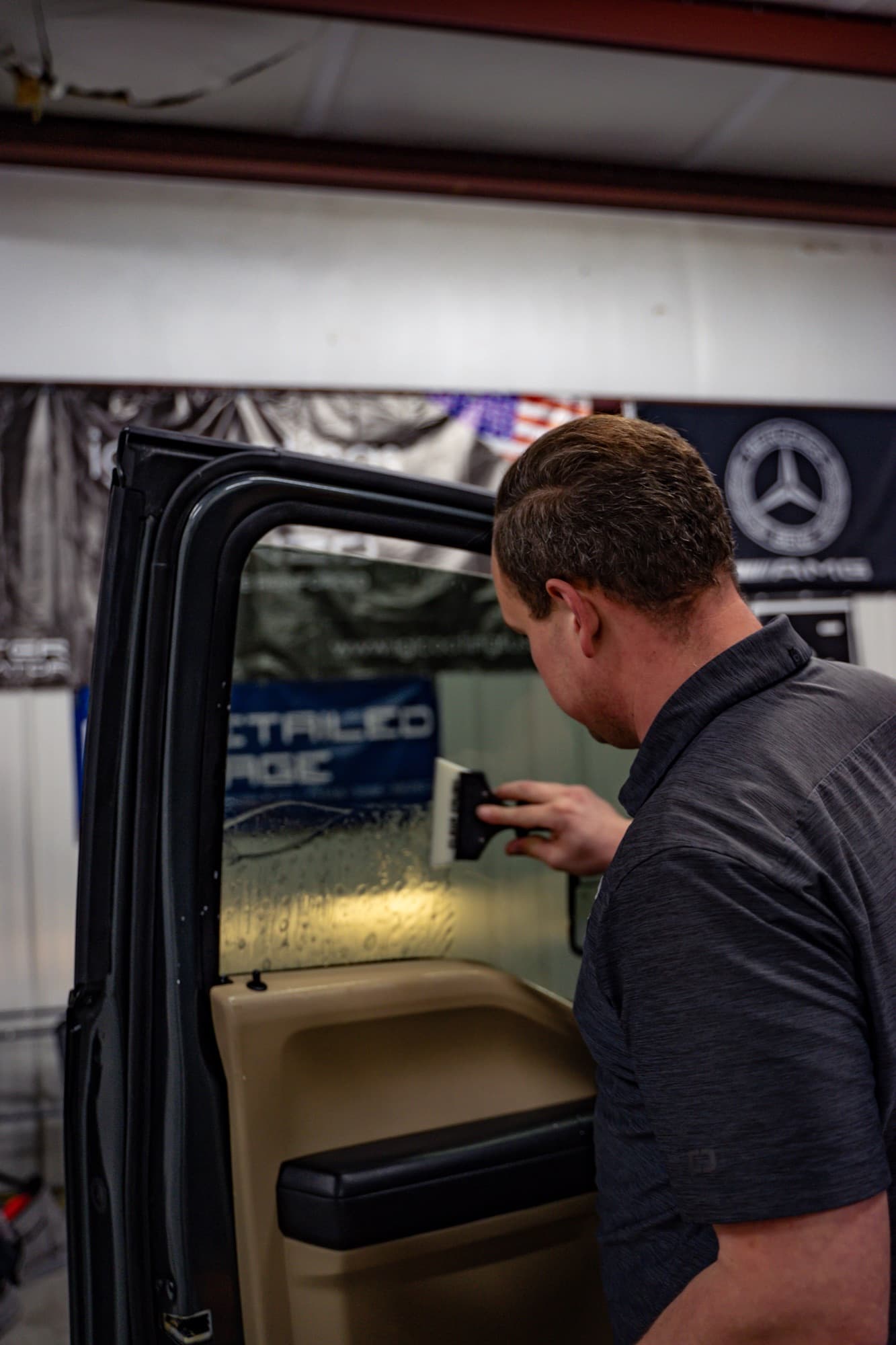
Window Tint Guide: Compare
LLumar Carbon vs LLumar Ceramic Tint
The Auto Show installs two window films, both from LLumar, the automotive film brand of Eastman Performance Films: LLumar Carbon and LLumar Ceramic. They look alike on the car. Both are charcoal, both block UV, both reduce glare, and both are computer cut for your vehicle. The difference you pay for is heat.
This page explains what separates the two, what LLumar itself publishes about how its ceramic films perform against its non-ceramic films, and how to choose the right one for the way you use your car.
The short answer
LLumar Carbon is the affordable choice: its color is built into the film, so the charcoal shade stays true instead of fading or turning purple, and it gives you the look, privacy and glare control. LLumar Ceramic adds nano-ceramic particles that reject more of the sun's infrared heat, keeping the cabin cooler without the darkest shade. At The Auto Show, Carbon starts at $125.99 and Ceramic at $199.99 for the two front side windows.
Key points
- Both films are LLumar, both block UV and reduce glare; LLumar rates its films to block up to 99% of UV rays.
- LLumar Carbon: color built into the film, a true charcoal that does not fade or turn purple, the value pick for looks and privacy.
- LLumar Ceramic: nano-ceramic particles reject more infrared heat, so the car stays cooler at a legal shade.
- LLumar's published data shows its ceramic films rejecting substantially more total solar energy than its non-ceramic film at the same shade.
- Prices for the two front side windows start at $125.99 for Carbon and $199.99 for Ceramic; full-vehicle coverage is by quote.
The basics
What the two films have in common
Both films are made to go on the inside of the glass, are cut by computer to the pattern for your specific vehicle, and are installed with the South Carolina certificate of compliance sticker on each tinted window, as the law requires. Neither is a metallized film, so neither has the reflective sheen of metal-layer tint.
Both also block UV and cut glare. LLumar rates its films to block up to 99% of UV rays, and LLumar notes that the Skin Cancer Foundation recommends window film as part of a comprehensive sun protection program. That benefit comes with either film, so UV should not be the reason you choose one over the other.
LLumar Carbon
LLumar Carbon: a true charcoal that stays true
The selling point of LLumar Carbon is color that lasts. The color is built into the film rather than dyed onto its surface, so the charcoal shade stays true instead of fading or turning the purple you see on old, cheap tint. That makes it the affordable choice for drivers who want the look and the privacy.
Carbon film absorbs light, so it cuts glare and adds privacy in proportion to its darkness, and it absorbs some of the sun's heat as well. It does not have the infrared-rejecting particles of a ceramic film, so it does less for the radiant heat you feel on your skin through the glass.
LLumar Carbon starts at $125.99 for the two front side windows at The Auto Show.
LLumar Ceramic
LLumar Ceramic: more heat rejection at the same shade
LLumar Ceramic uses nano-ceramic particles that reject more of the sun's infrared heat. Because it does not depend on darkness to keep you cool, the cabin stays cooler without needing the darkest shade, which matters in South Carolina, where the darkest film you can put on regulated windows is fixed by law.
LLumar describes its ceramic tint as ultra-thin film embedded with microscopic nano-ceramic particles, and says ceramic film can reject the sun's most heat-causing infrared rays. It also describes its CTX ceramic series as offering excellent heat rejection without blocking electronic signal transmission, so phones, GPS and toll tags work normally behind it.
LLumar Ceramic starts at $199.99 for the two front side windows at The Auto Show.
LLumar's data
What LLumar publishes about ceramic versus non-ceramic film
LLumar publishes performance data for its US automotive lineup. The useful comparison is total solar energy rejected (TSER), which adds up visible light, infrared and UV and is the closest single number to the heat you feel. At about 35% visible light transmission, LLumar lists its color-stable dyed ATC 35 at 35% TSER, its CTX 35 ceramic at 48% TSER, and its IRX 35 ceramic, a more concentrated infrared-rejecting film, at 54% TSER.
In other words, at essentially the same darkness, LLumar's own figures show its ceramic films rejecting roughly 13 to 19 more percentage points of the sun's total energy than its non-ceramic film. The infrared rejection figures differ even more: LLumar lists 22% infrared energy rejection for ATC 35, against 48% for CTX 35 and 60% for IRX 35.
These are LLumar's lab results for those named products, measured on single-pane clear glass under NFRC guidelines, and LLumar notes that actual performance varies with glass type. They illustrate how LLumar's ceramic and non-ceramic films compare, not the exact specs of the film on any particular car. LLumar's US site sorts its automotive tint by construction (ceramic, metallized, dyed and clear) and product names vary by region, so when you book, ask us for the exact LLumar product and shade on your paperwork and its spec sheet.
Choosing
Which LLumar film fits you
- Choose LLumar Ceramic if
- Your car sits outside at work or at home, you commute into low sun on I-85 or US-76, the sun on your arm bothers you, you have a dark interior, or you want a lighter shade that still controls heat. Is ceramic worth it?
- Choose LLumar Carbon if
- You mainly want the look, privacy for belongings and less glare, the car is garaged most of the time, your trips are short, or budget is the deciding factor. Choosing a shade
- Either one if
- You care about UV and color that will not turn purple. Both films block UV and hold their charcoal shade.
The law
Same legal limit for both films
South Carolina sets tint limits by combined light transmission, not by film type. Under S.C. Code Ann. § 56-5-5015, film on the front side windows and, for most cars, the windows behind the driver must be nonreflective and, combined with the factory glass, let through at least 27% of visible light. On the windshield, a sunscreening device may only run along the top, above the AS1 line. The rear windows of multipurpose passenger vehicles, such as most SUVs, are exempt from the light transmittance requirement under subsection (I); pickups are not.
Factory glass already reduces light, and factory privacy glass reduces it a lot, so the shade that is legal for your car depends on the glass. We check the legal shade for your vehicle before installing either film. If you have a physician's or optometrist's affidavit for a medical exemption, bring the paperwork and ask before you book.
Warranty
What LLumar says about warranty coverage
LLumar states that all of its tint products are backed by a manufacturer's lifetime limited warranty, with certain restrictions, and directs owners to their dealer for warranty details. LLumar says that if discoloration does occur, eligible film may be removed, replaced and reinstalled at no additional cost under that limited warranty. Read the warranty document for your film to see exactly what is covered, how registration works, and what is excluded.
Booking
How booking works
Pick your film
Choose LLumar Carbon or LLumar Ceramic. For the two front side windows, book online; for the whole vehicle, request a quote.
Confirm with a deposit
We work by appointment only, and a deposit confirms your time. The cancellation policy is shown when you book.
Plan your ride
There is no waiting area, so arrange a ride. Drop-off after 6 pm can be arranged by phone.
Legal check and install
We check the legal shade for your vehicle, install computer-cut film, and apply the South Carolina compliance sticker to each tinted window. Vehicles more than 8 years old are not tinted, because their seals and trim become brittle.
| LLumar Carbon | LLumar Ceramic | |
|---|---|---|
| Two front side windows | From $125.99 | From $199.99 |
| Full vehicle | By quote | By quote |
| Color | Built into the film; stays true charcoal | Charcoal |
| Heat control | Absorbs some heat | Nano-ceramic particles reject more infrared heat |
| UV and glare | Blocks UV, reduces glare | Blocks UV, reduces glare |
| Metal content | None (not a metallized film) | None (not a metallized film) |
| Best for | Look, privacy, budget | Comfort, sun exposure, lighter shades |
Both films are computer cut, installed after a legal shade check, and labeled with the South Carolina compliance sticker.
Book LLumar Carbon or Ceramic
Book your two front side windows online, or request a quote for full coverage. We check the legal shade for your vehicle before we install.
Common questions
Why are your prices only for the two front windows?
Many vehicles already have factory privacy glass in the back, which makes the two front side windows a common starting point, so that is the price we publish: from $125.99 for LLumar Carbon and $199.99 for LLumar Ceramic. Full-vehicle coverage depends on the vehicle and its windows, so request a quote for that.
How do I compare LLumar spec sheets?
LLumar publishes performance data for its automotive films, including visible light transmission, total solar energy rejected and infrared rejection. Ask us which LLumar product and shade you are getting, then compare total solar energy rejected at the same shade rather than a single infrared figure.
Will LLumar Ceramic match my factory privacy glass?
Factory privacy glass in the rear is often darker than the legal limit for front side windows, so the fronts may look lighter even with film. That applies to both films. We check the legal shade for your vehicle and explain how close a match is possible.
Does ceramic tint make the car cool on its own?
No film turns a parked car in a South Carolina summer into a cool one. Ceramic reduces the heat coming through the glass, so the cabin warms more slowly and cools down faster with the AC. Never leave children or pets in a parked car, tinted or not.
Sources
- LLumar Window Film Performance Data, automotive (LL0116NAEN, 03/26), Eastman Performance Films (https://llumar.com/content/dam/eastman/performance-films/llumar/documents/LL0116NAEN_AutoSpecs_screen.pdf), accessed October 2026
- Ceramic Window Tint, LLumar / Eastman Performance Films (https://llumar.com/en/tint/ceramic/), accessed October 2026
- CTX Ceramic Window Tint, LLumar / Eastman Performance Films (https://llumar.com/en/tint/ceramic/ctx/), accessed October 2026
- IRX Ceramic Window Tint, LLumar / Eastman Performance Films (https://llumar.com/en/tint/ceramic/irx/), accessed October 2026
- Dyed Window Tint, LLumar / Eastman Performance Films (https://llumar.com/en/tint/dyed/), accessed October 2026
- Automotive Window Tint Frequently Asked Questions, LLumar / Eastman Performance Films (https://llumar.com/en/resources/automotive-window-tint-frequently-asked-questions/), accessed October 2026
- S.C. Code Ann. § 56-5-5015, South Carolina Legislature (https://www.scstatehouse.gov/code/t56c005.php), accessed October 2026
Prices on this page are The Auto Show’s published starting prices. Film ratings and warranty terms come from the manufacturer. This guide explains South Carolina law in plain words; it is not legal advice.