
Window Tint Guide: Understand
What Is Window Tint and How Does It Work?
Window tint looks simple from the outside: the glass gets darker. Underneath that is a piece of engineered plastic film, a layer of adhesive and a set of coatings and particles chosen to treat three kinds of sunlight differently. Understanding those three kinds of light is the key to understanding every claim you will hear about tint.
This guide covers what the film is, how it works on ultraviolet, visible and infrared light, why people in the Upstate put it on their cars, where it falls short, and the few South Carolina rules every driver should know before choosing a shade.
The short answer
Window tint is a thin, multi-layer polyester film with a clear adhesive that is applied to the inside of a car's windows. Coatings and particles in the film block most ultraviolet light, cut the visible light that causes glare, and, depending on the film type, absorb or reflect part of the sun's infrared heat. Darkness is measured as visible light transmission (VLT), and South Carolina limits how dark most windows can be.
Key points
- Tint is a polyester film with adhesive on one side and a scratch-resistant coating on the other, installed on the inside of the glass.
- Sunlight arrives as ultraviolet, visible and infrared energy, and a film can treat each one differently.
- Darkness (VLT) and heat rejection are separate properties: a light ceramic film can reject more heat than a dark dyed one.
- In South Carolina, side and rear windows must let through at least 27% of light combined with the factory glass, with an exception behind the driver on SUVs and vans.
- Tint improves comfort and cuts UV exposure, but it is not a substitute for sunscreen or a reason to leave anyone in a parked car.
The material
What Window Film Actually Is
Automotive window film starts as polyethylene terephthalate (PET), the same family of clear polyester used in many packaging films, chosen because it is strong and optically clear. The Whole Building Design Guide describes a typical film as a stack: a release liner that protects the adhesive until installation, an adhesive layer that usually carries the UV inhibitors, one or more layers of polyester, and a hard scratch-resistant coating on the face you touch.
The color and heat-control ingredients go into or onto that stack. They can be dyes, carbon pigment, nano-ceramic particles or a thin metal layer. That choice is what separates a budget film from a premium one, more than the darkness of the shade.
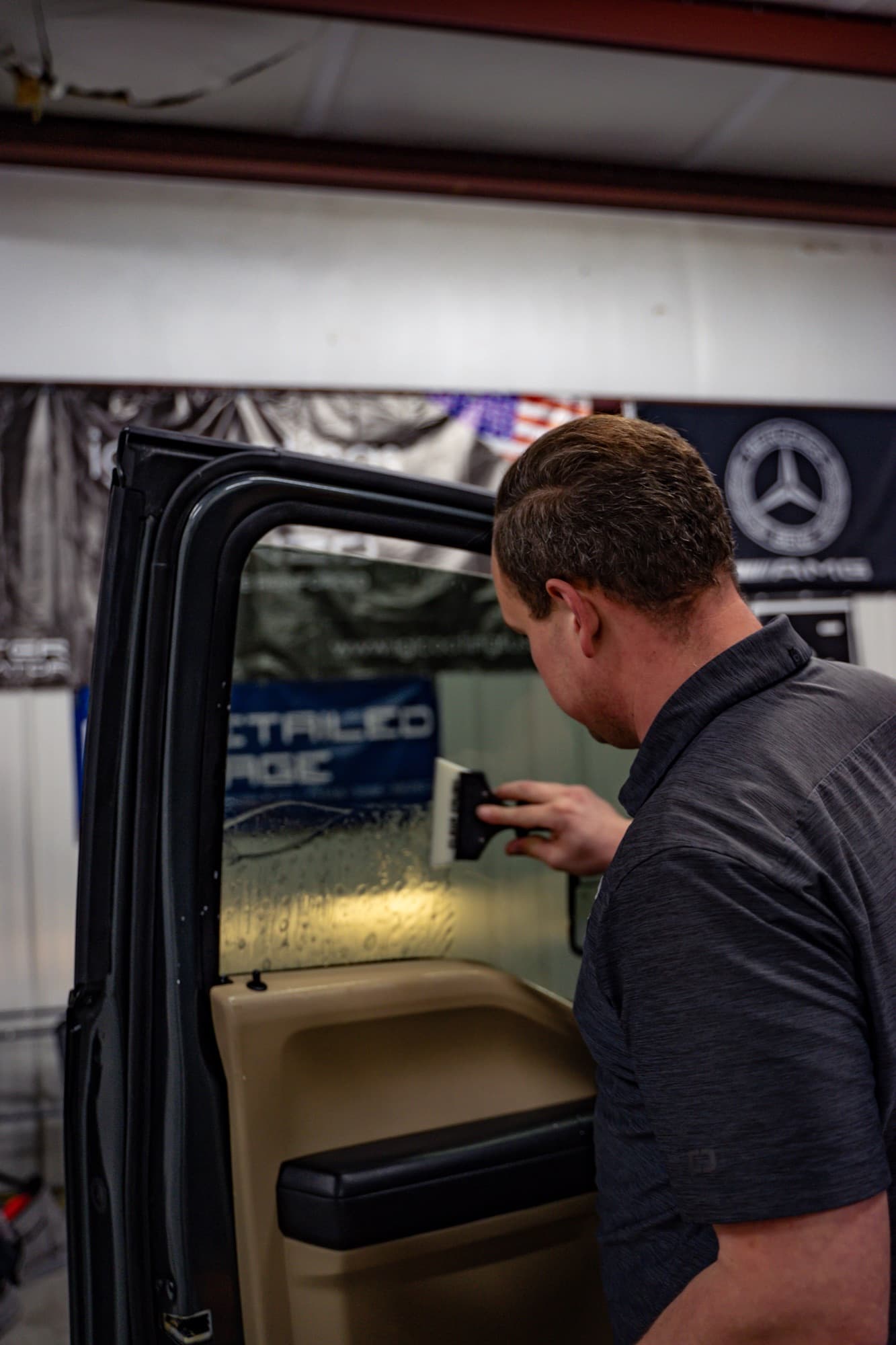
On cars, the film goes on the inside surface of the glass. LLumar notes that auto tint is typically applied to interior glass surfaces, which keeps it away from car washes, wipers and road grit. The scratch-resistant coat faces the cabin, where seat belts, rings and cleaning cloths touch it.
Three kinds of light
Ultraviolet, Visible and Infrared
Every tint claim is really a claim about one slice of the sun's spectrum. A film that is excellent on one slice can be ordinary on another, so it helps to separate them.
- Ultraviolet (UV)Invisible, damages skin and interiors
- The International Window Film Association (IWFA) notes that UV is only about 3% of the energy in sunlight, but it drives sunburn, skin aging and fading. Ordinary glass screens most UVB, and windshields are laminated, but side windows let through a meaningful share of UVA. Quality films block up to 99% of UV regardless of how dark they are. UV through car windows
- Visible lightWhat you see, and what causes glare
- This is the part of sunlight your eyes use, and it is what VLT measures. Cutting visible light reduces glare and adds privacy, but it also reduces what you can see at night. It is the only property the law regulates. VLT explained
- Infrared (IR)Invisible, felt as heat
- Infrared energy is what you feel as warmth on your arm through the glass. Darker films cut some of it simply by absorbing more energy, but ceramic films are designed to target infrared specifically, so they can stay lighter and still reject more heat. Reading a tint spec sheet
How it works
Absorb or Reflect: How Film Handles the Sun
When sunlight hits filmed glass, some passes through, some bounces off and the rest is absorbed. Dyed and carbon films work mostly by absorption: the film and glass warm up, and much of that heat is shed to the outside air as the car moves. Metallized films add a thin metal layer that reflects part of the energy away, which is why they have a slight sheen. Nano-ceramic films use particles that are tuned to absorb and scatter infrared while letting more visible light through.
That is why darkness and heat rejection do not track neatly. On LLumar's published performance sheet, its dyed ATC 05 film (5% VLT) is listed at 44% total solar energy rejection, while its IRX 50 ceramic film, at 54% VLT and far lighter, is listed at 50%. The lighter ceramic film rejects more total heat than the near-limo dyed film.
The heat number that matters is total solar energy rejection (TSER), which counts UV, visible and infrared together. Figures for infrared alone are often higher and are easy to misread, which the spec sheet guide in this series explains.
Film types
The Main Kinds of Tint Film
- DyedLowest cost
- Color comes from dye. It looks good and cuts glare, but heat rejection depends mostly on darkness. Lower-grade films with dye on the surface can fade or turn purple over years of sun; LLumar says its own dyed films use integrated dye to avoid that.
- CarbonTrue charcoal, matte look
- Carbon pigment gives a stable charcoal color that does not fade like surface dye, with no metal to reflect or interfere with signals. A common choice for look and privacy at a moderate price.
- CeramicMost heat rejection per shade
- Nano-ceramic particles reject infrared heat without metal, so a lighter shade can still keep the cabin cooler. Usually the most expensive tier. Carbon vs ceramic
- MetallizedReflective sheen
- A thin metal layer reflects heat. Effective, but the slight mirror look is a legal issue in South Carolina, which requires nonreflective film, and metal can interfere with some electronics. All four film types
Why tint
Why Drivers in the Upstate Tint Their Cars
- Heat: a car parked at work in an Anderson July heats up fast, and film reduces how much solar energy reaches the cabin while you drive and while it sits.
- UV: side windows pass far more UVA than windshields. A 2016 JAMA Ophthalmology study of 29 cars found side windows blocked an average of 71% of UVA (as low as 44%), against 96% for windshields.
- Glare: low sun on an east-west commute down I-85 or US-76 at sunrise and sunset is a real visibility problem, and film takes the edge off side glare.
- Interior: UV and heat both contribute to faded and cracked dashboards, leather and trim.
- Privacy and look: a darker shade hides what is on the seat and gives the car a finished appearance.
Honest limits
What Window Tint Does Not Do
- It does not make a parked car safe for children or pets. A tinted car still heats up to dangerous temperatures; never leave anyone inside.
- It does not replace sunscreen or sunglasses. It reduces UV through the glass it covers, but the windshield, open windows and sunroof are separate paths.
- It does not secure the car. Privacy is real; preventing a break-in is not something standard tint is designed or tested to do. Security film is a different, thicker product.
- It does not make illegal darkness legal. A darker shade than the law allows can mean a ticket for the driver, not only the installer.
- It does not cure a bad installation. Dust, lifted edges and contamination under the film come from the install, not the film brand.
South Carolina
The Rules to Know Before You Pick a Shade
South Carolina regulates tint in S.C. Code § 56-5-5015. Film on the side windows and rear window must be nonreflective, may not be red, yellow or amber, and the combined light transmission of the film plus the factory glass must be at least 27%. On the windshield, film may only run along the top and may not extend below the AS1 line; if that line is not visible, no film may go on the windshield.
The light limit does not apply to windows behind the driver on multipurpose passenger vehicles (most SUVs and vans), other trucks, buses and RVs, but it does apply behind the driver on pickup trucks. Every tinted window must carry a certificate of compliance sticker in the lower right corner. A doctor or optometrist's affidavit can exempt a registered owner with a qualifying condition.
Because the limit is combined with the factory glass, the number printed on a roll of film is not the number a meter reads on your car. That math is the most common source of surprise tickets.
This is a summary, not legal advice. For an unusual vehicle or situation, check with the South Carolina Department of Public Safety or a lawyer.
| Part of sunlight | What you notice | What film does | Main factor |
|---|---|---|---|
| Ultraviolet (UV) | Nothing until skin or dash shows damage | Quality films block up to 99% | UV inhibitors in the adhesive, not darkness |
| Visible light | Brightness, glare, privacy | Cuts a set percentage (the VLT rating) | Shade, the only property the law limits |
| Infrared (IR) | Warmth on skin, hot seats | Absorbs or reflects a share of it | Film technology: ceramic and metal do the most |
Heat rejection is best compared with total solar energy rejection (TSER), which combines all three.
Talk Through Tint for Your Car
The Auto Show installs computer-cut LLumar Carbon and LLumar Ceramic film and checks the legal shade for your vehicle before installing. Ask us which film fits how you drive.
Common questions
Does window tint go on the inside or outside of the glass?
On cars, tint goes on the inside surface of the glass. That protects it from car washes, wipers and weather, and the film's scratch-resistant coating faces the cabin. On some curved back glass, the installer shapes the film on the outside of the window first, then moves it inside for the actual installation.
Does darker tint always block more heat?
No. Darker film absorbs more visible light, which helps somewhat, but film technology matters more. On LLumar's published data, a light ceramic film at about 54% VLT rejects more total solar energy than its dyed film at 5% VLT. Compare total solar energy rejection, not darkness, when heat is the goal.
Does window tint block 100% of UV?
No film claims 100%. Quality automotive films are rated to block up to 99% of UV, and LLumar rates its films to block up to 99% of UV rays. UV can still reach you through open windows, sunroofs and any glass left untreated, so tint reduces exposure rather than eliminating it.
Is window tint the same as privacy glass?
No. Privacy glass is darkened during manufacturing by changing the glass itself, usually only on the rear windows of SUVs, vans and pickups. Tint is a film added afterward. If you add film over privacy glass, South Carolina counts the combined darkness of both where the light limit applies.
How long does window tint take to install?
Installation itself is usually measured in hours, not days, but the film needs extra time afterward for the moisture under it to dry out. During that curing period you keep the windows rolled up and avoid cleaning the inside of the glass. Your installer will tell you how long to wait.
Keep reading
Sources
- S.C. Code Ann. § 56-5-5015, South Carolina Legislature (https://www.scstatehouse.gov/code/t56c005.php), accessed October 2026
- Window Film Fundamentals, Whole Building Design Guide, National Institute of Building Sciences (https://legacy.wbdg.org/resources/window-film-fundamentals), accessed October 2026
- Automotive Window Tint Frequently Asked Questions, LLumar / Eastman Performance Films (https://www.llumar.com/en/resources/automotive-window-tint-frequently-asked-questions/), accessed October 2026
- LLumar Window Film Performance Data (LL0116NAEN), Eastman Performance Films (https://www.llumar.com/content/dam/eastman/performance-films/llumar/documents/LL0116NAEN_AutoSpecs_screen.pdf), accessed October 2026
- UV Protection, International Window Film Association (https://iwfa.com/benefits-of-window-film/uv-protection/), accessed October 2026
- Boxer Wachler BS. Assessment of Levels of Ultraviolet A Light Protection in Automobile Windshields and Side Windows, JAMA Ophthalmology 2016;134(7):772-775 (https://pubmed.ncbi.nlm.nih.gov/27258091/), accessed October 2026
- Dyed Window Tint, LLumar / Eastman Performance Films (https://www.llumar.com/en/tint/dyed/), accessed October 2026
Prices on this page are The Auto Show’s published starting prices. Film ratings and warranty terms come from the manufacturer. This guide explains South Carolina law in plain words; it is not legal advice.