
Window Tint Guide: Compare
Window Tint Warranties Explained
Almost every tint quote mentions a warranty, and many of them use the word lifetime. That word does a lot of work and explains very little. Whose lifetime? Covering what? Paid by whom? The answers are in a document most people never read until something goes wrong.
This guide explains the two kinds of tint warranty, what film manufacturers publicly say about theirs, what federal law requires a written warranty to tell you, and how to set yourself up so a claim is easy if you ever need one.
The short answer
A tint job usually carries two kinds of coverage: the film manufacturer's warranty against defects such as bubbling, peeling or discoloration, and the installer's promise about workmanship. Many film makers call theirs lifetime limited; LLumar says all its automotive tint carries one, with restrictions explained by the dealer. Read the actual document before paying: who is covered, what is excluded, whether it transfers and how to claim.
Key points
- The film manufacturer covers defects in the film; the installer covers how it was put on. They are separate promises.
- LLumar states that all of its tint products carry a manufacturer's lifetime limited warranty, with restrictions, and that its FormulaOne line has its best transferable coverage.
- The FTC notes that a lifetime warranty can mean the life of the product, the time the original buyer owns it, or the buyer's own life.
- Federal rules require a written warranty to state who is covered, what is covered, what the warrantor will do, how long it lasts and how to make a claim.
- Keep the invoice and the South Carolina compliance sticker; together they identify the film, the shade, the date and the installer.
Two promises
Manufacturer Warranty vs Installer Warranty
The film manufacturer makes the product and warrants the product. Its warranty typically deals with the film itself failing: the adhesive letting go, the film bubbling or delaminating, or the color changing. LLumar's public FAQ says that if discoloration occurs, a lifetime limited warranty may cover it, in which case its team will remove, replace and install new tint at no additional cost.
The installer controls everything about how the film went on: cleaning, cutting, edges, contamination trapped under the film and damage to the car during the job. Those are workmanship issues. Some installers put their workmanship promise in writing; others handle it informally. Ask which applies before you pay, and get it on paper if you can.
The line between the two is not always obvious. A bubble in the first days is often normal curing moisture. A bubble that appears after a year may be an adhesive problem. A speck of dust under the film from day one is a workmanship question. That is why the first call almost always goes to the installer, who can tell you which warranty applies.
LLumar
What LLumar Says About Its Tint Warranty
LLumar publishes only a summary of its automotive warranty online. Its tint FAQ states that all LLumar tint products are backed by a manufacturer's lifetime limited warranty, with the note that certain restrictions apply and that customers should see the dealer for warranty details. Its ceramic tint page repeats that all of its window tint comes with a manufacturer's limited lifetime warranty, and says FormulaOne products have its best lifetime transferable warranty coverage.
Notice what that implies: transferability is called out for one line, so do not assume every LLumar film transfers to the next owner. The full terms, including exclusions, come from the dealer. If you buy LLumar film from any installer, ask for that document and read it. This guide summarizes LLumar's public statements; it is not the warranty itself.
The words
What Lifetime and Limited Mean in a Warranty
- Lifetime warrantyAlways ask whose
- The Federal Trade Commission's guide to warranty law points out that lifetime can refer to the life of the product, the period the original buyer owns it, or the original buyer's own life, and says warrantors should make clear which one they mean. For tint, it often means for as long as you own the car.
- Limited warrantyMost tint warranties
- Under federal law, a warranty is full only if it meets several standards, including service for anyone who owns the product during the warranty period and no charge for the remedy. If any standard is not met, the warranty is limited. Limited does not mean bad; it means you need to read the conditions.
- TransferableMatters when you sell
- A transferable warranty follows the car to the next owner. A non-transferable one ends when you sell. If you plan to sell in a few years, ask which you are getting. Tint and resale value
Your rights
What a Written Warranty Must Tell You
Federal rules under the Magnuson-Moss Warranty Act require a written warranty on a consumer product costing more than $15 to disclose certain things in a single, clear document. A separate rule says the seller of a product with a written warranty must make the warranty text available for you to examine before you buy, either by displaying it near the product or by providing it on request. Asking to see the tint warranty before you pay is reasonable.
- Who is covered, if coverage is limited to the original buyer.
- What is covered and, where needed, what is excluded.
- What the warrantor will do if there is a defect, including what it will and will not pay for.
- When coverage starts, if not on the purchase date, and how long it lasts.
- Step-by-step instructions for making a claim, including who to contact.
- Any limits on implied warranties or on incidental and consequential damages.
Exclusions
Questions to Ask About What Is Not Covered
Warranty documents vary, so rather than guess at exclusions, ask. Scratches from rings, seat belts or ice scrapers are physical damage, not a defect in the film, and you should expect that to be treated differently from bubbling or color change. The same goes for damage from harsh cleaning tools.
Is physical damage covered?
Ask how scratches, nicks and tears are handled, since these come from use rather than defects.
Is labor included?
If a film fails, find out whether removal and reinstallation labor is covered or only the film.
Does it require registration?
Some warranties need the installer or owner to register the installation. Ask who does it and what proof you get.
What if the installer closes?
Ask how you would claim the manufacturer's warranty through another dealer if your original installer is no longer in business.
Does it transfer?
If you sell the car, will the next owner have coverage?
Claims
How to Make a Tint Warranty Claim
Start with the installer. Bring the car, the invoice and photos of the problem taken in good light. The installer can tell whether it is normal curing, a workmanship issue or a film defect, and can submit a manufacturer claim if needed.
Your South Carolina compliance sticker helps here. The statute requires each tinted window to carry a certificate showing the light transmission, the installer's name, address and phone number, and the date of installation. If you bought the car used, that sticker may be the only way to identify who installed the film and when.
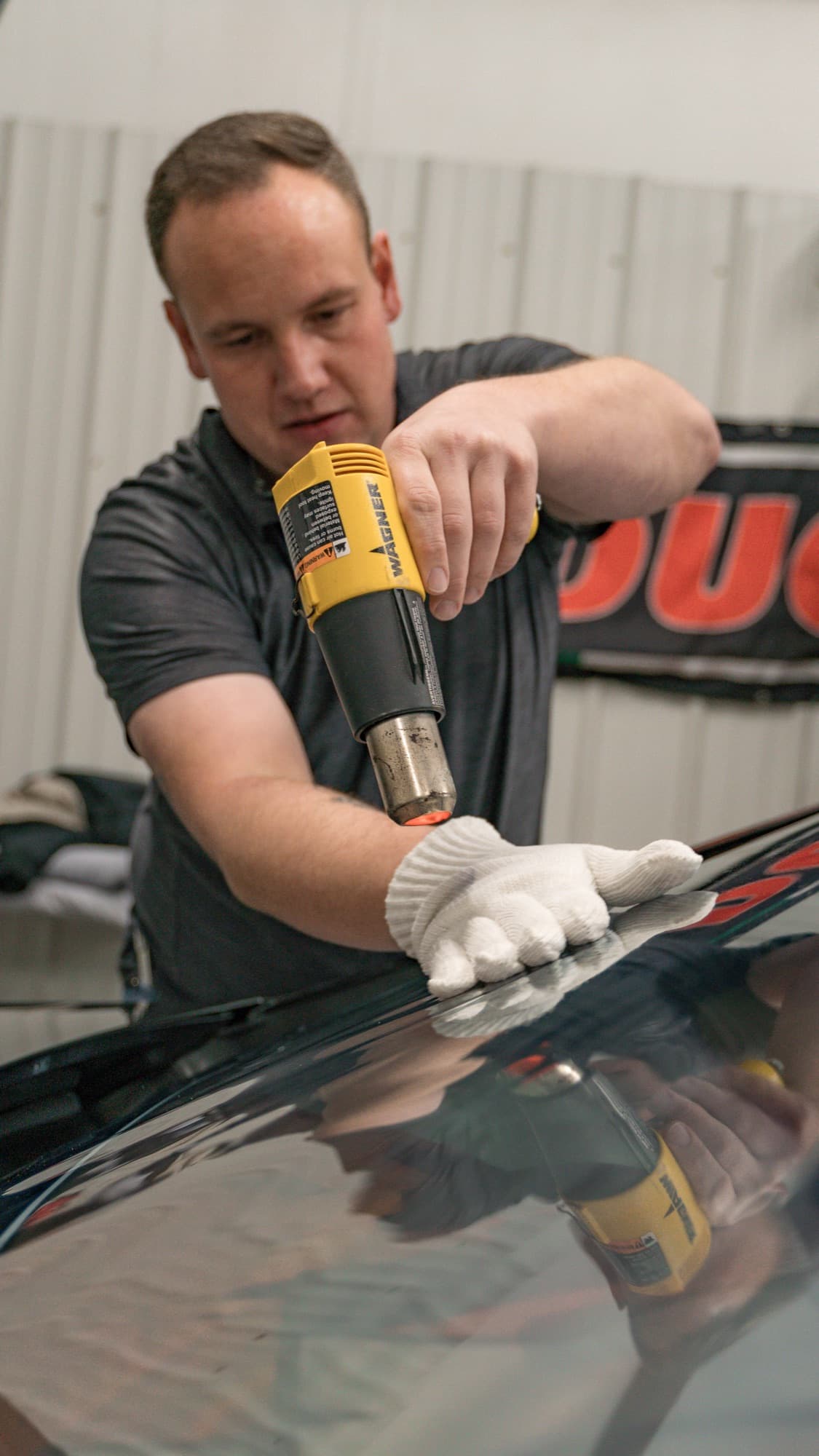
Do not try to fix a failing film yourself before the claim is reviewed. Peeling an edge back, pressing out bubbles with a card or using a heat gun can turn a covered defect into excluded damage.
| Problem | Usually starts as | What to do |
|---|---|---|
| Small bubbles or haze in the first days | Normal curing moisture | Wait as instructed; call the installer if it persists |
| Dust or hair under the film from day one | Workmanship question | Call the installer soon |
| Peeling edge in the first week | Workmanship or early handling | Call the installer; do not touch it |
| Bubbling or lifting after months or years | Possible film or adhesive defect | Call the installer to review a warranty claim |
| Purple or faded color | Possible film defect, common with dyed film | Check the film's warranty for discoloration |
| Scratches or nicks | Physical damage | Ask; usually not a defect |
Every warranty document is different. Read yours.
Questions about the film on your car?
We install LLumar Carbon and LLumar Ceramic with a South Carolina compliance sticker on every tinted window. Ask us about the film you are considering, and read the manufacturer's warranty document before you book.
Common questions
Does a lifetime tint warranty mean my lifetime?
Not necessarily. The FTC notes that lifetime can mean the life of the product, the time the original buyer owns it, or the buyer's own life. For automotive film it often means as long as you own the car. The written warranty should say which; if it does not, ask the installer to clarify in writing before you pay.
Does a tint warranty cover scratches?
Usually it is written to cover defects in the film, such as bubbling, peeling or discoloration, rather than damage from use. Scratches from seat belts, rings, pets or ice scrapers are physical damage. Ask how the installer handles them, and remember that scratched film cannot be patched; the piece has to be replaced.
What happens to my warranty if I sell the car?
It depends on whether the warranty is transferable. LLumar says its FormulaOne line carries its best transferable coverage, which suggests other lines may differ. Ask before you buy, and if the warranty does transfer, give the next owner the invoice and warranty document so they can use it.
Do I need to register my tint warranty?
Some manufacturers ask the installer or the owner to register the installation. Ask the installer whether registration is needed, who does it, and what confirmation you will receive. Either way, keep the invoice that names the film, the shade, the installation date and the installer with your car's records.
Can I see the warranty before I pay?
You should be able to. The FTC's pre-sale availability rule requires sellers of products with a written warranty to make the warranty text available for examination before the sale. A shop that cannot show you any written terms is a reason to keep shopping.
Keep reading
Sources
- Automotive Window Tint Frequently Asked Questions, LLumar (https://llumar.com/en/resources/automotive-window-tint-frequently-asked-questions/), accessed October 2026
- Ceramic Window Tint, LLumar (https://llumar.com/en/tint/ceramic/), accessed October 2026
- Businessperson's Guide to Federal Warranty Law, Federal Trade Commission (https://www.ftc.gov/business-guidance/resources/businesspersons-guide-federal-warranty-law), accessed October 2026
- 16 CFR § 701.3 Written warranty terms, Legal Information Institute, Cornell Law School (https://www.law.cornell.edu/cfr/text/16/701.3), accessed October 2026
- 16 CFR § 702.3 Pre-sale availability of written warranty terms, Legal Information Institute, Cornell Law School (https://www.law.cornell.edu/cfr/text/16/702.3), accessed October 2026
- S.C. Code Ann. § 56-5-5015, South Carolina Legislature (https://www.scstatehouse.gov/code/t56c005.php), accessed October 2026
Prices on this page are The Auto Show’s published starting prices. Film ratings and warranty terms come from the manufacturer. This guide explains South Carolina law in plain words; it is not legal advice.