
Window Tint Guide: Understand
Why Window Tint Bubbles (and When It's Normal)
Few things worry a new tint customer more than bubbles. You drive away with dark, smooth windows, and the next morning you see small blisters scattered across the glass. Is the job ruined?
Usually not. Window film is installed wet, and new tint almost always holds a little water that takes time to dry out. But some bubbles are a real problem, and old film that bubbles years later is a different story altogether. This guide explains each kind, how to tell them apart and when to call the installer.
The short answer
Small, soft, slightly cloudy bubbles in new tint are usually leftover water from installation and shrink as the film dries over days to a couple of weeks. Bubbles with a speck of dirt in the middle, sharp air pockets that never change, or bubbling in film that is years old point to contamination or adhesive failure. Leave new bubbles alone, and call the installer if they remain after the curing period.
Key points
- Tint is floated onto the glass with a slip solution, and some water always stays behind; the IWFA says water haze and distortion during drying are not defects.
- Water bubbles are soft, cloudy and shrink over time; air and contamination bubbles are sharper and do not change.
- Curing typically takes a few days to a couple of weeks and runs longer in cool, damp or cloudy weather.
- Bubbling in old film usually means the adhesive is breaking down from years of sun, and the fix is replacing the film.
Why it happens
Why New Tint Holds Water
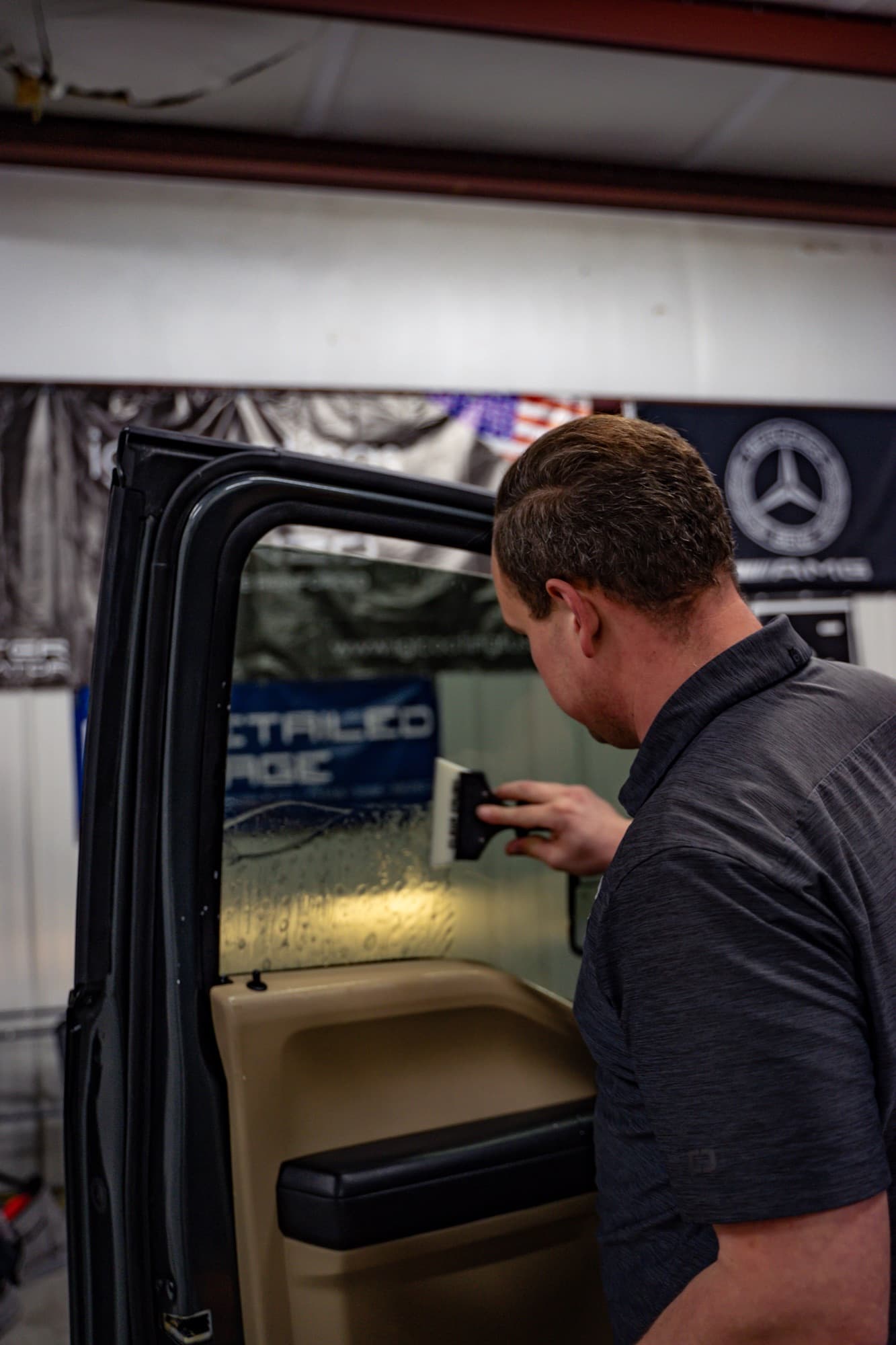
Window film is not stuck on dry. The installer sprays the glass and the film's adhesive with a slip solution, a mix of water and a small amount of surfactant, so the film can be floated into position and lined up with the edges. Then most of the water is squeegeed out.
Most, not all. The International Window Film Association's automotive inspection guideline says that some residual water will inevitably remain between the film and glass. That water affects clarity and adhesion at first, and adhesion builds from a lower value to its normal strength as the moisture dries out through the film.
The IWFA notes that what people call the adhesive cure time on automotive film is really the drying time of that residual moisture. It is related to the thickness of the film and its coatings, and it can be extended or shortened by climate and how the car is stored. Some high-performance films with special coatings take longer to dry.
Types
The Four Kinds of Tint Bubbles
- Water pocketsNormal during curing
- Small, soft, slightly milky blisters or a general haze, often more noticeable near the bottom of a window. They appear right after installation and gradually shrink and disappear as the film dries. The IWFA guideline says water distortion and water haze during drying are not to be regarded as defects. Haze after installation
- Air bubblesAn installation issue
- Clear, crisp-edged pockets that look the same day after day. They form when air gets trapped during squeegeeing, often at a curve or along an edge. They do not dry out the way water does, so if they are obvious once the film has cured, the installer should look at them.
- Contamination bubblesLook for a speck
- A small raised point with a tiny piece of dust, hair or grit at the center. The film cannot lay flat over the particle, so a little tent forms around it. They do not go away with time, though very small ones may be hard to spot from outside. Dust and specks under tint
- Adhesive failureOld film
- Large, irregular bubbles or a wavy look that appears years after installation, often spreading over time. RACQ, the Queensland motoring club, explains that bubbling often occurs when the film's adhesive slowly breaks down from sun exposure and parts of the film lift off the glass.
Timing
How Long Water Bubbles Take to Clear
The IWFA describes the curing period as typically ranging from a few days to a couple of weeks, depending on the film and the conditions. There is no single number, because heat, sun and humidity all change how fast moisture can leave.
Sunny, warm days speed drying. An Upstate July afternoon can clear light haze quickly. Cool, cloudy or damp stretches, typical of late fall and winter in the Upstate, slow it down, and a car that lives in a shaded garage dries slower than one parked in the sun. Thicker, multilayer films can also take longer.
The rule of thumb is simple: if bubbles are shrinking, they are water and they are working their way out. If a bubble looks exactly the same after the curing period, it is probably not water.
During curing
What to Do (and Not Do) While Tint Cures
Keep the windows up
The IWFA advises against rolling down tinted windows during curing, because the film's edges can catch on the seals before the adhesive has full strength.
Don't push or pick at bubbles
Pressing a bubble with a fingernail or card can crease the film or lift an edge. Water pockets will leave on their own.
Don't clean the inside of the glass yet
Leave the film alone until it has cured. Ask your installer how long they recommend for the film they used.
Park in the sun when you can
Warmth helps moisture leave the film. A few sunny days usually make a visible difference.
Inspection
How to Judge Whether Bubbles Are a Problem
The IWFA guideline gives a fair way to inspect an installation. View the glass at right angles from inside the car, and from outside at a distance of about three feet, in natural daylight. An installation is acceptable if dirt particles, hair and fibers, adhesive gels, air bubbles, water haze, scratches, distortion, creases, edge lift, nicks and tears are all unobtrusive, disregarding effects during cure.
That standard admits an important truth: installed film is not expected to have the same visual quality as glass. Inspecting with your nose against the window under a shop light will always turn up something. What matters is whether the flaw is obtrusive when you look through the window normally.
If something does stand out after the film has cured, take photos in daylight, note which window and where, and contact the installer. Most problems on new film are handled by re-doing the affected window.
Old film
When Bubbles Show Up Years Later
Bubbles that appear in film that has been on the car for years are a different issue. The adhesive and the film itself break down slowly under sun and heat, and lower quality films tend to go first. Often the bubbling comes with other signs: fading, a purple cast, or edges starting to peel.
This kind of bubbling cannot be pressed out or patched. Once the adhesive has failed, the only fix is removing the old film and installing new film on that window. RACQ warns that waiting too long makes film more brittle and harder to remove, which raises the risk to rear defroster lines.
Check your paperwork first. LLumar's FAQ says that if its tint cracks, bubbles or discolors, a lifetime limited warranty may cover removal and replacement, with certain restrictions. Warranty terms vary by manufacturer and product, so read the warranty document that came with your film.
| Type | When it appears | What it looks like | Normal? | What to do |
|---|---|---|---|---|
| Water pocket or haze | Right after install | Soft, milky, shrinking | Yes, during curing | Wait; keep windows up |
| Air bubble | Right after install | Clear, crisp, unchanging | No, if obtrusive | Show the installer after curing |
| Contamination | Right after install | Tiny tent with a speck inside | Minor ones are common | Show the installer if obtrusive |
| Adhesive failure | Years later | Large, wavy, spreading | No | Check warranty; replace the film |
New tint, clean install
We clean the glass, use film computer cut for your vehicle and walk you through curing at pickup. LLumar Carbon starts at $125.99 and LLumar Ceramic at $199.99 for the two front side windows.
Common questions
Can I use a hair dryer or heat gun to get rid of tint bubbles?
It is better not to. Water pockets will dry out on their own, and concentrated heat on curing film can distort it or soften the adhesive unevenly. Heat will not fix air or contamination bubbles either. If bubbles are still visible after the curing period, take the car back to the installer rather than working on the film yourself.
Should I poke a tint bubble with a pin to let the water out?
No. A pinhole stays in the film for good, and on a water pocket it is unnecessary because the moisture leaves through the film as it dries. On an air bubble, a hole can let in dirt and leave a visible blemish. Leave bubbles alone and let the installer judge whether that window needs to be redone.
Why are there more bubbles on my back window than the sides?
Rear glass is usually curved in two directions, so the film has to be heat-shrunk to fit before it goes on, and it often sits over defroster lines. Both make it harder to squeegee out every drop of water, so some extra haze or small pockets on the back glass during curing are common. They should still clear as the film dries.
Do bubbles mean my tint is not legal?
No. Bubbles are a cosmetic and adhesion issue; they do not change the shade's light transmission rating. What matters for South Carolina law is that the film and glass together meet the 27% combined minimum where it applies, that the film is nonreflective, and that each tinted window carries a certificate of compliance sticker.
Sources
- Automotive Visual Inspection Guideline For Applied Window Film, International Window Film Association (https://iwfa.com/wp-content/uploads/2024/04/Automotive-Visual-Inspection-Guideline-For-Applied-Window-Film.pdf), accessed October 2026
- After You Buy, International Window Film Association (https://iwfa.com/after-you-buy/), accessed October 2026
- Automotive Installation, International Window Film Association (https://iwfa.com/automotive-installation-process/), accessed October 2026
- When should you replace your car window tint?, RACQ (https://www.racq.com.au/articles/car-maintenance/when-should-you-replace-your-car-window-tint), accessed October 2026
- Automotive Window Tint Frequently Asked Questions, LLumar (https://llumar.com/en/resources/automotive-window-tint-frequently-asked-questions/), accessed October 2026
- S.C. Code Ann. § 56-5-5015, South Carolina Legislature (https://www.scstatehouse.gov/code/t56c005.php), accessed October 2026
Prices on this page are The Auto Show’s published starting prices. Film ratings and warranty terms come from the manufacturer. This guide explains South Carolina law in plain words; it is not legal advice.