
Window Tint Guide: Understand
Dust and Specks Under Window Tint
Once the haze clears from new tint, some owners spot a few tiny bumps under the film: a pinpoint with a small halo around it, a hair, or a fleck of something near the edge. On a dark film with the sun behind it, even one speck can catch your eye every time you check the mirror.
Window film is installed on the inside of a car, in a space full of fabric, carpet and moving air, so a completely speck-free job on every window is hard to guarantee. But there is a big difference between one barely visible dot and a window full of grit. Here is how to tell which you have.
The short answer
A few tiny specks under window tint can happen even with careful work, because dust, lint and hair float around inside a car during installation. The International Window Film Association guideline says an installation is acceptable when dirt particles, hair and fibers are unobtrusive when you look through the film in daylight. Specks that are easy to see from the driver's seat, or grit across a whole window, are worth raising with your installer.
Key points
- Contamination comes from the car's interior, the air, the installer's hands and tools, and the window seals.
- The IWFA standard is unobtrusive, judged by looking through the film in natural daylight from inside and from 3 feet outside.
- A speck creates a small halo or air pocket around it that will not dry out like a water bubble.
- Trapped debris cannot be pushed out after the film bonds; fixing it means replacing the film on that window.
- Prep matters more than anything: thorough glass cleaning, a clean bay, and a clean interior reduce specks.
Where it comes from
How dust gets under the film
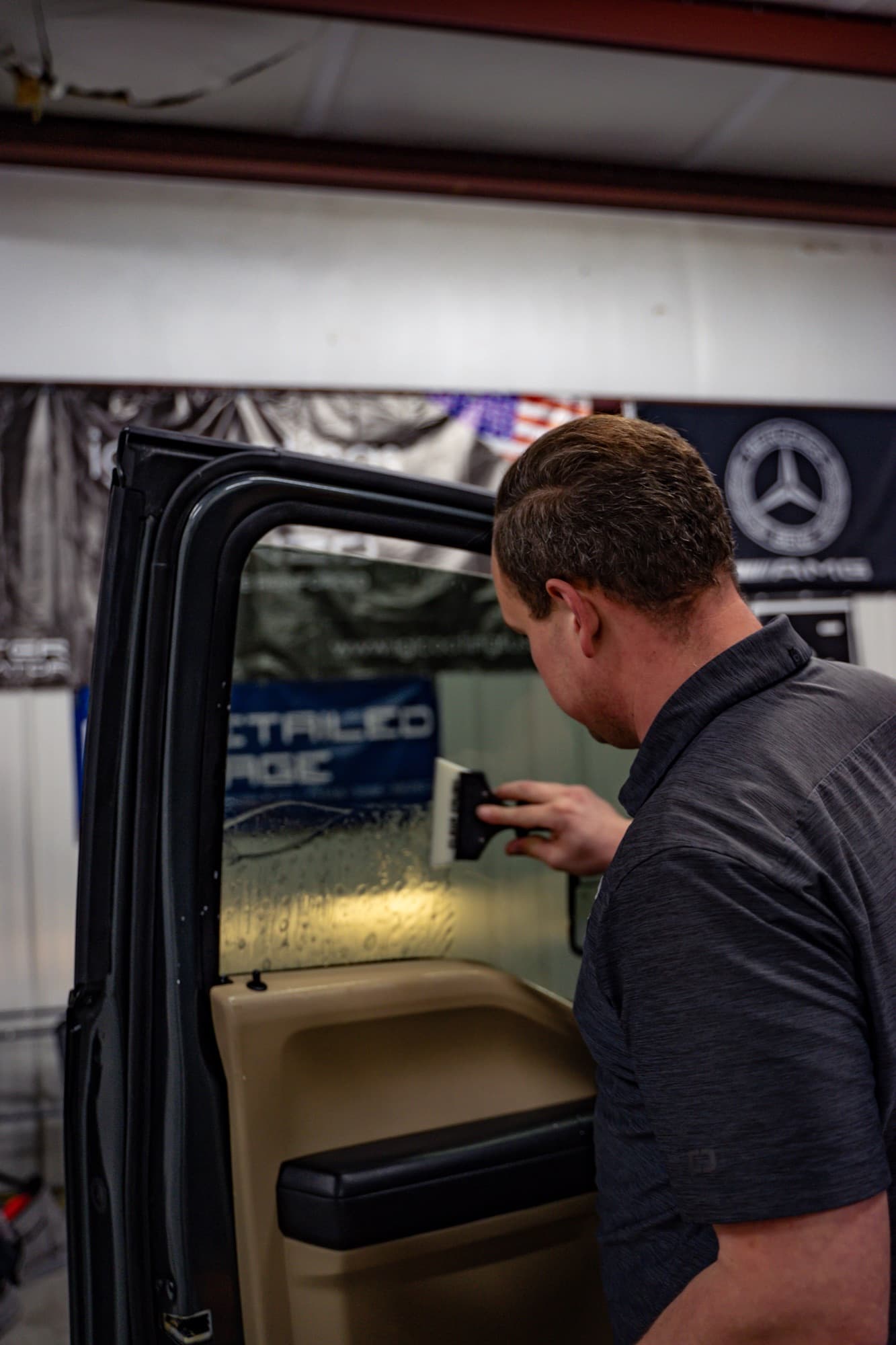
Automotive film goes on wet. The installer cleans the inside of the glass, sprays it with a slip solution, peels the protective liner off the film's adhesive, and lays the film onto the wet glass. From the moment the liner comes off, the exposed adhesive attracts anything floating nearby.
Inside a car, there is plenty floating nearby. Carpet and seat fabric shed lint, headliners drop fibers, pets leave hair, and air vents blow dust. The rubber seals at the edges of door glass hold grit that can be dragged onto the glass when the installer squeegees near the edge. A breeze through an open bay door can carry pollen, and in the Upstate spring, pollen gets everywhere.
Each particle that ends up between film and glass holds the film slightly off the surface. That creates a pinpoint bump with a tiny ring of air around it, which is what you see as a speck with a halo.
Telling them apart
Specks versus water bubbles versus air bubbles
- Water pocketusually goes away
- A soft-looking blister with no hard center, often seen in the first days. Gila, an Eastman film brand, says most small water bubbles dry out in a few days as the leftover moisture evaporates.
- Air bubbleusually stays
- A clear pocket where air, not water, got trapped. Gila notes that air bubbles will not disappear without proper squeegee work, and if one is found after the film has bonded, removal of the film may be required.
- Debris speckstays
- A visible particle, often with a small round halo. The film cannot bond over the particle, so the halo stays. Pressing on it from inside only risks denting the film.
- Fiber or hairstays
- A thin line or curl, often near an edge. Fibers usually come from clothing, towels or the car's interior and are one of the items the IWFA guideline lists by name.
The standard
What the industry considers acceptable
The International Window Film Association (IWFA) publishes an automotive visual inspection guideline that many manufacturers and installers refer to. It starts from a realistic premise: installed automotive film is not expected to have the same level of visual quality as glass.
Under that guideline, the glass with film is viewed at right angles from inside the vehicle and from 3 feet outside, in natural daylight. The installation is deemed acceptable if dirt particles, hair and fibers, adhesive gels, fingerprints, air bubbles, water haze, scores and scratches, film distortion, creases, edge lift, and nicks and tears are all unobtrusive. Effects during the drying period are disregarded, and inspection can be done within a day of installation.
Unobtrusive is a judgment call rather than a count. The practical test is whether a speck stands out when you look through the window normally, not whether you can find it by pressing your face to the glass with a flashlight. A tiny dot tucked near the bottom corner of a rear side window is very different from a cluster of specks in the driver's line of sight.
Prevention
How careful installers keep contamination down
- A clean, enclosed installation bay with doors closed and fans off near the work area.
- Thorough cleaning of the inside glass, including scraping the surface and flushing debris out of the edges and seals.
- Clean, lint-free tools and towels, and squeegees inspected for nicks that could drag grit.
- Covering door panels and seats so the slip solution does not soak fabric and pull lint loose.
- Filtered or fresh slip solution, mixed in clean bottles.
- Peeling the liner close to the glass and laying the film quickly so the adhesive is exposed as briefly as possible.
- Using a computer-cut pattern, so less trimming is done on the car and fewer film shavings fall into the door.
Your part
How you can help before the appointment
Vacuum the interior
Vacuum seats, carpets and the rear deck the day before. Loose pet hair and crumbs are a common source of debris, and a clean cabin gives the installer a better starting point.
Clear the rear deck and door pockets
Take out loose items, papers and anything on the package shelf in front of the back glass. The installer needs room to work, and clutter holds dust.
Skip the air freshener sprays
Oily sprays and dressings on interior trim can leave residue on the glass. Avoid dressing the dashboard and door panels right before your appointment.
Mention pets
If a dog rides in the back seat, tell the installer. They may take extra care cleaning seals and covering seats in the areas where hair collects.
After pickup
What to do if you see specks
First, wait for the film to dry. In the first days, water pockets and haze can look like contamination, and some soft spots will disappear on their own. Check again once the windows are clear, in daylight, from the driver's seat and from a few feet outside, the way the IWFA guideline describes.
If a speck is clearly visible in normal use, contact your installer, tell them which window and roughly where, and take a photo with the sun behind the glass. A reputable shop will look at it and tell you honestly whether it falls within normal tolerance or whether redoing that window makes sense. Because debris cannot be lifted out of bonded film, the fix for a bad window is new film on that window, not a patch.
Do not try to fix a speck yourself by pressing it or pricking the film with a pin. That leaves a lasting mark of its own and can make a reasonable request for a redo harder.
Perspective
Why a single speck is not a sign of bad work
Even careful installers working in clean bays occasionally trap a particle, especially on large back glass that has to be shaped with heat and handled more. Judge the whole job: straight edges, consistent gaps, a clean back glass and a correct compliance sticker on each window say more about workmanship than one dot.
That said, contamination across many windows, specks in the windshield visor strip right in your line of sight, or grit along every edge points to rushed prep. That is a fair thing to raise, politely and early.
Planning tint for your car?
Our film is computer cut for your vehicle and installed with the South Carolina compliance sticker on each tinted window. Book online or ask us any questions before your appointment.
Common questions
Can specks under tint be removed without replacing the film?
Generally not. Once the adhesive has bonded, the film cannot be lifted and laid back down cleanly. Gila notes that its adhesive films cannot be reinstalled once removed. Getting rid of a speck means removing the film on that window and installing a new piece.
Why are there more specks on my back glass than my side windows?
Back glass is large and often curved, so the film is shaped with heat and handled more before it goes on. There is also a rear deck and defroster grid to work around, and the dot band at the edges can look like texture. All of that makes back glass the hardest window to get perfectly clean.
Will a speck under the tint get worse over time?
A single trapped particle usually stays the same size. If the area around it starts to lift, grow, or the edge near it begins to peel, that is a different problem and worth showing your installer.
Is it normal to see specks only when the sun is behind the window?
Yes. Low sun shining through the glass exaggerates every tiny halo. The IWFA guideline judges film in natural daylight while looking through it normally, which is a fairer test than staring into the sun.
Keep reading
Sources
- Automotive Visual Inspection Guideline For Applied Window Film (January 1, 2020), International Window Film Association (https://iwfa.com/wp-content/uploads/2024/04/Automotive-Visual-Inspection-Guideline-For-Applied-Window-Film.pdf), accessed October 2026
- Automotive Frequently Asked Questions, Gila Window Film / Eastman Performance Films (https://gilafilms.com/en/automotive-window-tint/faq/), accessed October 2026
- Home Window Film Frequently Asked Questions, Gila Window Film / Eastman Performance Films (https://gilafilms.com/en/home-window-film/faq/), accessed October 2026
Prices on this page are The Auto Show’s published starting prices. Film ratings and warranty terms come from the manufacturer. This guide explains South Carolina law in plain words; it is not legal advice.