Auto Detailing Guide: Compare
Mobile Detailing or a Shop Detail: Which Fits Your Car?
A detailer who comes to your driveway or office parking lot saves you a drop-off, a ride and half a day. A detailer with a shop gives the work a roof, shade, strong lights and a closed door against wind and pollen. Both can do excellent work. The question is which one suits the job your car needs.
This page compares the two honestly, job by job, including the jobs where mobile is the better choice and the ones where the conditions of a shop make a real difference to the result.
The short answer
Mobile detailing fits when convenience matters most and the job is upkeep: a wash, a vacuum and wipe-down, a spray sealant, done at home or work. A shop detail fits when the job needs controlled conditions: shade and a cool surface for products, strong light for paint work, and time and space for decontamination, machine polishing, drying after extraction or a ceramic coating. The two can work together, with mobile upkeep between shop details.
Key points
- Mobile wins on convenience: no drop-off, no ride to arrange, no time off work.
- A shop wins on conditions: shade, a cooler surface, strong lighting and shelter from wind, pollen and rain.
- Quick upkeep at home or work is a good mobile job; machine polishing and coatings are better done indoors.
- Coating makers set application conditions; IGL's data sheet for its Kenzo coating rules out direct sunlight and hot panels.
- Whoever you hire, ask where the water and power come from and what happens if it rains.
Next: decide: How much does a car detail cost in Anderson?. If a shop detail suits your car, see what each package costs by vehicle size and what condition adds.
Convenience
What mobile detailing does well
The case for mobile detailing is time. Your car is cleaned where it already sits, while you work or get on with the day. There is no drive across town, no second driver to bring you back, and no gap in your week without a car. For a family with one vehicle, or anyone whose schedule makes a drop-off hard, that is worth a lot.
It also suits regular upkeep. A maintenance wash, a vacuum and wipe-down of the cabin, glass inside and out and a fresh spray sealant are all jobs that work well in a driveway on a mild, overcast day. If what your car needs is to be kept clean rather than brought back from months of build-up, mobile can be the right answer.
A shop detail asks more of you. At The Auto Show every detail is by appointment, there is no waiting area, and the shop does not provide rides, so a shop detail means planning a drop-off and pickup. Evening drop-off can be arranged by phone, but it is still a trip. Be honest with yourself about that cost when you compare.
Conditions
Why conditions matter for some jobs
Detailing products are made to be used on a cool surface out of the sun, and an Upstate summer makes that hard outdoors. Soap and rinse water dry on hot paint and leave spots. Sealants and polishes flash too fast to work properly. Coating makers are specific: IGL's technical data sheet for its Kenzo coating says not to expose the surface to direct sunlight before or during application, that the surface must not be hot, and that application should happen between 41 and 104 degrees Fahrenheit, preferably about 68 to 79.
Wind and pollen are the next problem. A wet panel or a freshly applied product collects whatever is in the air, and in the Upstate that means pine pollen from late March through April, according to Clemson Extension, as well as dust from gravel drives and red clay. Indoors, the air is still and the door can stay shut.
Then there is light. Swirls and high spots from a polish or coating are easy to miss in shade and obvious in the sun. Paint work needs strong, even light to see what the pad is doing. Rain is the last variable: a coating needs time to air-dry without water after it goes on, and the same IGL data sheet says it takes days to fully cure.
By job
Which jobs suit mobile, and which suit a shop
The fairest way to choose is by the job. Here is how the common detail work splits.
- Maintenance wash and spray sealantMobile works well
- Loose dirt, pollen and road film off, a quick protective layer on. Done carefully in the shade, there is little a shop adds.
- Interior vacuum and wipe-downMobile works well
- Vacuuming, hard surfaces, glass and door panels need a vacuum and power, not a building. A good mobile setup handles it.
- Carpet and upholstery extractionEither, drying is the issue
- Extracted fabric needs time to dry. In a driveway on a humid Upstate day it dries slowly, and a car closed up damp can smell musty. Plan for drying time whoever does it.
- Decontamination and clayEasier in a shop
- Iron removers and clay need plenty of water and a cool surface, and clay dropped on a dusty driveway is ruined. Possible outdoors with care, easier under a roof. What decontamination involves
- Machine polishingBetter in a shop
- Polishing needs power, strong light to see defects, a cool panel and still air. Sun and wind make it slower and the result harder to judge. Polish vs correction
- Ceramic coatingBetter in a shop
- Coating makers set conditions on temperature, sun and surface heat, and the coating then needs time to air-dry without water. That is hard to control outdoors. Coating vs sealant
Questions
Questions to ask any detailer, mobile or shop
Whoever you hire, a few questions tell you how the work will be done. A good detailer answers them easily.
Where does the water come from?
Mobile units either carry a tank or use your outside tap. Ask which, and whether that matters where you live.
What about power?
Vacuums, extractors and polishers need it. Ask whether they bring a generator or need an outlet.
What if it rains or is very hot?
Ask how they reschedule and what they will not do in direct summer sun.
Is it allowed where the car is parked?
Some apartment complexes, office parks and homeowners' associations limit washing in their lots. Check before you book anyone to work on site.
What exactly is included, and what costs extra?
Get the list of work and any condition charges confirmed before the job starts, whichever kind of detailer you choose.
The shop
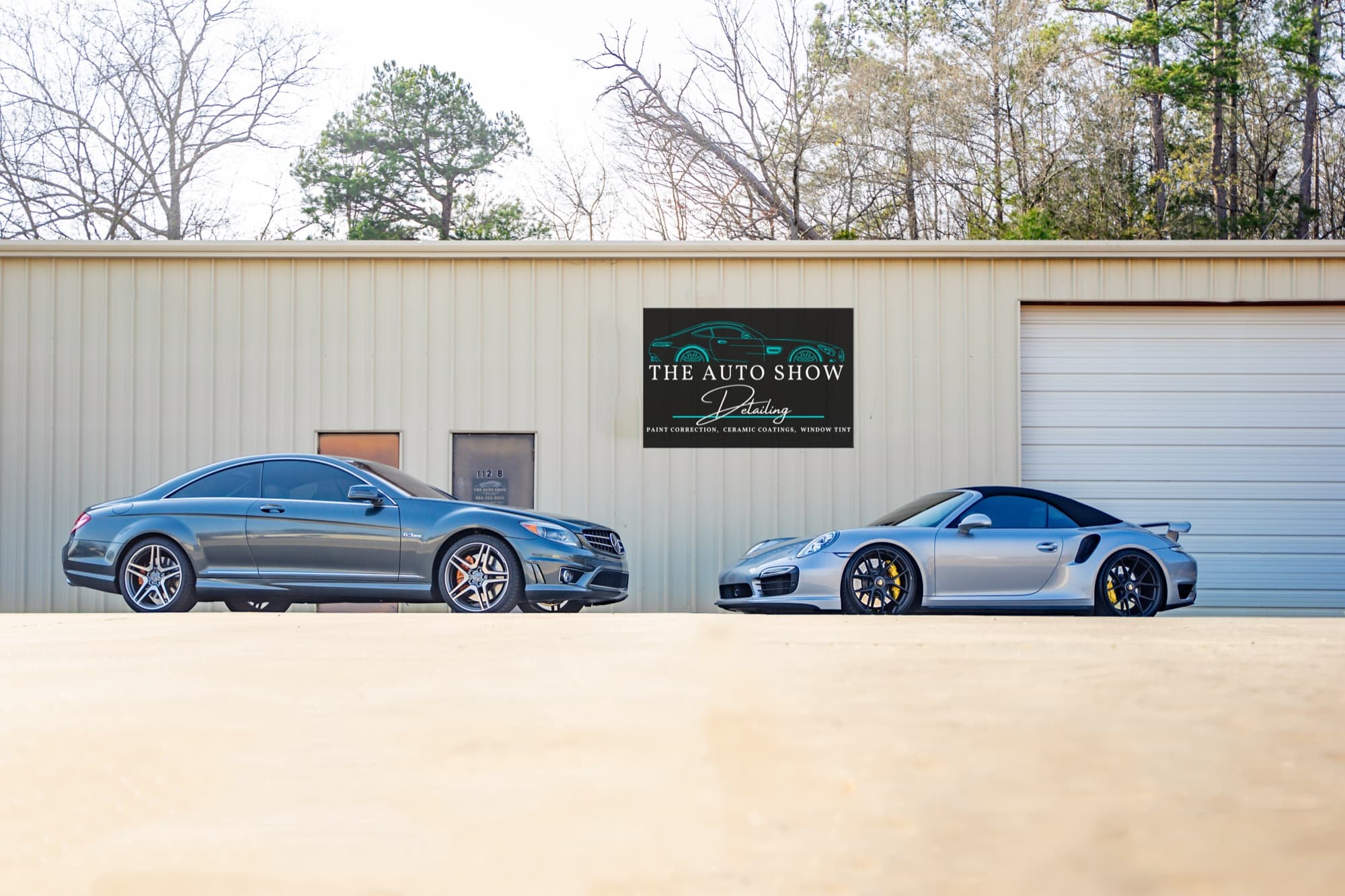
What a shop detail looks like at The Auto Show
The detail packages on our detailing page are done by appointment in our shop on Metro Drive. The vehicle is looked over with you at drop-off, its size and condition are noted, and the price is confirmed before work starts. From there it is a full detail: wheels and tires first, a pre-soak and contact hand wash, decontamination and polishing on the packages that include them, a sealant, and the full interior clean.
Because there is no waiting area and no ride service, plan how you will get to and from the shop. If you have questions about where or how the work can be done for your vehicle, call or text before you book.
What drop-off day involves: how to prepare for your drop-off.
Both
Using both
Mobile and shop detailing are not either-or. Plenty of cars are best served by a shop detail to reset them, with decontamination, polish or a coating, followed by regular upkeep at home, whether you do it yourself or have someone come to you. The upkeep keeps the reset looking good for longer; the reset gives the upkeep something worth maintaining.
The one thing to avoid is asking any detailer to do a job in conditions it was not designed for. Polishing in the sun or coating in the wind does not save money if the result has to be done again.
If you plan to do the upkeep yourself, start with DIY detailing vs a professional detail.
| Compared | Mobile detailing | Shop detail |
|---|---|---|
| Convenience | Done where the car is parked | Drop-off and pickup to plan |
| Sun and heat | Depends on shade and the day | Indoors, out of direct sun |
| Wind, pollen, dust | Exposed | Sheltered |
| Lighting for paint work | Daylight | Shop lighting |
| Rain | Reschedule | Work continues indoors |
| Good fit for | Maintenance washes, interior upkeep | Decontamination, polishing, extraction, coatings |
Book a shop detail
Request a booking with your name, phone and email, choose the package and tell us about the vehicle. We call or text to confirm the time and the price before any work starts.
Common questions
Is mobile detailing cheaper than a shop detail?
Not necessarily. Prices depend on what is included, the size of the vehicle and its condition, not just where the work happens. A mobile maintenance wash and a shop paint decontamination are different jobs. Compare the list of work and any condition charges side by side, rather than the label on the van or the building.
Can a ceramic coating be applied in a driveway?
It is difficult to do well. IGL's data sheet for its Kenzo coating says not to apply it in direct sunlight or on a hot surface, sets a temperature range of 41 to 104 degrees Fahrenheit, and has the coating air-dry without water after application. Wind-blown dust and pollen also land on wet coating. A shop controls those conditions.
Is mobile detailing good enough for a car I am selling?
It can be, if the car mainly needs cleaning. If the paint feels rough or looks dull, decontamination and a machine polish make a bigger difference to how it presents, and both are easier to do well indoors. Decide by what the car needs, not by where the work is done.
What if I cannot arrange a ride to and from a shop?
Ask the shop what it can do around your schedule. At The Auto Show there is no waiting area and no ride service, but a drop-off after 6 pm can be arranged by phone, so you can leave the car in the evening and plan the pickup. If that still does not work, a mobile maintenance detail may suit you better for now.
Sources
- Technical Data Sheet: IGL Coatings Ecocoat Kenzo K1, revision 8 September 2023, IGL Coatings (https://iglcoatings.com/wp-content/uploads/2023/09/tds_ecocoat_kenzo_K1_154343.pdf), accessed November 2026
- Why Pine Pollen Covers Everything in Spring (The "Pollening" in the South), Clemson Cooperative Extension Home & Garden Information Center (https://hgic.clemson.edu/why-pine-pollen-covers-everything-in-spring-the-pollening-in-the-south/), accessed November 2026
Detail prices on this page come from the shop’s published price list and are starting prices. The Auto Show confirms the price for your vehicle before any work starts.