
Ceramic Coating & PPF Guide: Compare
Ceramic Coating vs PPF: Which Do You Need?
Ceramic coatings and paint protection film get mentioned in the same breath, but they solve different problems. A coating is a thin, hard chemical layer that makes paint glossy, slick and easier to clean. Paint protection film (PPF) is a clear urethane sheet thick enough to take a hit from a stone and keep it off your paint.
Once you know which problem bothers you more, chips or upkeep, the choice usually makes itself. For many Upstate drivers the honest answer is film where the rocks hit and a coating everywhere else.
The short answer
Choose paint protection film if your main worry is rock chips, sand and road rash on the front end: it is a thick, self-healing urethane layer that absorbs impacts. Choose a ceramic coating if you want gloss, slickness and easier washing across the whole car: it is far thinner and cannot stop chips. Many owners combine them, filming the high-impact front and coating the rest.
Key points
- PPF is a physical barrier; a coating is a chemical layer far too thin to absorb a rock strike.
- Coatings make every panel easier to wash and add gloss; film protects only the panels it covers.
- LLumar backs its Platinum gloss, matte and extra-thick films with a 10-year manufacturer's limited warranty, subject to restrictions.
- Front-end film at The Auto Show starts at $1,199.99; coatings start at $699.98 for a coupe.
- Film can be ceramic coated on top, so the two work together rather than competing.
How they work
Two completely different kinds of protection
A ceramic coating starts as a liquid and cures into a glass-like film bonded to the clear coat. It is thin. IGL's data sheet for Kenzo calls for roughly 1 to 5 ml of coating per square meter, which spreads into a layer measured in thousandths of a millimeter. That is enough to change how water, dirt and chemicals behave on the surface, and nowhere near enough to cushion a stone.
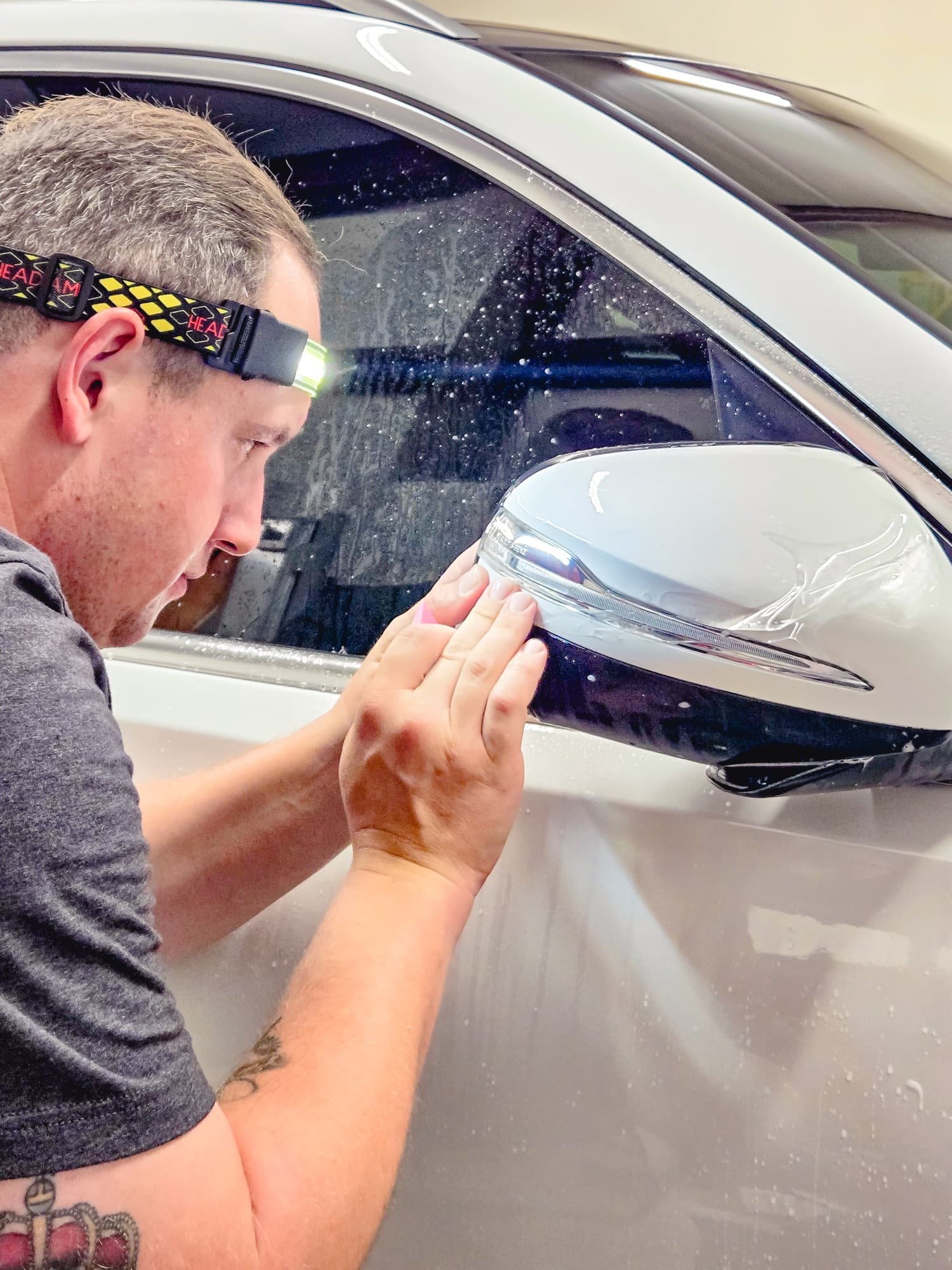
Paint protection film is a pre-made sheet of clear thermoplastic urethane with an adhesive on the back and a protective top coat on the front. You can pinch it between two fingers and feel its thickness. When a stone hits, the film flexes and takes the damage. LLumar describes its Platinum film as guarding against flying rocks, road salt, sand, dirt, bugs and oil.
Protection
What each one actually protects against
- Rock chips and road rashPPF
- Film absorbs most stone strikes on the panels it covers. A coating does not. Neither one is indestructible: a large or sharp impact can still cut film or chip paint at the edge. Why cars get chips
- Light swirls and scratchesPPF heals, coating resists
- LLumar says most surface scratches in its film self-heal with heat from the sun, warm water or a warm engine. A coating resists very light marring a little but will not heal; deep cuts go through either.
- Bird droppings, bugs and sapBoth help
- Both give you more time to clean them off before they stain or etch. Neither makes it safe to leave droppings baking on a summer afternoon.
- Easier washing and glossCoating
- A coating makes every coated panel slick, so pollen, clay dust and road film rinse away more easily. Film has its own hydrophobic top coat, but only where the film is.
- UV and oxidationBoth help
- Both add a protective layer over the clear coat. Garage parking still does the most to slow sun damage.
Durability
How long each one lasts
Coatings are rated in years with proper maintenance. The shop's tiers are a 1-year IGL EZ, a 3-year IGL Quartz+ and a 5-year IGL Kenzo. The years describe rated durability, not a promise, and depend on hand washing and avoiding brush car washes.
LLumar backs its Platinum gloss, matte and Platinum Extra films with a 10-year manufacturer's limited warranty, and notes that certain restrictions apply. LLumar's FAQ also says the film is designed for original factory paint, that aftermarket or repaired paint is not covered, and that edge lifting caused by pressure washing or automatic car washes is not covered. Read the warranty document for your film rather than assuming.
Cost
What each one costs at The Auto Show
- Interstate PPF, from $1,199.99: front half of the hood, front half of the fenders, front bumper and mirrors.
- Long Distance Driver PPF, from $2,199.99: full hood, full fenders, headlights, fog lights, mirrors and door edges.
- Off Roader PPF: full hood and fenders, lights, mirrors, and front and rear rocker panels. Call for a quote.
- Full Car PPF, from $5,499.99: whole-vehicle coverage, with exact panels confirmed at inspection.
- Ceramic coating, coupe starting prices: 1-year $699.98, 3-year $899.98, 5-year $1,299.98, plus at least a Level 2 detail and a paint enhancement or correction.
All prices are starting prices; final prices are confirmed after inspection.
Decide
A quick way to decide
Look at your hood and bumper
Already peppered with chips after a year or two of I-85 or US-76 miles? Film on the front end is the priority.
Think about how you wash
Tired of scrubbing pollen, bugs and red clay off the whole car? A coating makes every wash quicker.
Be honest about budget
If you can only do one now, choose the one that fixes your biggest annoyance. The other can come later.
Consider how long you will keep it
Long ownership favors front-end film plus a multi-year coating. A short lease may need only a coating or a detail.
Check the paint first
Both lock in what is underneath. Swirls, scratches and old chips should be addressed before either goes on.
Both
Why the answer is often both
Film and coatings complement each other. The film takes impacts where they happen most: the bumper, the leading edge of the hood, the fenders and the mirrors. The coating covers everything else, the roof, doors, trunk and rear bumper, and makes the whole car easier to keep clean. A coating can also go over the film itself for extra slickness and stain resistance.
Order matters. LLumar advises against applying wax or coatings before film is installed because they interfere with adhesion. So the film goes on clean, bare paint first, and the coating follows over the remaining paint and, if you choose, the film.
| Ceramic coating | Paint protection film | |
|---|---|---|
| What it is | Thin cured chemical layer | Thick clear urethane sheet with adhesive |
| Rock chips | No protection | Absorbs most strikes on covered panels |
| Light scratches | Resists slightly, no healing | Most surface marks heal with heat |
| Coverage | Whole car, wheels and glass as add-ons | Only the panels you choose |
| Easier washing | Yes, every coated panel | Yes, where the film is |
| Rated life | 1, 3 or 5 years (IGL tiers) | 10-year limited warranty from LLumar on Platinum |
| Starting price | From $699.98 (coupe, 1-year) | From $1,199.99 (Interstate) |
Coating years are rated durability with proper maintenance. Film warranty terms come from LLumar and have restrictions.
Not sure which one your car needs?
Bring it by for an inspection. We will look at where your paint is already chipping, how you drive and how you wash, then recommend film, a coating or both.
Common questions
Is PPF better than ceramic coating?
Better at different things. PPF is better at stopping rock chips and road rash because it physically absorbs impacts. A ceramic coating is better at making the whole car glossy, slick and easy to wash. If chips are your main problem, start with film. If upkeep is, start with a coating. Many owners end up with both.
Which lasts longer, PPF or ceramic coating?
Quality film generally lasts longer. LLumar backs its Platinum films with a 10-year limited warranty with restrictions, while coatings are rated for 1 to 5 years depending on the product. Both depend on care: brush car washes, aggressive pressure washing near film edges and harsh chemicals shorten either one.
Can I get a ceramic coating now and add PPF later?
You can, but plan for it. LLumar advises against coatings under film because they interfere with adhesion, so any panel getting film later would need the coating removed by polishing first. If you expect to add front-end film within a year or so, it is usually cheaper to do the film first.
Do I need either one on a car that lives in a garage?
Garage parking cuts UV, pollen and sap exposure a lot, but it does nothing for rock chips on the highway or swirls from washing. A garaged car that sees regular highway miles still benefits from front-end film. A garaged weekend car often does well with a coating alone.
Which is better for factory matte paint, film or a coating?
Both can work. Matte paint cannot be polished to remove marks, so protection matters more. LLumar makes a matte version of its Platinum film designed to blend with flat finishes, and IGL marks its coatings as safe for matte paint. Film adds chip protection; a matte-safe coating makes cleaning easier without adding gloss. Never use waxes or polishes made for gloss paint.
Sources
- Platinum Gloss Paint Protection Film, LLumar / Eastman Performance Films (https://llumar.com/en/paint-protection-film/platinum-gloss/), accessed October 2026
- Platinum Extra Paint Protection Film, LLumar / Eastman Performance Films (https://llumar.com/en/paint-protection-film/platinum-extra/), accessed October 2026
- Platinum Matte Paint Protection Film, LLumar / Eastman Performance Films (https://llumar.com/en/paint-protection-film/platinum-matte/), accessed October 2026
- Paint Protection Film Frequently Asked Questions, LLumar / Eastman Performance Films (https://llumar.com/en/resources/paint-protection-film-frequently-asked-questions/), accessed October 2026
- Technical Data Sheet: Ecocoat Kenzo K1, IGL Coatings (https://iglcoatings.com/wp-content/uploads/2023/09/tds_ecocoat_kenzo_K1_154343.pdf), accessed October 2026
- Ecocoat EZ, IGL Coatings (https://iglcoatings.com/products/ecocoat-ez/), accessed October 2026
Prices on this page are The Auto Show’s published starting prices and are confirmed after we inspect the vehicle. Product ratings and warranty terms come from the manufacturers.