
Ceramic Coating & PPF Guide: Understand
Why Cars Get Rock Chips (and Where)
Rock chips are the one kind of paint damage almost every car collects, no matter how carefully it is washed. They come from the road, not from you, and they pile up on the same few panels on nearly every vehicle.
Knowing where chips come from explains why the front of the car looks worse than the rest after a couple of years of highway driving, why some chips turn into rust spots, and which habits and protection actually reduce them.
The short answer
Rock chips happen when tires pick up gravel, sand or debris and fling it into the car behind or beside them. Speed multiplies the impact energy, so highway driving close behind other vehicles is the main cause. Chips concentrate on the leading edge of the hood, the bumper, mirrors, headlights and the lower body behind the wheels. Chips through to bare steel can rust if left open.
Key points
- Most chips come from gravel thrown by other vehicles' tires, plus debris falling or blowing off loads.
- Impact energy rises with the square of speed, so a stone hitting at highway speed carries far more energy than one at town speed.
- Mazda's owner's manual puts the paint chipping zone at about 164 feet behind a vehicle at 56 mph, and says cold paint chips more easily.
- The front edge of the hood, the bumper, mirrors and the lower panels behind the front wheels take most of the hits.
- A chip down to bare steel can start rusting, so touching it up or protecting the area matters more than the cosmetic damage.
The physics
What actually happens in a stone strike
A tire rolling over loose gravel can catch a stone in its tread and release it backward and upward at a meaningful fraction of the vehicle's speed. Your own car is moving toward that stone, so the impact speed is roughly the two speeds combined. A small stone does not need to be big to chip paint; it needs to be fast and hard.
Impact energy grows with the square of speed. Double the closing speed and the stone hits with about four times the energy. That is why a car can drive gravel roads at low speed for years with few chips, then collect a dozen in one week of interstate travel.
Paint makers design for this. Industry chip tests, such as the SAE J400 gravelometer test, fire about a pint of standardized gravel (roughly 300 pieces) at a coated panel with compressed air, then rate the damage by chip size and count and note which layer failed. The primer surfacer layer under the color coat is formulated in part to absorb stone impact. Even so, no automotive paint is chip proof.
Where they hit
The panels that take the most chips
- Front edge of the hoodHighest risk
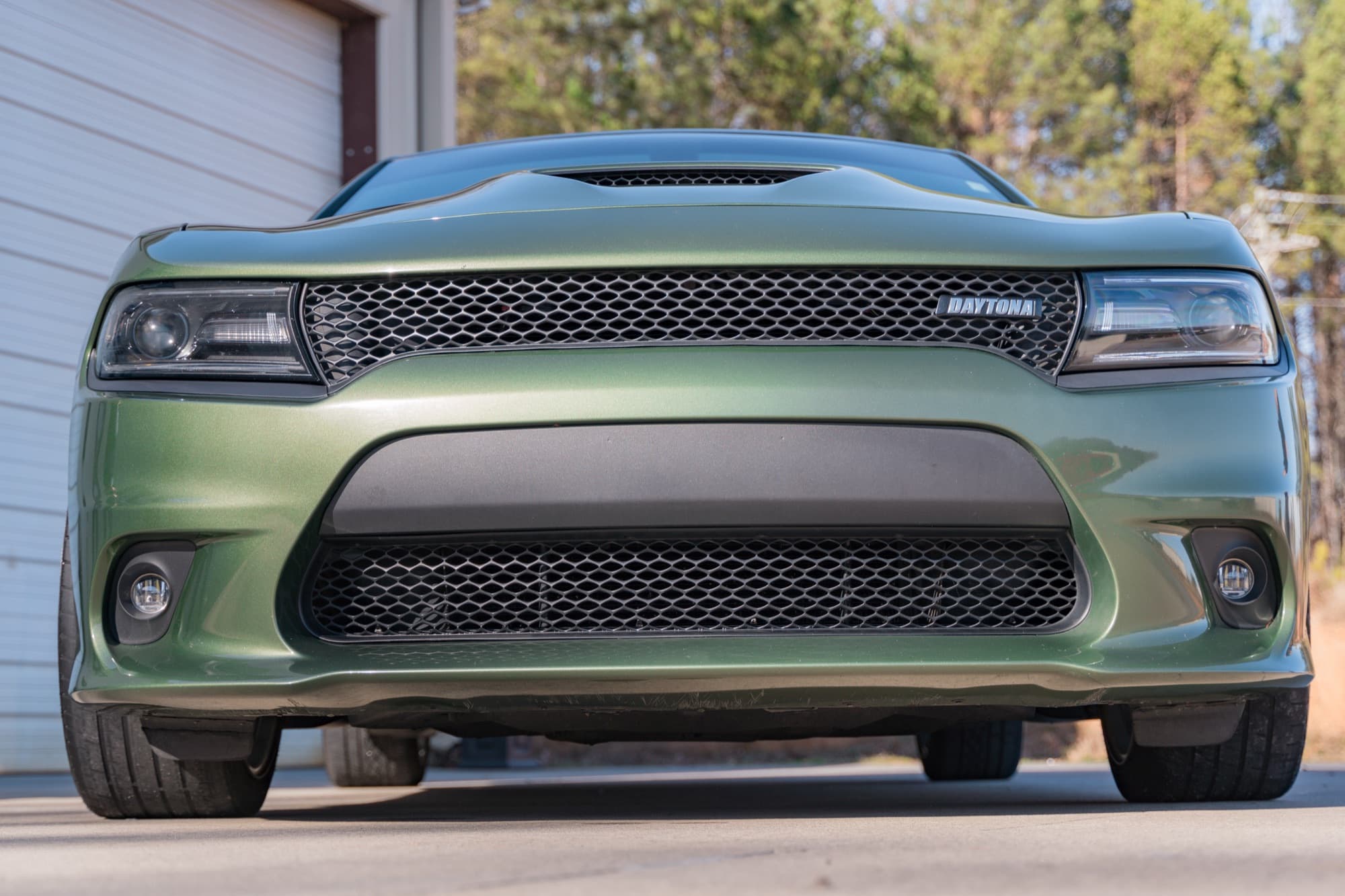
- The first painted surface a stone meets at an upward angle. Chips here are often small and dense, like peppering, and they are the first thing people notice on a car that has spent years on the highway. Partial vs full hood film
- Front bumperHighest risk
- Takes direct hits at nose level. Most bumpers are plastic, so chips do not rust, but the paint on plastic chips readily and is expensive to refinish well.
- Mirrors and headlightsHigh risk
- Mirror caps face straight into oncoming debris. Headlight lenses pit and haze from years of sand and grit, which also dulls the light output.
- Lower doors and rocker panelsHigh on trucks and lifted vehicles
- Stones thrown by your own front tires hit the lower body behind them. Wider tires, mud-terrain tread and gravel roads make it worse. Rocker panel PPF
- Front edges of rear fendersWide cars and duallies
- On cars with wide rear haunches and on dual-rear-wheel trucks, the paint just ahead of the rear wheels sits right in the spray path of the front tires.
- Windshield and A-pillarsHigh risk
- The steep glass and the pillars beside it catch stones that clear the hood. Glass chips are their own repair issue, but the painted pillars chip too.
On the road
Driving situations that throw the most stones
South Carolina law requires vehicles to be built or loaded so nothing drops, sifts, leaks or escapes, and loads of rock, gravel or stone must sit at least six inches below the top of the walls or be covered by a tarp. The same law allows sand, salt and other chemicals to be dropped deliberately for traction, so winter roads can carry extra grit even when everyone follows the rules.
- Following closely at highway speed, especially behind trucks with many tires and open treads.
- Passing or being passed by dump trucks and trailers hauling stone, sand or gravel.
- Construction zones and freshly chip-sealed or milled pavement, where loose aggregate sits on the surface.
- Gravel driveways, unpaved county roads and job sites, mostly from your own tires.
- Winter days when sand and salt have been spread for traction, which can leave grit on the road for weeks.
- Merging onto busy interstates like I-85 in the Upstate, where you spend time close behind other vehicles at speed.
Cold and distance
Why following distance and temperature matter
Mazda's owner's manual is unusually specific here. It says the paint chipping zone varies with speed and gives an example: at 90 km/h (56 mph), the chipping zone is about 50 meters, or 164 feet. Staying out of that zone behind the vehicle ahead reduces how many thrown stones reach you at all, and those that do have slowed down.
The same manual notes that a vehicle's finish hardens at low temperatures, which increases the chance of chipping. Cold, harder paint is less able to flex and absorb a strike, so a winter commute can chip paint that would only scuff in summer.
South Carolina's following-too-closely rule asks drivers to leave a distance that is reasonable and prudent for speed, traffic and road conditions. That is a safety rule first, but it is also the cheapest paint protection available.
Why it matters
From chip to rust: why small chips are worth fixing
Paint is a layered system. A light chip may only take a flake of clear coat. A deeper one goes through the color, into the primer, and sometimes down to bare metal. Once steel is exposed to water, humidity and road salt, it can start to rust, and rust spreads under the paint around the chip.
Mazda's manual warns that chipped paint can lead to rust and recommends repairing chips with touch-up paint before that happens. Aluminum panels do not rust the way steel does but can corrode, and plastic bumpers do not corrode at all, though their chips still grow as edges flake.
Touch-up paint will not make a chip disappear, but sealing the exposed metal is the important part. Hoods and fenders that take dozens of chips a year are where prevention starts to pay for itself.
Reducing chips
What actually reduces rock chips
Leave more space
Drop back from trucks and trailers, and change lanes rather than sitting behind a vehicle that is shedding gravel.
Slow down on loose surfaces
On gravel, construction zones and fresh chip seal, lower speed reduces both what your tires throw and how hard stones hit you.
Fit mud flaps on trucks
Flaps behind the tires cut the spray hitting your own rockers and the cars behind you.
Put film where the chips land
Paint protection film is the only common product designed to absorb stone strikes. It reduces chips on the panels it covers; it does not stop every one.
Seal chips quickly
Clean and touch up chips that reach primer or metal before winter, or have them looked at, to keep rust from starting.
| Area | Why it gets hit | What helps most |
|---|---|---|
| Hood leading edge | First surface stones meet | Film on at least the front of the hood |
| Front bumper | Direct hits at nose level | Film; distance from trucks |
| Mirrors | Face straight into debris | Film on mirror caps |
| Headlights | Sand and grit pitting | Film on the lenses |
| Rockers and lower doors | Your own tires' spray | Film, mud flaps, slower on gravel |
| Rear fender fronts | Front tire spray on wide bodies | Film on the leading edge |
Coatings make paint easier to clean but are not designed to absorb stone impacts.
Protect the panels that take the hits
Our LLumar Platinum film packages are built around the chip zones: the Interstate package covers the front half of the hood and fenders, the front bumper and the mirrors, and larger packages go further.
Common questions
Why does my new car already have rock chips?
New cars get chipped just like old ones; the first weeks of highway driving are often when owners first notice it because the paint is otherwise perfect. Delivery transport, dealer lots near busy roads and a few interstate trips can be enough. Chips on the hood edge and bumper in the first month are common, which is why film is often installed early.
Should I fix rock chips right away?
Fix the ones that reach primer or bare metal soon, especially before winter, because exposed steel can rust. Tiny chips that only took a flake of clear are cosmetic and can wait. Clean the chip, let it dry and apply a small amount of matching touch-up paint, or have it looked at if you are not sure how deep it goes.
Do mud flaps really help with rock chips?
They help most with chips on your own vehicle's lower panels and on cars behind you, because they block some of what your tires throw. They do nothing for stones coming from vehicles ahead. On trucks and SUVs that see gravel roads, flaps plus film on the rockers is a common pairing.
Why do I get more chips in winter?
Two reasons. Grit spread for traction can stay on the road surface for weeks, so there is more to throw. And Mazda's owner's manual notes that paint hardens in low temperatures, which makes it more likely to chip than flex when a stone hits. Extra following distance on cold, gritty days helps.
Can a windshield chip and a paint chip happen from the same stone?
Often, yes. A stone that clears the hood edge carries on into the glass or the pillars. That is why cars with heavily chipped hood edges often have pitted windshields and headlights too. Film covers the painted panels and headlight lenses; windshield chips are handled separately by glass repair.
Keep reading
Sources
- Appearance Care: Exterior Care (2025 CX-5 Owner's Manual), Mazda North American Operations (https://www.mazdausa.com/static/manuals/2025/cx-5/contents/07040100.html), accessed October 2026
- Section 56-5-4100 Preventing escape of materials loaded on vehicles, and Section 56-5-1930 Following too closely, South Carolina Code of Laws Title 56 Chapter 5, South Carolina General Assembly (https://www.scstatehouse.gov/code/t56c005.php), accessed October 2026
- Chip Resistance of Coatings (Gravelometer) ASTM D3170, SAE J400, Intertek (https://www.intertek.com/polymers/testlopedia/chip-resistance-astm-d3170), accessed October 2026
- Talc in Automotive Coatings (application leaflet on OEM layer functions, including stone chip resistance), Elementis (https://www.elementis.com/fileadmin/elementis/About_Elementis/03-businesses/Performance_Specialties/Adding_Future/Papers_Leaflets/finntalc/0102030901_Talc_automotive.pdf), accessed October 2026
- Platinum Gloss Paint Protection Film, LLumar / Eastman Performance Films (https://llumar.com/na/en/automotive/paint-protection-film/platinum-gloss/), accessed October 2026
Prices on this page are The Auto Show’s published starting prices and are confirmed after we inspect the vehicle. Product ratings and warranty terms come from the manufacturers.