
Ceramic Coating & PPF Guide: Understand
What Is Paint Protection Film (PPF)?
Paint protection film, usually shortened to PPF and sometimes called clear bra, is a clear urethane film that is bonded to your car's painted panels. It is thick enough to take hits that would chip paint and clear enough that, done well, most people never notice it is there.
This guide covers what the film is made of, what each layer does, how it protects, the finishes you can choose from and what it cannot do. If you are deciding between film and a coating, start here, then read the comparison guides linked below.
The short answer
Paint protection film (PPF) is a clear, flexible urethane film with a pressure-sensitive adhesive that is installed over painted panels to absorb rock chips, sand, bug and bird damage and light scratches. Modern films have a self-healing top coat, a thick impact-absorbing urethane core and an acrylic adhesive. A typical film is around 7 to 8 mils thick. It reduces chips dramatically but does not make paint indestructible.
Key points
- PPF is a sacrificial layer: the film takes the impact, abrasion and staining so the paint underneath does not.
- Its protection comes from thickness and flexibility; the urethane core spreads out the force of a stone instead of letting it crack the paint.
- The top coat is what makes modern film self-healing and stain resistant; the adhesive is what makes it removable.
- Coverage is your choice: from the front edge of the hood to every painted panel on the car.
The basics
Paint Protection Film in One Paragraph
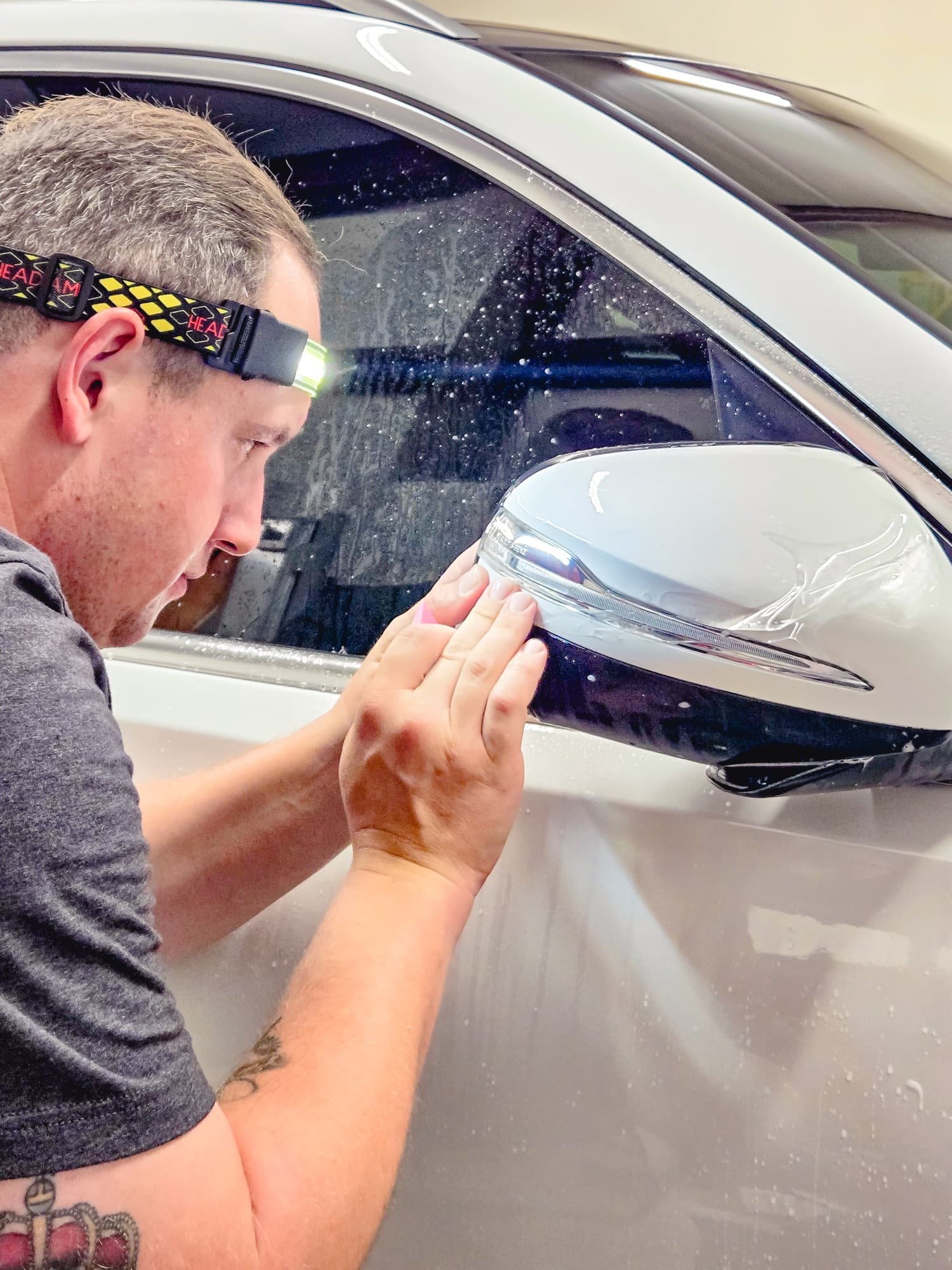
Think of PPF as a clear, tough skin for paint. It is cut to the shape of each panel, laid on with a slip solution so it can be positioned, squeegeed down and wrapped around edges where possible. Once the adhesive sets, stones, sand and grit hit the film instead of the clear coat. When the film eventually wears out or gets damaged, it can be peeled off and replaced, and the paint underneath has been sheltered the whole time.
It is different from a ceramic coating. A coating is a microscopically thin hard layer that makes paint glossy, slick and easy to clean but adds almost no impact protection. Film is many times thicker and is built to absorb physical hits. Many owners use both: film on the front end, a coating everywhere else.
Construction
The Layers Inside a Sheet of PPF
An earlier LLumar technical specification from Eastman, the company that makes LLumar film, breaks a typical self-healing film into five layers. Two of them come off during installation, so three stay on the car.
- Cap sheetRemoved
- A removable polyester film that protects the top coat during manufacturing, cutting and handling.
- Clear top coatStays on the car
- A flexible, self-healing polyurethane coating. It provides the gloss or matte look, resists stains and lets light swirls level out with heat. How self-healing works
- Urethane coreStays on the car
- The thick, impact-resistant layer, about 6 mils in that specification, formulated for UV, heat and water resistance. This is what absorbs a stone strike.
- AdhesiveStays on the car
- A self-crosslinking acrylic adhesive balanced so the film holds firmly yet can be removed later without pulling factory paint.
- Release linerRemoved
- A polyester backing that protects the adhesive until the installer peels it away.
The same document lists total thickness as 7 to 8 mil without the liner or cap sheet. A mil is a thousandth of an inch, so that is roughly 0.18 to 0.20 millimeters. Extra-thick films are thicker still.
History
From Helicopter Blades to Hoods
The idea started in the military. A Ward's Auto feature quotes a film-maker representative explaining that paint protection film was born out of the Vietnam era need to protect helicopter rotor edges from debris kicked up in landing zones.
The same article dates the contemporary automotive aftermarket to the mid-1990s, when digital drawing tools made it possible to create precise, vehicle-specific patterns. Pattern software is still central today: many installs start from a computer-cut kit for the exact make and model, with installers trimming and wrapping edges by hand.
Today's films add things the first ones did not have: top coats that heal light scratches, hydrophobic surfaces that resist stains, and adhesives designed to hold for years and still come off cleanly.
How it protects
What Happens When a Rock Hits Film
Paint is hard and thin. When a piece of gravel hits a bare hood at highway speed, the clear coat and color coat can crack and flake, leaving a chip down to primer or metal. Film changes the impact. The soft, elastic urethane deforms under the stone and spreads the force over a wider area, so less of it reaches the paint.
Manufacturers test this. Eastman's earlier LLumar specification lists a pass on the SAE J400 gravelometer test, a standard chip-resistance test that fires road gravel at a test panel. It also reports more than 400 percent elongation at break, which is a measure of how far the film can stretch before it tears.
That is why PPF is the go-to for the front of cars that see a lot of highway miles. On I-85 behind loaded trucks, or on gravel roads around the lake, the front bumper, hood edge, mirrors and headlights take a steady stream of small impacts.
Finishes
Gloss, Matte, Black and Extra-Thick
Clear gloss film is the most common. It is designed to disappear on the paint and add a little depth. LLumar's Platinum line, for example, includes a gloss film with a high-shine top coat, a matte film that gives glossy paint a flat look or protects factory matte paint, and Platinum Extra, which LLumar describes as its thickest film for high-wear areas such as rocker panels, fenders, hoods and bumpers. Black film adds color change for roofs, mirrors or trim.
The Auto Show installs LLumar Platinum PPF as an authorized LLumar installer, in gloss, black, matte and extra-thick versions.
Coverage
Where Film Goes on a Car
Which coverage makes sense depends on how and where you drive, how long you plan to keep the car and your budget. The coverage guide walks through each option in detail.
- Partial front: the leading edge of the hood and fenders, front bumper and mirrors. The most chip-prone areas for the least film.
- Full front: full hood, full fenders, bumper, headlights and mirrors, so there is no visible film line across the hood.
- High-impact extras: rocker panels behind the front wheels, door edges, door cups, rear bumper load area and A-pillars.
- Full car: every painted panel, for owners who want the whole finish protected from chips, scratches and stains.
Limits
What PPF Cannot Do
- It does not make paint indestructible. A large or sharp stone at speed can still cut film or chip paint underneath.
- Self-healing works on light swirls and marring in the top coat; deep cuts and gouges through the film stay.
- Edges and seams exist on every install. They can be minimized and wrapped, but they collect a little dirt over time.
- It is meant for original paint. LLumar's FAQ notes that issues with aftermarket and repaired paint are not covered by its warranty, and recommends waiting 30 days after fresh paint so it can outgas.
- It does not fix paint defects. Swirls and scratches under the film are sealed in, so paint is corrected before film goes on.
| Paint protection film | Ceramic coating | |
|---|---|---|
| What it is | Clear urethane film with adhesive, about 7 to 8 mils | Thin hard layer bonded to the clear coat |
| Rock chips | Absorbs most small impacts | Little to no chip protection |
| Light scratches | Top coat self-heals light marring with heat | Adds some resistance; does not heal |
| Gloss and slickness | Gloss or matte finish; can be coated on top | High gloss, very slick, easy washing |
| Typical coverage | High-impact areas or full car | Whole vehicle, plus glass, wheels, trim |
| Removal | Peels off and can be replaced | Wears away or is polished off |
See what film would cover on your car
We install LLumar Platinum paint protection film as an authorized LLumar installer, from partial front packages to full car coverage. Ask for a quote and we will confirm coverage and price for your vehicle.
Common questions
Is paint protection film the same as a clear bra?
Yes. Clear bra is an older name for clear paint protection film, borrowed from the black vinyl front-end bras that used to snap over bumpers and hoods. Modern PPF is very different from those covers: it is bonded to the paint, clear, self-healing and does not trap grit against the finish the way a loose vinyl bra could.
How thick is paint protection film?
An earlier LLumar technical specification lists 7 to 8 mils without the liner, with about 6 mils of that in the urethane core. A mil is one thousandth of an inch, so that is roughly 0.2 millimeters. Extra-thick films used for rockers and off-road vehicles are thicker. Check the data sheet for the exact film you are quoted.
Can you see paint protection film on a car?
From normal viewing distance, good clear film on a well-prepared panel is very hard to spot. Up close you may see edges where the film ends, slight texture, or a line across a partial hood. Wrapped edges and full-panel coverage reduce what is visible. Matte and black films are meant to be seen.
Can PPF go on a used car?
Yes, as long as the paint is sound. Swirls, scratches and stains should be corrected first, because film seals in whatever is underneath. Repainted panels need extra care, since adhesion and removal depend on the paint quality, and LLumar's FAQ says aftermarket and repaired paint issues are not covered by its warranty.
How soon can I wash a car after PPF?
LLumar's FAQ advises not washing for three days after installation, then hand washing. It discourages pressure washers and automatic car washes because they can lift film, especially at the edges, and says that damage is not covered by its limited warranty. Your installer's care sheet will give the exact routine.
Sources
- Self-Healing Paint Protection Film Technical Specification (01/19), Eastman Performance Films / LLumar, hosted by a European distributor (https://vikiallo.dk/wp-content/uploads/data_sheets/558130_ENG_010119.pdf), accessed October 2026
- Platinum Gloss Paint Protection Film, LLumar (https://llumar.com/na/en/automotive/paint-protection-film/platinum-gloss), accessed October 2026
- Platinum Matte Paint Protection Film, LLumar (https://llumar.com/na/en/automotive/paint-protection-film/platinum-matte), accessed October 2026
- Platinum Extra Paint Protection Film, LLumar (https://llumar.com/na/en/automotive/paint-protection-film/platinum-extra/), accessed October 2026
- Paint Protection Film Frequently Asked Questions, LLumar (https://llumar.com/en/resources/paint-protection-film-frequently-asked-questions/), accessed October 2026
- Many Vehicles Still Wear Front 'Bras'; You Just Can't See Them, Jim Leman, Ward's Auto, 20 October 2017 (https://www.wardsauto.com/news/archive-wards-many-vehicles-still-wear-front-bras-you-just-can-t-see-them/791252/), accessed October 2026
Prices on this page are The Auto Show’s published starting prices and are confirmed after we inspect the vehicle. Product ratings and warranty terms come from the manufacturers.