
Window Tint Guide: Compare
DIY Tint Kits vs Professional Installation
A roll of film or a precut kit costs a fraction of a professional job, and the videos make it look like an afternoon project. Some people do get a result they are happy with, especially on flat side windows. Many more end up with specks, creases, a back glass they gave up on, and film they have to scrape off.
This guide walks through what a DIY tint job actually involves, the steps where home installs usually go wrong, and the part most kit buyers never hear about: South Carolina's compliance rules apply to film you install yourself, not just to shops.
The short answer
A DIY tint kit can work on flat side windows if you are patient, work in a clean, still space and accept some flaws. Curved back glass, dust control and clean edges are where most home jobs fail. In South Carolina, a consumer install must still meet the 27% combined light rule where it applies and carry a certificate of compliance on every tinted window, or the owner faces a misdemeanor.
Key points
- South Carolina's statute says the certificate of compliance is required whether film is installed by a consumer or a professional tinter.
- A consumer who skips the certificate faces a misdemeanor fine of not less than two hundred dollars or up to thirty days for each offense.
- Most rear windows are curved and need film heat-shrunk to the glass, which is the hardest skill for a beginner.
- Dust is the enemy: every speck that lands on the adhesive or glass stays under the film.
- If a DIY job fails, the film and adhesive have to come off before anything else goes on, often over the defroster lines.
The real job
What Installing Tint Actually Involves
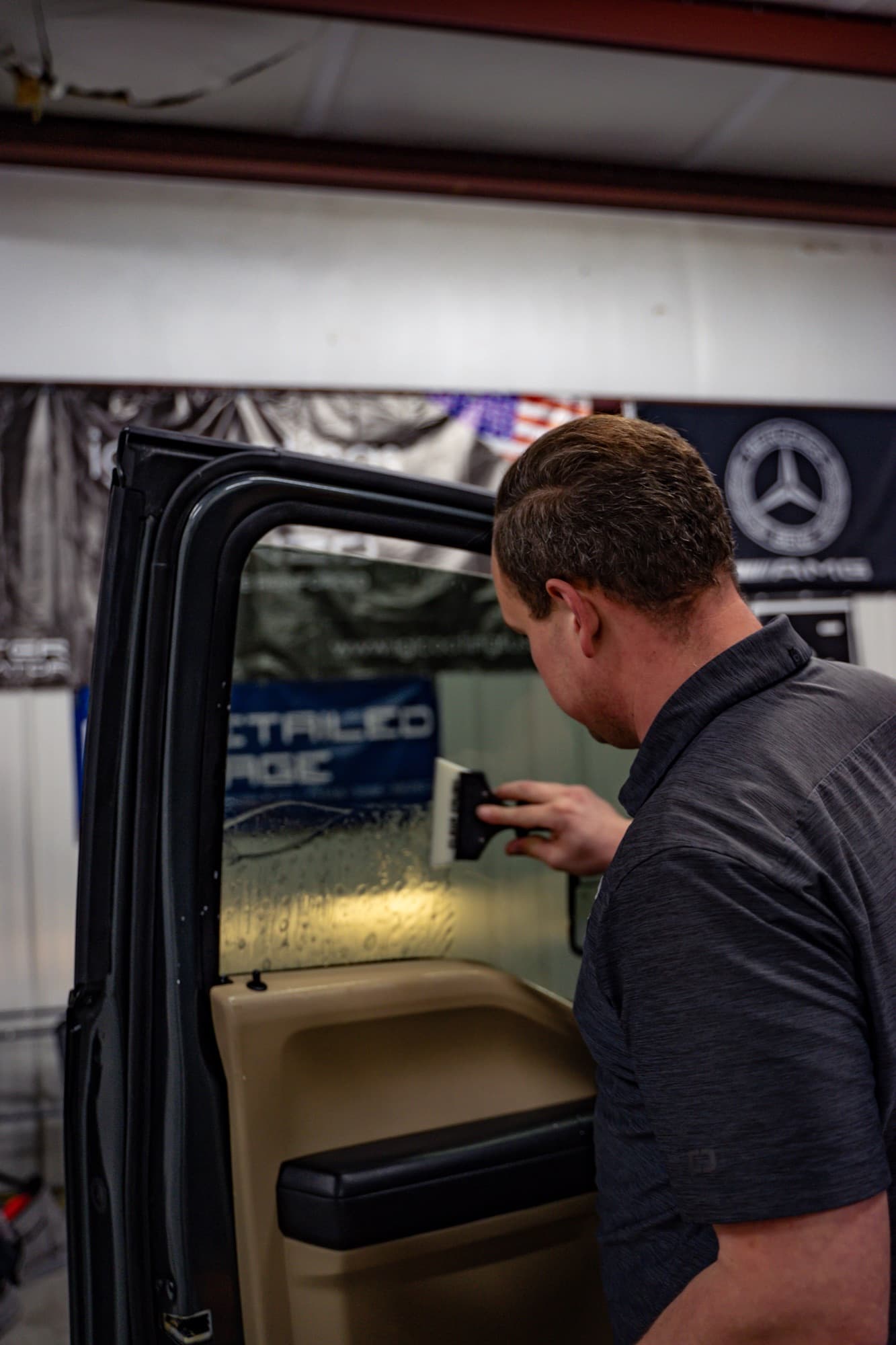
The International Window Film Association lays out the professional process. The glass is cleaned thoroughly to remove dirt and debris. The film is measured and cut to each window. A soapy solution goes on the glass so the film can be positioned without sticking early. The film is laid on the inside of the window and aligned to the edges, a squeegee pushes out water and air, and heat may be applied so the film conforms to curved glass. Finally the edges are trimmed and the work is checked for defects.
None of that is secret, and every step is learnable. The difficulty is doing all of it in one go without contamination, without creasing the film, and without scratching it, on glass you are often reaching awkwardly inside a door to get to. Professionals do it every day, in a controlled space, with patterns made for the vehicle. A first-time installer is doing it once.
Kit types
Precut Kits vs a Roll of Film
- Precut kitEasiest DIY option
- Pieces are cut to your make and model, which removes the hardest measuring and trimming work. You still have to clean, position, squeegee and, on curved glass, shrink the film. Fit depends on the kit maker's pattern matching your exact glass.
- Roll of filmHardest DIY option
- You cut every piece yourself, usually by laying film on the outside of the glass to rough it out, then trimming. It takes practice to get straight top edges and even gaps without nicking seals or trim.
- Professional, computer cutWhat we do
- Patterns are cut by machine for the vehicle before the film touches the car, then installed and heat-formed by someone who does it daily. At The Auto Show, film is computer cut for the vehicle. How tint is installed, step by step
Trouble spots
Where Home Installs Usually Go Wrong
Dust and hair
Film adhesive is a dust magnet. A garage with a breeze, a dog nearby or a shirt that sheds fibers will put specks under the film. Once it is squeegeed down, contamination is trapped for good.
Back glass shrinking
Most rear windows curve in two directions, so a flat sheet will not lie down without being shrunk with a heat gun. Too little heat leaves fingers of lifted film; too much distorts or burns it. Many DIYers stop at the side windows for this reason.
Creases and fold marks
Window film is thin and creases easily while you handle it wet. A crease does not come out, so the piece is wasted.
Top edges and gaps
Roll-down windows need the film's top edge trimmed so it is close to the glass edge but not touching the seal. Off by a little and you get a light gap or an edge that catches and peels.
Rolling windows too soon
Film needs time to cure before windows go down. Impatience is the most common cause of a peeled bottom edge on a brand-new DIY job.
Blades near defroster lines
Trimming or scraping on the back glass can cut through the defroster grid. That is an expensive mistake on a cheap project.
The law
South Carolina's Rules Apply to You Too
This is the part most kit buyers miss. S.C. Code Ann. § 56-5-5015 says each vehicle with an after-factory sunscreening device, whether installed by a consumer or professional window tinter, must at all times bear a certificate of compliance. The certificate goes on the inside, lower right corner of each tinted window and must show the light transmission, the installer's name, address and phone number, and the date of installation.
The statute also puts duties on the film makers: sunscreening products offered for sale or use in South Carolina must include installation instructions, and the manufacturer must provide the certificate of compliance and instructions for attaching it. And it says no person may install film on a vehicle titled for public roads without affixing that certificate.
The penalties are written out. A consumer who violates the certificate or installation rules is guilty of a misdemeanor triable in magistrate's court and must be fined not less than two hundred dollars or imprisoned not more than thirty days for each offense. Separately, anyone who owns or operates a vehicle in violation of the section faces a misdemeanor with a fine of up to two hundred dollars or up to thirty days.
Plain-language summary of the statute, not legal advice. If your situation is unusual, check with SCDPS or a lawyer.
Shade math
The Shade Problem DIYers Can't See
Kits are sold by the film's own shade, such as 35% or 20%. South Carolina measures something different: the combined light transmission of the film and the factory glass, which must not be less than 27 percent on the side and rear windows of sedans, coupes and pickups. Factory glass already blocks some light, so a film that sounds legal on the box can measure darker than 27% once it is on your glass.
Shops check this before installing because factory glass varies, and privacy glass already reduces light. At home you are guessing. Windows behind the driver on multipurpose passenger vehicles, which covers most SUVs and many vans, are exempt from the light transmission limit, but the front side windows are not, and the film everywhere must still be nonreflective and not red, yellow or amber.
Honest take
When DIY Makes Sense and When It Doesn't
- Reasonable: an older work truck or second car, flat side glass, a patient installer who accepts a few specks.
- Reasonable: practicing on a single small window before committing to the whole car.
- Risky: curved back glass, frameless windows or small quarter windows with tight edges.
- Risky: a car you care about the look of, where every flaw will bug you for years.
- Risky: a shade near the legal limit, because you cannot measure the combined transmission at home.
- Skip it: if you do not have a clean, still indoor space and an afternoon without interruptions.
Our side
What a Professional Job Includes Here
At The Auto Show the professional route starts at $125.99 for LLumar Carbon or $199.99 for LLumar Ceramic on the two front side windows, with full-vehicle coverage by quote. The film is computer cut for your vehicle, we check the legal shade for your vehicle before installing, and each tinted window gets the South Carolina certificate of compliance sticker.
Two limits worth knowing before you book. We do not tint vehicles more than 8 years old, because door seals and trim become brittle and are likely to break during installation. And we do not advertise removal of old film, so if a DIY attempt has gone wrong, ask us before booking so we can tell you what is possible.
| Factor | DIY kit | Professional |
|---|---|---|
| Cut | Precut pattern or hand cut from a roll | Computer cut for the vehicle |
| Back glass | Hardest step; often skipped | Heat-formed to the curve |
| Contamination control | Home garage | Controlled shop space |
| Legal shade check | Guesswork | Checked with factory glass |
| Compliance sticker | Your responsibility | Applied to each window |
| Manufacturer warranty | Depends on the kit | Brand named on the invoice |
| If it goes wrong | Remove and redo yourself | Ask the installer |
Rather Skip the Specks and Creases?
We'll check what's legal on your vehicle, computer cut LLumar film to fit, and put the compliance sticker on every window. Book online or request a full-car quote.
Common questions
Is it hard to tint your own car windows?
Flat side windows are manageable for a careful beginner; curved rear glass is genuinely hard because the film must be heat-shrunk to fit. The biggest challenge is keeping dust off the adhesive and glass. Expect your first windows to have some flaws, and expect to waste a piece or two of film learning.
Do I need a sticker if I tint my own windows in South Carolina?
Yes. The statute requires a certificate of compliance on each tinted window whether the film was installed by a consumer or a professional, showing the light transmission, the installer's name, address and phone number, and the installation date. It also says the film manufacturer must supply the certificate for products sold in the state.
What is the fine for DIY tint without a certificate in SC?
The statute says a consumer who violates the certificate or installation rules is guilty of a misdemeanor and must be fined not less than two hundred dollars or imprisoned not more than thirty days for each offense. That is separate from the owner and operator violation for tint that does not meet the section. This is not legal advice.
Can a shop fix a bad DIY tint job?
Usually the failed film has to come off completely, including its adhesive, before new film goes on, and that is slow work, especially over rear defroster lines. Whether it is practical depends on the car and the film. We don't advertise tint removal, so ask us before booking and we'll tell you what's possible.
Sources
- S.C. Code Ann. § 56-5-5015, South Carolina Legislature (https://www.scstatehouse.gov/code/t56c005.php), accessed October 2026
- Automotive Installation Process, International Window Film Association (https://iwfa.com/automotive-installation-process/), accessed October 2026
- Automotive Window Film, International Window Film Association (https://iwfa.com/automotive/), accessed October 2026
- Automotive Window Tint Frequently Asked Questions, LLumar (https://llumar.com/en/resources/automotive-window-tint-frequently-asked-questions/), accessed October 2026
Prices on this page are The Auto Show’s published starting prices. Film ratings and warranty terms come from the manufacturer. This guide explains South Carolina law in plain words; it is not legal advice.