
Window Tint Guide: Understand
How Window Tint Is Installed, Step by Step
A good tint job looks like nothing happened to the glass except that it got darker: no bubbles, no dust specks, no ragged edges, no light leaking around the top. Getting there takes a sequence of steps that have to be done in the right order, and most visible flaws trace back to one of them being rushed.
This guide walks through a professional installation from start to finish, including the steps you never see, such as shaping film on the outside of the back glass, and the ones the law requires, such as the certificate of compliance.
The short answer
A professional installer confirms the legal shade, cleans the glass inside and out, cuts the film to the window (usually with a computer plotter), heat-shrinks film on the outside of curved glass such as the back window, then sprays a slip solution on the clean inside surface, lays the film on, and squeegees out the water. Edges are finished, the film is left to dry, and South Carolina requires a compliance sticker on each tinted window.
Key points
- Tint goes on the inside of the glass, but curved windows are shaped on the outside first with a heat gun.
- Most professional film is now cut by computer from vehicle patterns rather than with a blade on the car.
- A soapy slip solution lets the installer float the film into position before squeegeeing the water out.
- Some moisture always stays under the film at first; haze and small water pockets during drying are normal.
- In South Carolina, every tinted window must get a certificate of compliance in the lower right corner.
Before the film
Step Zero: Inspection and the Legal Shade
The job starts before any film comes off the roll. The installer looks at the glass for chips, cracks and existing film, checks the condition of door seals and trim that will be pushed back during the install, and notes the rear defroster lines and any antenna in the glass.
Then comes the legal question. South Carolina sets a 27% minimum for the combined light transmission of film plus factory glass on side and rear windows, with an exception behind the driver on multipurpose passenger vehicles. Because factory glass already blocks some light, a careful installer meters the glass and picks a film that keeps the result legal, rather than going by the shade name alone.
The install
The Installation, Step by Step
Clean the outside of the glass
The outside is cleaned first because it becomes the work surface for cutting checks and for shaping film on curved windows. Any grit trapped under film on the outside can transfer to the adhesive side.
Cut the film to the window
Film is cut to each window's shape. Most professionals now use a computer plotter that cuts from a digital pattern for the exact vehicle; hand cutting is still used for unusual vehicles. The film is cut slightly oversize where it will be trimmed or tucked.
Shape film for curved glass
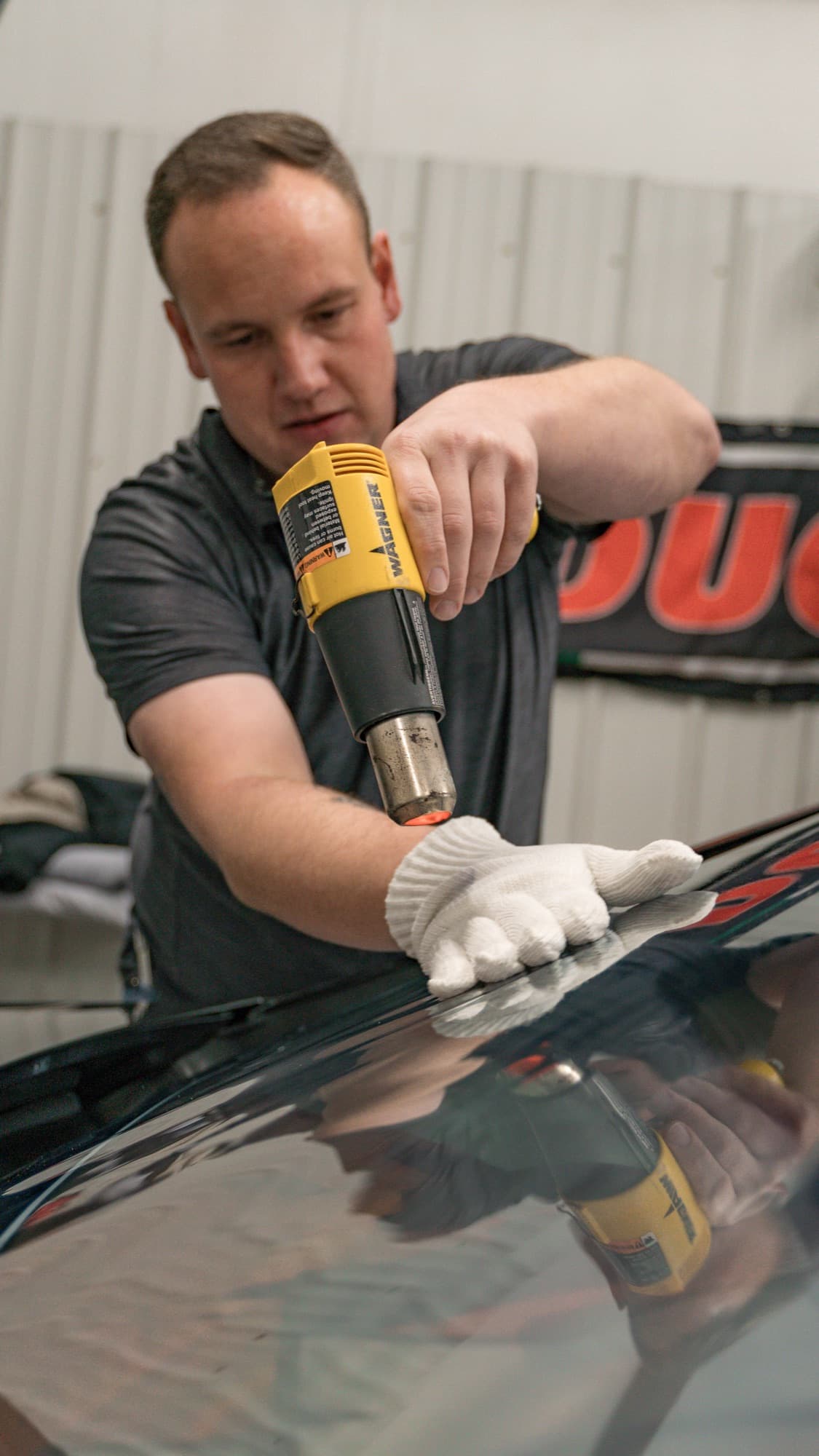
Flat film will not lie smoothly on glass that curves in two directions, such as most back windows. The installer lays the film on the outside of the glass and uses a heat gun to shrink it until it matches the curve, then trims it.
Deep-clean the inside surface
The inside of the glass is scrubbed and scraped to remove film-grade contamination: dust, oils and fine grit. On the back glass this is done with care around the defroster lines, which are bonded to the inside surface.
Spray slip solution
A soapy water solution goes on the glass and on the adhesive side of the film once the liner is peeled off. It keeps the adhesive from grabbing so the film can be floated into position.
Position and squeegee
The film is laid on the inside of the glass, aligned to the edges, and squeegeed from the center outward to push out water and air. On roll-down windows the bottom edge is tucked below the door seal.
Finish the edges
Edges are checked, and on side windows the top edge is left with a hairline gap so the film is not lifted when the window runs up into its channel.
Inspect and apply the sticker
The installer checks the film in good light, wipes down the door panels and glass, and applies the South Carolina certificate of compliance to each tinted window.
Cutting
Computer Cut vs Hand Cut
Window film once was always cut by hand, often with a blade on the car's own glass. Today most professionals plot it. In a 2022 Window Film magazine report, Eastman Performance Films said about 75% of its dealers use plotters and cutting software, while about 25% still hand-cut. Eastman staff added that hand cutting remains valuable for unique vehicles, but a pattern is generally much faster.
The practical difference for you is risk. Cutting directly on the vehicle means a blade working on your glass and near your door seals and paint, where the smallest slip is costly. A plotted pattern arrives at the car already shaped, and the remaining trimming is minimal.
Back glass
Why the Back Window Takes the Longest
Rear windows curve in two directions, which is why they are shaped on the outside first. Hyundai Motor Group, explaining why it engineered heat-rejecting factory glass, describes the process plainly: on curved windshields and rear glass, film must be placed on the outer surface and contracted with strong heat, then thermoformed to match the curve. It also notes that film does not always shrink evenly, which can leave a slight flicker when you look through it.
That is the skill in a back window: shrinking the film evenly so it lies flat without creases or distortion. The back glass also has defroster lines and, on many cars, a black dotted border called the dot matrix (or frit). Film does not sit perfectly flat over those raised dots, so a light band at the edge of a back window is common and is not a sign of a bad install.
Drying
What Happens After the Car Leaves
The installation uses water, and not all of it can be squeegeed out. The International Window Film Association's automotive inspection guideline explains that installation uses a surfactant or slip agent solution in water to float the film onto the glass, and that some residual water inevitably remains. It says on automotive films the so-called adhesive cure time is really the drying time of that moisture.
During drying you may see haze or small water pockets. The IWFA guideline says water distortion and water haze during clearing and drying are not to be regarded as defects. Weather and where the car is parked change how long it takes, which is why the installer asks you to keep the windows up for a while.
Quality
What a Good Installation Looks Like
- Viewed in daylight from inside, and from about three feet outside, dust, hair, bubbles and scratches are unobtrusive. That is the viewing standard the IWFA guideline uses.
- The top edge of roll-down windows has a gap no wider than about 1 to 2 mm (1/32 to 1/16 inch), per the IWFA guideline, or none if the edge was shaved.
- No edges lifting, no creases, no nicks or tears at the corners.
- Back glass film is smooth, without fingers or waves where it was shrunk.
- Door panels, speakers and the rear deck are dry and clean, and each tinted window has a compliance sticker in the lower right corner.
The law
The Certificate of Compliance Is Part of the Job
South Carolina's tint statute requires every vehicle with after-factory film to bear a certificate of compliance on the inside lower right corner of each tinted window. It must state the light transmission allowed by the film, the installer's name, address and telephone number, and the date of installation.
The rule applies to consumers and professionals alike. A professional window tinter who installs film without permanently affixing the certificate faces a misdemeanor with a fine of not less than $1,000 or up to 30 days in jail, or both, for each offense; a consumer faces a fine of not less than $200 or up to 30 days. If your installer does not put a sticker on, ask why.
Penalties quoted from S.C. Code Ann. § 56-5-5015(G). This is not legal advice.
Computer-Cut Film, Legal Shade, Sticker on Every Window
The Auto Show computer cuts LLumar Carbon and LLumar Ceramic film for your vehicle, checks the legal shade before installing and applies the South Carolina compliance sticker. Book online or request a quote.
Common questions
Why do installers put tint on the outside of the window first?
Only to shape it. Curved glass, especially the back window, needs the film shrunk with a heat gun to match its curve, and that is done on the outside where the installer can work on the convex surface. Once shaped, the film is moved to the inside of the glass for the actual installation.
Do they remove the door panels to tint windows?
Usually not. On most cars the film is tucked down behind the window seal at the bottom of the glass, and the window is lowered and raised during the install to reach the whole surface. Some vehicles with tight seals or unusual trim may need more disassembly, which your installer will tell you about.
What is the soapy water used during tint installation?
It is a slip solution, usually water with a small amount of surfactant. It stops the adhesive from grabbing the glass immediately so the film can be positioned, and it is squeegeed out afterward. A little always remains between film and glass and dries out over the following days.
Can tint be installed in the rain or cold?
Professional installation happens indoors, so weather outside matters less during the install itself. Weather does affect drying afterward: the IWFA notes that cure times are extended or shortened by climatic conditions and vehicle storage, so cool, damp weather usually means waiting longer before rolling windows down.
Is a light band around the edge of the back window a defect?
Usually not. Many back windows have a black dotted border, called the dot matrix or frit, and film cannot sit perfectly flat on those raised dots. The result is often a lighter or silvery-looking band along that edge. It is a property of the glass rather than a sign that the film failed.
Keep reading
Sources
- Automotive Installation Process, International Window Film Association (https://iwfa.com/automotive-installation-process/), accessed October 2026
- Automotive Visual Inspection Guideline for Applied Window Film (January 1, 2020), International Window Film Association (https://iwfa.com/wp-content/uploads/2024/04/Automotive-Visual-Inspection-Guideline-For-Applied-Window-Film.pdf), accessed October 2026
- Success by Software, Window Film magazine, September/October 2022 (https://wf.mydigitalpublication.com/articles/success-by-software), accessed October 2026
- Genesis Solar Glass, a functional glass with high transparency, Hyundai Motor Group Newsroom (https://www.hyundaimotorgroup.com/en/story/CONT0000000000002020), accessed October 2026
- Defroster, 2026 Kia owner's manual, Kia America (https://ownersmanual.kia.com/full_webhelp/MQ4A/2026/en_US/topics/t00335.html), accessed October 2026
- S.C. Code Ann. § 56-5-5015, South Carolina Legislature (https://www.scstatehouse.gov/code/t56c005.php), accessed October 2026
Prices on this page are The Auto Show’s published starting prices. Film ratings and warranty terms come from the manufacturer. This guide explains South Carolina law in plain words; it is not legal advice.