
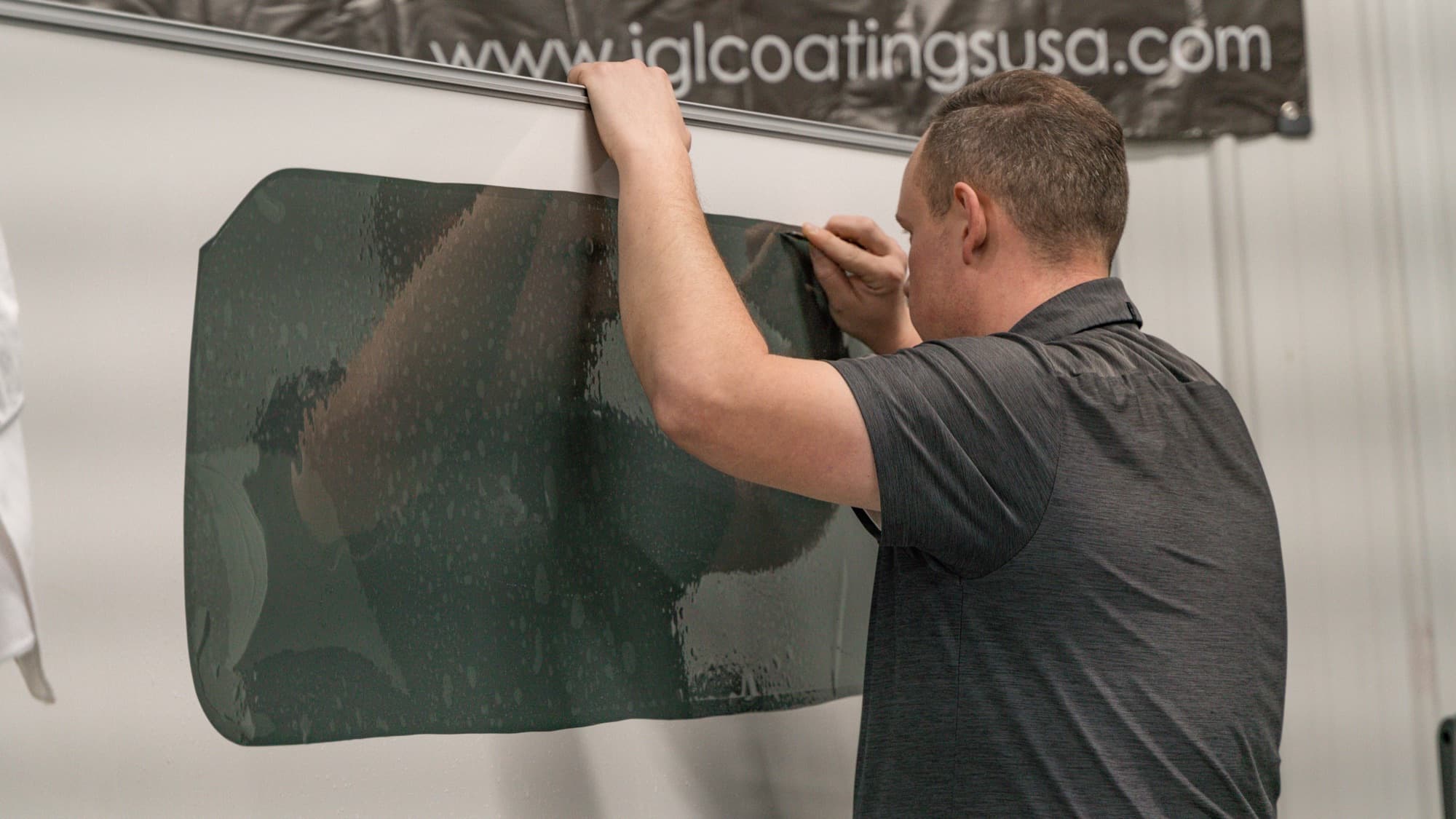
Window Tint Guide: Understand
Light Gaps and Edges on Window Tint
Look closely at almost any tinted side window with the glass rolled up and you will find a thin sliver of untinted glass along the top edge. On the back glass, you may see a band where the film looks lighter, silvery or slightly lifted over the black dots around the border. Owners often wonder whether these are mistakes.
Some of them are deliberate and some are not. This guide explains why edges are cut the way they are, what the industry guideline allows, and how to tell careful work from sloppy work.
The short answer
A small gap at the top edge of a roll-down side window is normal and intentional. The International Window Film Association guideline allows a top edge gap of about 1/32 to 1/16 inch (1 to 2 mm) so the film does not catch on the window seal as the glass moves up and down. Wide or uneven gaps, ragged cuts, and edges that lift are signs of poor work.
Key points
- A 1 to 2 mm gap at the top of a moving side window keeps the seal from peeling the film edge.
- Some installers file or shave the top edge so the film runs almost to the glass edge with no visible gap.
- The black dot band (frit) on many back and quarter windows has a raised texture that film cannot fully grip, so a lighter or silvery band there is common.
- Good edges are straight, even and consistent from window to window, with no fingers of film running into the seal.
- Gaps along the sides and bottom of door glass are hidden by the seals and do not count against the job.
The top edge
Why there is a sliver of light at the top of the window
Car door glass slides up into a rubber channel, sometimes called the run channel or seal. If the film went all the way to the very top edge of the glass, the seal would rub against the film edge every time you lowered and raised the window. Over months, that friction lifts the corner, starts a peel, and lets dirt get under the film.
To prevent that, installers stop the film just short of the edge. The International Window Film Association (IWFA) automotive inspection guideline states that the top edge may have a maximum edge gap of 1/32 to 1/16 inch (1 to 2 mm), which ensures film edges are not lifted by contact with the frame gasket when a window is raised and lowered.
When the window is closed, you see that tiny untinted strip as a bright line, especially against a dark film and a bright sky. It is a design choice that protects the film, not a cutting error.
No-gap edges
Filed or shaved edges
Some installers aim for an edge with no visible light line. The IWFA guideline mentions this directly: in certain installations where top edge shaving has been performed, there may appear to be no gap at all. The method varies by shop, but the idea is to bring the film right up to a carefully prepared edge so the seal still rides on glass and the film edge is protected.
Not every window suits this approach, and a no-gap edge is a style preference rather than a requirement. Either a clean, even 1 to 2 mm gap or a careful shaved edge is acceptable work. What matters is that the edge is straight, sealed down and consistent.
Dot matrix
The black dots on back glass and why film looks different there
Many rear windows, quarter windows and windshields have a black border that fades into a pattern of dots. That border is a ceramic enamel, usually called the frit, that is screen printed onto the glass and baked on. A Hackaday explainer on windshield frit describes how the inner part of the band gives urethane adhesive a surface to bond to, while the band blocks UV from reaching that adhesive and hides it from view. The dots spread the temperature change from solid black to clear glass so the glass does not distort as it heats.
The enamel dots stand slightly proud of the glass, so the surface is bumpy instead of smooth. Window film adhesive needs a smooth surface to sit flat. Over the dots, the film bridges from bump to bump and traps tiny pockets of air, which shows up as a lighter, slightly silvery or hazy band around the edge. This is common on many vehicles and is a limitation of the glass, not necessarily a bad install.
Installers handle the dot band in different ways depending on the car and the width of the dots: some lay the film over the dots and work them as flat as possible, some cut the film to end at the solid black band, and some use techniques to help the film bond better in that area. Ask before the job how the shop plans to handle your back glass if the look matters to you.
Judging edges
What good tint edges look like
- The top edge line on each roll-down window is straight and parallel to the glass edge, not wavy.
- The gap is the same width across the whole top edge and similar from one door to the next.
- Corners are cleanly rounded or square to match the glass, with no small flaps or tags of film.
- The film edge is fully stuck down; you cannot see a raised lip or catch it with a fingernail.
- There are no knife marks or scratches in the glass along the cut line on the outside.
- On fixed windows, the film reaches into the seal or to the black border evenly, with no gaps on one side only.
- The back glass is one continuous piece where the glass allows, without obvious seams in the viewing area.
Warning signs
Edge problems that are not normal
- Wide or uneven top gap
- A gap that is several millimeters wide, or wider at one end than the other, usually means the film was cut short or slipped during installation. It lets in a noticeable line of sun and looks unfinished.
- Lifting or curling edge
- An edge that rises off the glass or rolls back on itself is not part of drying. It often follows lowering the window too early, a cut that touches the seal, or contamination at the edge. It tends to spread if ignored.
- Film running into the seal
- On moving glass, film that extends under the rubber channel at the top will be dragged by the seal. You might see it as a creased or frayed edge after a few weeks.
- Jagged or stepped cuts
- Visible steps, nicks or wavy lines suggest the film was hand trimmed in a hurry. A computer-cut pattern, like the shop uses, starts with a consistent shape for the exact window.
- Dirt line along the edge
- A row of specks right at the edge means debris was trapped as the film was sealed. The IWFA guideline treats dirt particles and edge lift as acceptable only when they are unobtrusive.
Other glass
Windshields, sunroofs and sliding rear windows
On the windshield, South Carolina law only allows a sunscreening device along the top, and it may not extend downward beyond the AS1 line marked on the glass. If the AS1 line is not visible, no sunscreening device may be applied to the windshield. A visor strip should follow that line cleanly.
Pickup trucks with a sliding rear window have a frame and vertical seams between panes. Each pane gets its own piece, and small gaps around the frame and latch are normal. Sunroofs and fixed glass panels are judged on whether the film reaches the edges evenly. Whatever the window, South Carolina requires a certificate of compliance on the inside lower right corner of each window with an after-factory sunscreen device, so do not be surprised to find a small sticker there.
How to check
Inspecting your edges after pickup
Look in daylight
The IWFA guideline says installed film should be viewed at right angles to the glass, from inside the vehicle and from 3 feet outside, in natural daylight. Bright shop lights and low sun can exaggerate edges.
Close every window
With the glass fully up, compare the top gap on each door. Small differences are normal; one window that looks clearly different is worth pointing out.
Leave the edges alone for now
Do not run a fingernail along new edges or try to press them down. Wet film moves easily. Note anything that concerns you and ask about it after the film has had time to dry.
Recheck after curing
Once the haze is gone and you are rolling windows normally, look again at the top edges. A good edge stays put. One that starts to lift should be shown to your installer early, before it spreads.
| What you see | Normal? | Why |
|---|---|---|
| Thin, even light line at top of a roll-down window | Yes | Planned 1 to 2 mm gap keeps the seal off the film edge |
| No visible top line at all | Yes, if sealed | Edge filed or shaved so film meets the glass edge |
| Lighter or silvery band over black dots | Common | Raised enamel dots keep film from sitting fully flat |
| Gap of several millimeters or uneven width | No | Cut short or slipped during install |
| Edge lifting or curling | No | Seal contact, early window use or contamination |
| Small gaps around a sliding rear window frame | Yes | Each pane is filmed separately around the hardware |
Want to see how edges are finished?
Ask us how we handle top edges and back glass on your vehicle before you book. Our film is computer cut for the vehicle, and we check the legal shade for your windows first.
Common questions
Can an installer go back and close the top gap?
Not on film that is already installed. The edge of cured film cannot be stretched, and adding a strip would leave a seam. Closing the gap would mean removing and replacing the film on that window. A clean, even gap of 1 to 2 mm is normal and protects the film, so most owners leave it.
Why does the dot band on my back glass look silver?
The ceramic dots are raised slightly above the glass. Film laid over them cannot press flat between the dots, so small air pockets reflect light and give that band a silvery or hazy look. It is common on many cars and is mainly cosmetic.
Do frameless door windows need a different edge?
Frameless doors drop the glass slightly when the door opens and the top edge seals against the body. The edge is exposed when the door is open, so a neat, sealed top edge matters even more. Ask your installer how they finish the edge on frameless glass.
Is a gap at the bottom of the door glass a problem?
No. The bottom of roll-down glass sits inside the door, and film is usually tucked down under the felt or rubber strip at the beltline. You should not see a light gap at the bottom when the window is closed. If you do, ask about it.
Sources
- Automotive Visual Inspection Guideline For Applied Window Film (January 1, 2020), International Window Film Association (https://iwfa.com/wp-content/uploads/2024/04/Automotive-Visual-Inspection-Guideline-For-Applied-Window-Film.pdf), accessed October 2026
- Tech In Plain Sight: Windshield Frit, Hackaday (https://hackaday.com/2024/01/18/tech-in-plain-sight-windshield-frit/), accessed October 2026
- S.C. Code Ann. § 56-5-5015, South Carolina Legislature (https://www.scstatehouse.gov/code/t56c005.php), accessed October 2026
Prices on this page are The Auto Show’s published starting prices. Film ratings and warranty terms come from the manufacturer. This guide explains South Carolina law in plain words; it is not legal advice.