
Window Tint Guide: Get Tinted
What Happens at a Window Tint Appointment
If you have never had a car tinted, the appointment can feel like a black box: you hand over the keys, and hours later the windows are dark. Knowing what happens in between helps you choose the right film, spot good work and avoid the most common mistake, which is rolling a window down too soon.
This guide follows a tint job at The Auto Show from booking to pickup. Where a step is specific to us, we say so. Where it is general industry practice, we describe how it usually works and confirm the details for your vehicle when you book.
The short answer
A tint appointment starts with a vehicle check and a legal shade check, so the film you choose keeps each window at or above South Carolina's 27% combined limit. The inside of the glass is cleaned, the computer-cut film is applied with a slip solution and squeegeed out, curved rear glass is heat-shrunk, and each tinted window gets a certificate of compliance sticker. You leave with care instructions.
Key points
- The appointment begins with a look at the vehicle and a legal shade check, accounting for any factory tint.
- At The Auto Show, film is computer cut for your vehicle rather than trimmed by hand on the glass.
- Film goes on the inside of the glass with a soapy slip solution, then the water is squeegeed out; curved rear glass is shaped with heat.
- Every tinted window gets South Carolina's certificate of compliance sticker in the lower right corner.
- Some haze or small water pockets right after install are normal while the film dries.
Before the day
Booking and choosing your film
Most of the decisions happen before you arrive. You choose between LLumar Carbon (from $125.99 for the two front side windows) and LLumar Ceramic (from $199.99 for the same pair), and decide whether you want just the fronts or the whole car, which we price by quote. A deposit confirms the appointment; the amount and the cancellation policy are shown when you book.
Two things can stop a job before it starts, so we raise them early. We do not tint vehicles more than 8 years old, because aging seals and trim can break. And if you are hoping for darker film under a medical exemption, bring the paperwork and ask us before you book.
Drop-off
Arriving and handing over the car
We work by appointment only and there is no waiting area, so arrange a ride for the time the car is with us. If an evening drop-off suits you better, call and we can arrange drop-off after 6 pm.
At drop-off, mention anything that matters to you: a window that has always been slow, an aftermarket dash camera wired near the glass, a toll transponder or parking pass on the windshield, or factory tint you are unsure about. It is easier to plan around those things before work starts.
Legal check
Checking the legal shade for your vehicle
South Carolina sets a 27% minimum for combined light transmission on the front side windows, the windows behind the driver and the rear-most window. Combined means the film and the glass together. Many cars already have some tint in the glass, and SUVs often have dark factory privacy glass in the back, so the same film reads differently on different vehicles.
We check the legal shade for your vehicle before installing. We also look at how the vehicle is classified: the law's rules for windows behind the driver do not apply to multipurpose passenger vehicles, such as most SUVs and minivans, but they do apply to pickups. If the shade you wanted would land below the limit on a regulated window, we tell you before any film goes on.
- Want the detail?
- Our guide to the legal tint check explains the math, factory glass and the vehicle-type rule step by step. How the legal check works
Plan B
If the legal check changes your plan
Sometimes the shade a customer pictured is not possible on a regulated window. That usually happens on cars whose front glass already carries noticeable factory tint, or when someone wants the fronts to match dark rear privacy glass on a vehicle where the rear windows are not exempt.
There are good options when that happens. A lighter shade of LLumar Ceramic can keep the cabin cooler than a darker carbon film, because its nano-ceramic particles reject infrared heat rather than relying on darkness alone. On an SUV or minivan, the front doors can be tinted to the legal limit while the exempt rear windows stay as they are or go darker. We talk through the choice with you before any film is applied, so nothing is installed that we would have to take off again.
The install
From clean glass to finished film
Protect the interior
Door panels and nearby surfaces are typically covered, because the install uses water and slip solution. We confirm how we handle this for your vehicle when you book.
Clean the glass
The inside of each window is cleaned thoroughly. The International Window Film Association notes that dirt, dust or debris can interfere with how the film adheres, so this step matters more than any other.
Cut the film
At The Auto Show, film is computer cut from your vehicle's window patterns. That gives consistent edges and reduces the need for blades near your glass and seals.
Shape curved glass
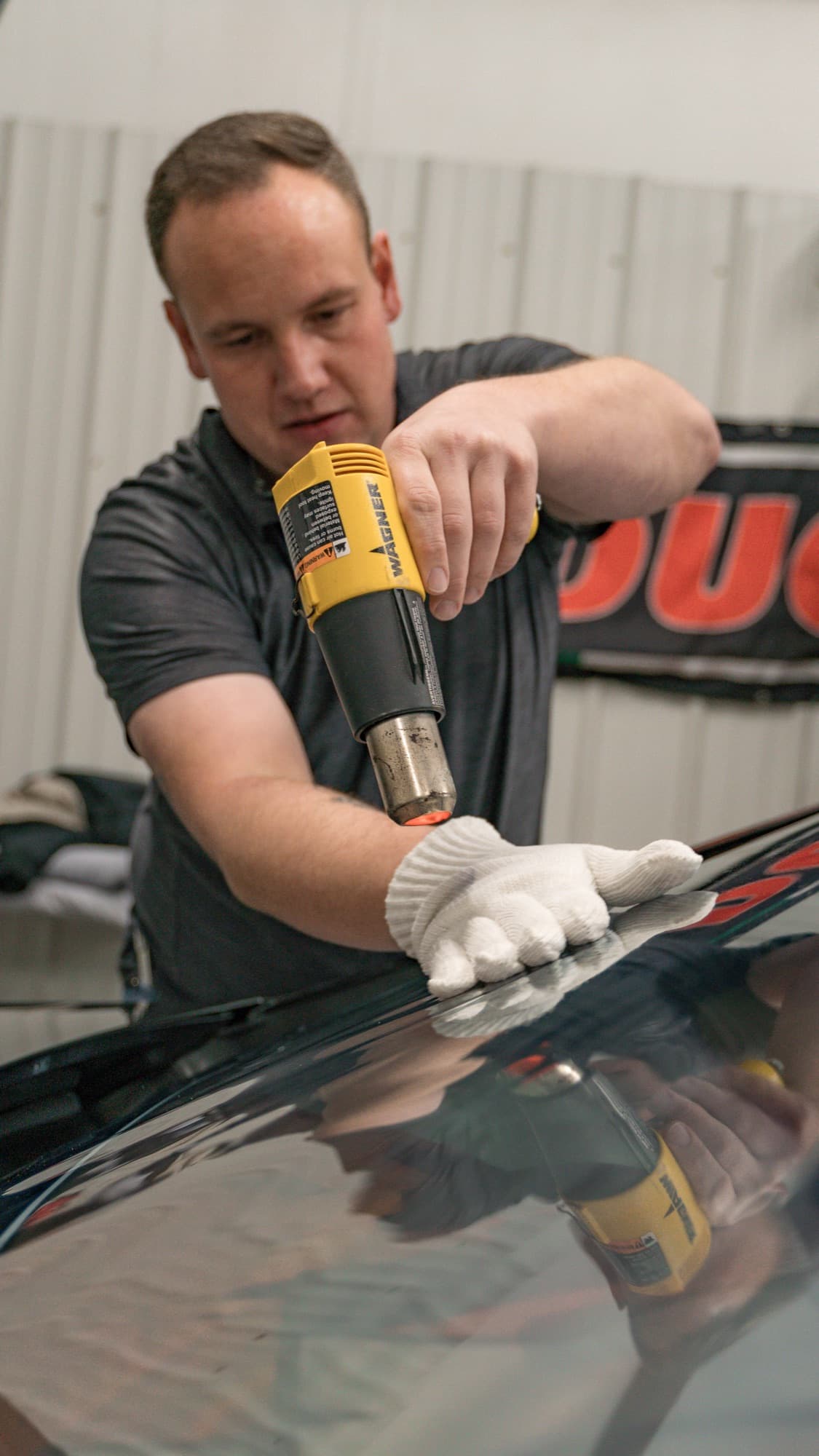
Rear windows are curved in two directions. Installers lay the film on the outside of the glass and use heat to shrink it to the curve before moving it inside.
Apply and squeegee
A soapy slip solution goes on the glass so the film can be positioned, then a squeegee pushes the water and air out from under it.
Edges and final check
Edges are finished and each window is checked for contamination, lifted corners or creases.
Sticker
The certificate of compliance
South Carolina requires every vehicle with after-factory tint to carry a certificate of compliance on the inside, lower right corner of each tinted window. The sticker must show the percentage of light transmission allowed by the film, the installer's name, address and telephone number, and the date of installation.
We apply it to each tinted window as part of the job. Leave it in place. It is your evidence that the film was installed to the law, and the statute sets penalties for installers and consumers who install film without it.
Pickup
What to look at when you collect the car
- A compliance sticker in the lower right corner of every tinted window.
- Clean, even edges along the top of roll-down windows and around fixed glass.
- No creases, lifted corners or large trapped particles.
- Some haze, cloudiness or small water pockets: normal at this stage while moisture dries out from under the film.
- Defroster lines on the back glass visible through the film, as they should be.
- Ask what to avoid and for how long, especially rolling windows down and cleaning the inside of the glass.
After
The first days after the appointment
The adhesive needs time to cure as the remaining water evaporates. The International Window Film Association says drying time varies with temperature and humidity, so a sunny Upstate summer week and a damp January week are not the same. Keep the windows up and leave the inside of the glass alone until the cure period you were given has passed.
If a haze or bubble is still there well after that, or a corner starts lifting, call us rather than pressing on it. Most early issues are just moisture, and the ones that are not are easier to deal with when caught early.
Book your tint appointment
Pick LLumar Carbon or LLumar Ceramic for the front windows, or request a quote for the whole car. We check the legal shade before we start.
Common questions
Can I bring my car with a dirty interior?
A normal lived-in interior is fine, but clear the door pockets, the rear deck and anything near the windows being tinted. Dust and pet hair near the glass can end up under the film. If the interior needs real attention, consider booking a detail separately; the glass itself is cleaned as part of the tint job.
Why does my new tint look hazy or have little bubbles?
Right after installation a small amount of water remains between the film and the glass. It shows as haze, cloudiness or small pockets and clears as the film dries. Drying time depends on temperature and humidity. If spots remain well after the cure period, call your installer rather than pushing on them.
Do you remove the door panels to tint the windows?
Practices vary by vehicle and installer. Many side windows can be tinted with the panels in place, while some vehicles need trim moved for access. We confirm the details for your vehicle when you book. This is one reason we do not tint vehicles older than 8 years: aging trim and seals break more easily.
Will tint go over my rear defroster lines?
Yes. Film is applied over the defroster grid on the inside of the back glass and, properly installed, does not normally affect how it works. The lines stay visible through the film. Never scrape or use a blade on the inside of tinted rear glass afterward, since that can damage both the film and the grid.
Sources
- S.C. Code Ann. § 56-5-5015, South Carolina Legislature (https://www.scstatehouse.gov/code/t56c005.php), accessed October 2026
- Automotive Installation Process, International Window Film Association (https://iwfa.com/automotive-installation-process/), accessed October 2026
- Automotive Window Tint Frequently Asked Questions, LLumar (https://llumar.com/en/resources/automotive-window-tint-frequently-asked-questions/), accessed October 2026
- Care and Maintenance of Window Film, Solar Gard (https://www.solargard.com/?p=70816), accessed October 2026
- 49 CFR 571.3 Definitions (multipurpose passenger vehicle), Legal Information Institute, Cornell Law School (https://www.law.cornell.edu/cfr/text/49/571.3), accessed October 2026
Prices on this page are The Auto Show’s published starting prices. Film ratings and warranty terms come from the manufacturer. This guide explains South Carolina law in plain words; it is not legal advice.