
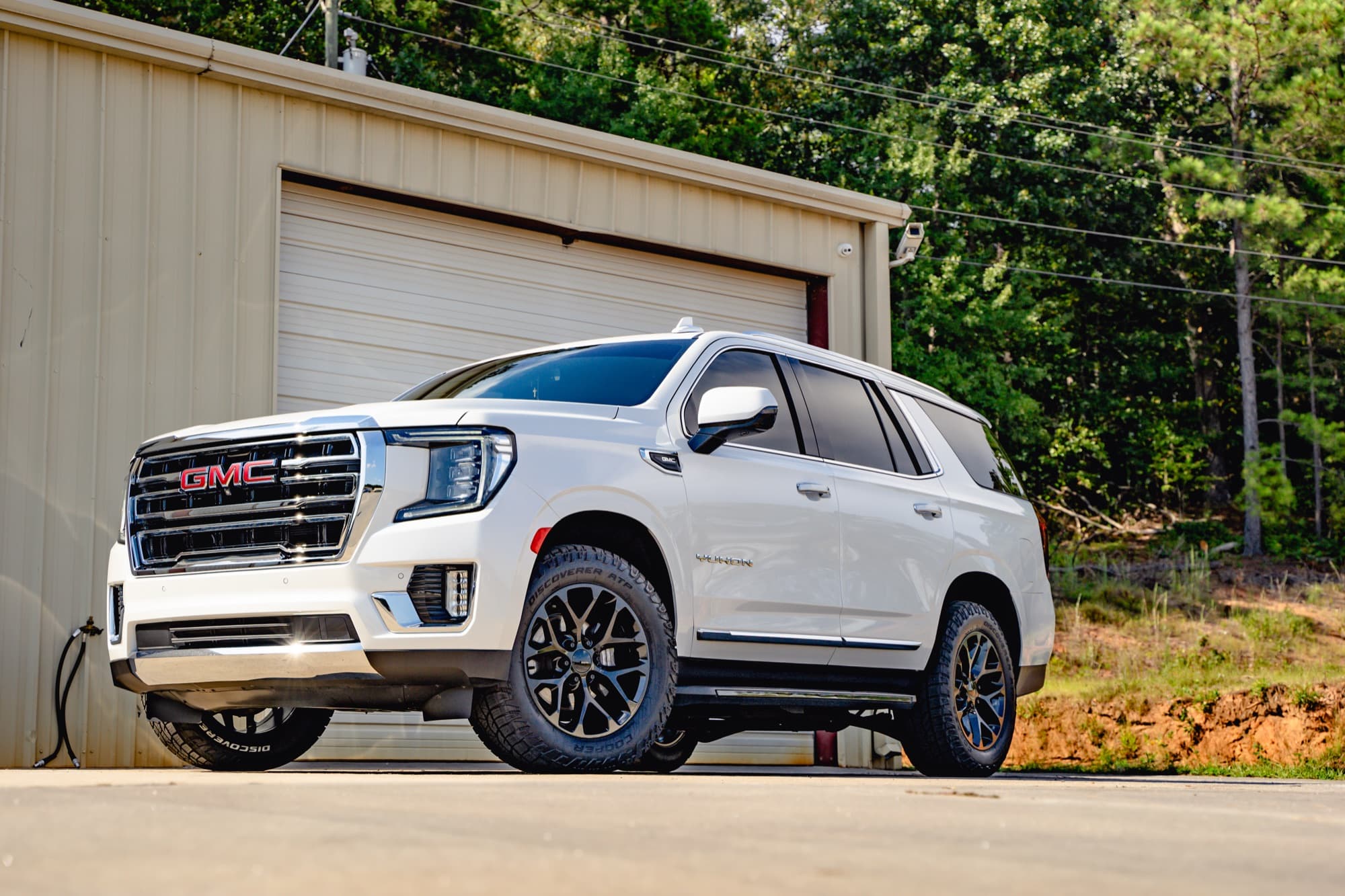
Window Tint Guide: Compare
Matching Front Tint to Factory Rear Privacy Glass
Park almost any new SUV, minivan or pickup in the sun and you will see it: dark glass from the rear doors back, and front door windows that look nearly clear by comparison. For a lot of owners, that two-tone look is the whole reason they want tint.
The fix sounds simple: tint the fronts to match. In South Carolina it usually isn't quite that simple, because the factory glass in the back may be darker than the law allows film to make your front windows. This guide explains why the mismatch exists, how close a legal match can get, and what to do about heat, which privacy glass handles less well than its looks suggest.
The short answer
You can tint the front side windows to look much closer to factory privacy glass, but in South Carolina the fronts must keep at least 27% combined light transmission with the glass, and factory rear glass can be darker than that. The usual result is a near match rather than an exact one. On vehicles classified as MPVs you may also film over the rear privacy glass for heat and UV without a darkness limit; pickups are held to 27% combined behind the driver.
Key points
- Factory privacy glass is darkened in the glass itself, so it is not covered by South Carolina's light-transmission limits until film is added.
- Federal glazing rules require front side glass to pass at least 70% of light, which is why the fronts look clear and why they are the windows people want to match.
- Front side windows on every vehicle must stay at 27% combined or lighter, so an exact match to very dark rear glass may not be legal.
- Privacy glass mostly reduces visible light; LLumar itself notes that factory privacy glass lacks good heat control.
- On MPVs, film over the rear privacy glass has no darkness limit; on pickups, any film added behind the driver must keep 27% combined.
Why it happens
Why the Back Is Dark and the Front Is Not
The mismatch is built into federal glazing rules. Standard No. 205 adopts the ANSI/SAE Z26.1 glazing code, and NHTSA has summarized its light-transmission requirements this way: on trucks and buses, the windshield and the windows immediately to the right and left of the driver must transmit at least 70% of light, while on passenger cars all windows must. Federal rules also say MPV glazing follows the requirements for trucks.
So on an SUV, minivan or pickup, the automaker can use darker glass from the B-pillar back but must keep the windshield and front doors at 70% or clearer. On an ordinary sedan, every window has to meet the 70% figure from the factory, which is why sedans do not come with dark rear glass. The two-tone look on your SUV is the automaker using exactly the freedom the rules give it.
The law
Where South Carolina Draws the Line on the Fronts
South Carolina's statute starts by saying its light-transmission provisions do not apply if no after-factory film has been added. Your factory privacy glass is fine as delivered, however dark it is. The moment you add film to a window, that window's combined transmission (film plus glass) has to meet the rule for that position.
For the front side windows of every vehicle, the rule is a single nonreflective film with combined light transmission of not less than 27%. There is no exception for SUVs, vans or trucks at the front. If your rear privacy glass meters darker than 27%, the front windows cannot legally be made to match it with film. The best you can do is the darkest film that keeps the fronts at 27% or above, which often looks close, especially from a few steps away.
The math
How Dark the Fronts Can Actually Go
Film darkness multiplies with the glass. If your front door glass measures 80% on its own, every film choice lands lower than its label. The table below shows the arithmetic for that example glass. Your car's glass will be a little different, which is why it gets measured before a film is chosen.
Notice how quickly the margin disappears. A 35% film on 80% glass reads 28%, just over the line. The next common shade down drops below it. That is why a careful installer measures the glass first instead of assuming a film number is legal.
Look
Getting a Match That Looks Right
An exact numeric match is rarely the goal anyway. Privacy glass is pigmented in the glass, while carbon and ceramic film get their charcoal tone from the film, so the color and depth can read slightly differently even at similar darkness. What most people actually want is for the side profile to look even, not two-tone.
Look at the car in daylight
Stand back about ten feet in normal daylight. That is how other people see your car, and it is the view a front film choice should be judged from.
Measure both sets of glass
A meter reading of the rear privacy glass and the bare front glass shows the gap. It also tells you the lightest front film that will still look like part of the same car.
Pick the front film within 27%
Choose the darkest film that keeps the front reading comfortably above 27% combined. On many SUVs and trucks that closes much of the visible gap.
Think about night driving
Your side mirrors are viewed through the front windows. If you drive back roads at night or your eyes are not what they were, a slightly lighter front film may be the better trade.
Heat and UV
What Privacy Glass Does Not Do
Privacy glass is designed to block visible light, which gives privacy and cuts glare in the back seat. That is not the same as blocking heat. LLumar, whose clear ceramic film is marketed for use over privacy glass, describes factory privacy glass as offering style and privacy but lacking good heat control. On a long Upstate summer afternoon, the third row of a dark-glassed SUV can still get very warm.
UV is uneven too. A 2016 study in JAMA Ophthalmology measured 29 cars and found windshields blocked an average of 96% of UVA, while driver's side windows averaged 71%, ranging from 44% to 96%. Front side glass, the clear part of your two-tone car, is where UV protection varies most. LLumar rates its films to block up to 99% of UV rays, which is a reason to tint the fronts even if the look is not your main concern.
Options
Three Ways to Handle the Rear Glass
- Leave the factory glass alonelowest cost
- Tint only the two front side windows to approach the rear look. This is the simplest job and evens out the two-tone profile on many vehicles. Front windows only vs full car
- Add film over the privacy glassMPVs, for heat and UV
- On a vehicle classified as an MPV, film behind the driver has no darkness limit in South Carolina, so you can darken further or simply add a heat-rejecting film. Each filmed window still needs a compliance sticker. SUV window tint
- Pickups: proceed carefully27% combined behind the driver
- South Carolina applies the 27% rule to windows behind the driver on pickups. If the factory rear glass already reads near or below 27%, adding any film may make those windows non-compliant. Pickup truck tint
At the shop
How We Approach a Privacy Glass Match
Factory privacy glass already reduces light, so we check the legal shade for your vehicle before installing anything: the vehicle type on the door-jamb label, the front glass, and whether film behind the driver is allowed and at what shade. Film is computer cut for your vehicle, and every tinted window gets the South Carolina certificate of compliance sticker.
For the fronts, LLumar Carbon from $125.99 gives a true charcoal look that does not turn purple. LLumar Ceramic from $199.99 adds nano-ceramic particles that reject more infrared heat, which matters when the law keeps the fronts lighter than the back. Both prices are for the two front side windows; adding the rear is by quote.
| Film label (VLT) | Combined reading | Front side windows in SC |
|---|---|---|
| 70% | 56% | Within the 27% minimum |
| 50% | 40% | Within the 27% minimum |
| 35% | 28% | Within the minimum, almost no margin |
| 30% | 24% | Below 27%: not allowed |
| 20% | 16% | Below 27%: not allowed |
| 5% | 4% | Below 27%: not allowed |
Combined = glass x film. Illustrative only: actual glass and film vary, so the window is measured. A medical exemption can change the answer.
Close the gap between front and back
Send us your vehicle and we will check the legal front shade against your factory glass before quoting. LLumar Carbon or Ceramic, computer cut, with the compliance sticker on every tinted window.
Common questions
Why doesn't my sedan have privacy glass like my SUV?
Federal glazing rules require all windows of a passenger car to transmit at least 70% of light, while trucks, buses and MPVs only need that on the windshield and front side windows. Automakers can put darker glass behind the driver on SUVs, vans and pickups, but not on cars. Any darkening on a sedan comes from aftermarket film.
What percentage is factory privacy glass?
It varies by make, model and even model year, and automakers rarely publish a figure for it. The only reliable way to know is to measure your own glass with a light meter. That reading matters if you plan to add film behind the driver on a pickup, where the combined result must stay at 27% or above.
Will tinted front windows match the rear exactly?
Usually not exactly. Privacy glass is pigmented glass, while film gets its tone from the film, and South Carolina limits the fronts to 27% combined. The darkest legal front film often makes the side profile look much more even from normal viewing distance, which is usually the real goal.
Is it worth putting film over privacy glass?
It can be, if the back seats get hot or you carry passengers often. Privacy glass mainly blocks visible light, and LLumar describes it as lacking good heat control. A ceramic film adds infrared rejection. On an MPV there is no darkness limit behind the driver; on a pickup, the combined reading must stay at 27% or more.
Sources
- S.C. Code Ann. § 56-5-5015, South Carolina Legislature (https://www.scstatehouse.gov/code/t56c005.php), accessed October 2026
- 49 CFR 571.205, Standard No. 205, Glazing materials, Legal Information Institute, Cornell Law School (https://www.law.cornell.edu/cfr/text/49/571.205), accessed October 2026
- Fleetwood Enterprises, Inc.; Action on Application for Decision of Inconsequential Noncompliance, 63 FR 10964, NHTSA via Federal Register (https://www.govinfo.gov/content/pkg/FR-1998-03-05/html/98-5743.htm), accessed October 2026
- Clear Performance Film, LLumar / Eastman Performance Films (https://llumar.com/en/tint/clear/), accessed October 2026
- Assessment of Levels of Ultraviolet A Light Protection in Automobile Windshields and Side Windows, JAMA Ophthalmology 2016;134(7):772-775, via PubMed (https://pubmed.ncbi.nlm.nih.gov/27258091/), accessed October 2026
- Automotive Window Tint Frequently Asked Questions, LLumar / Eastman Performance Films (https://llumar.com/en/resources/automotive-window-tint-frequently-asked-questions/), accessed October 2026
Prices on this page are The Auto Show’s published starting prices. Film ratings and warranty terms come from the manufacturer. This guide explains South Carolina law in plain words; it is not legal advice.