
Window Tint Guide: Understand
Factory Privacy Glass vs Window Tint
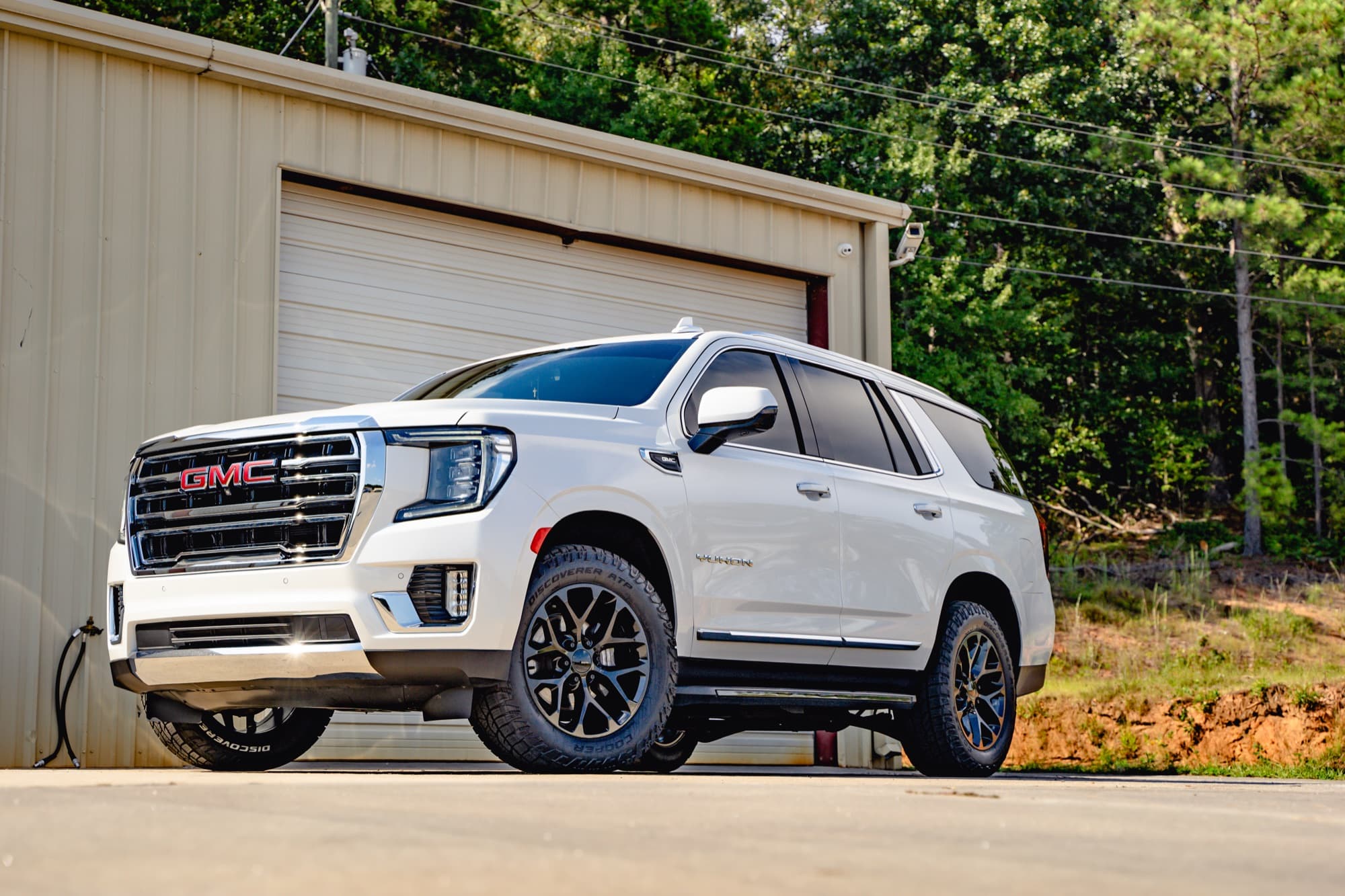
Walk around most SUVs, minivans and pickups and you will see it: clear glass on the front doors, dark glass from the second row back. Many owners assume the rear windows are already tinted. They are, in a sense, but not with film, and the difference matters for heat, for how the front windows will look next to them, and for the law.
This guide explains what factory privacy glass is, what it does well, where film does more, and what South Carolina says when you add film to a window that came dark from the factory.
The short answer
Factory privacy glass is darkened during manufacturing by changing the glass composition; window tint is a polyester film added to the inside of the glass afterward. Privacy glass mainly cuts visible light for privacy, and its heat and UV performance varies by vehicle. Film can add heat rejection and UV blocking on top of it. In South Carolina, film over privacy glass is judged by the combined darkness, except behind the driver on SUVs and vans.
Key points
- Privacy glass is dark because of what is in the glass, not a coating or film, so it cannot peel or fade.
- It is used behind the driver on SUVs, vans and pickups because federal rules let those windows be darker than the front.
- Privacy glass cuts light well, but heat and UV performance vary; film makers say it lacks good heat control on its own.
- South Carolina's light limit does not apply to factory glass with no film on it, but it does apply to the combined glass and film once film is added, except where the MPV rule exempts the window.
- On a pickup, adding any film to factory rear privacy glass almost always puts that window under 27%.
What it is
How Factory Privacy Glass Is Made
Privacy glass is not tinted glass in the film sense. AGC, one of the large automotive glass makers, explains that the dark tint is obtained by altering the chemical composition of the glass, which lowers its light transmission. The color runs through the glass itself, usually gray or green.
AGC lists its privacy glass at 4.5% to 40% light transmission, compared with more than 70% for the normal vision glass used where the driver needs to see. That range is wide. Two vehicles that both have privacy glass can have very different rear windows.
Because the darkness is in the glass, it does not bubble, peel or turn purple. It also cannot be removed or lightened. If you ever replace a privacy glass window, the replacement needs to match.
Why only the back
Why Privacy Glass Stops at the Front Doors
Federal glazing rules set the pattern. Standard 205, through the ANSI Z26.1 code it incorporates, requires the windshield and the windows to the immediate right and left of the driver on trucks to transmit at least 70% of light. Under 49 CFR 571.205, glazing for multipurpose passenger vehicles follows the truck requirements. That leaves the glass behind the driver free to be darker on SUVs, vans and pickups.
South Carolina's tint law mirrors the idea. Subsection (I) of S.C. Code § 56-5-5015 says the light transmittance requirement does not apply to windows behind the driver on trucks other than pickups, buses, trailers, mobile homes, multipurpose passenger vehicles and recreational vehicles, but it does apply behind the driver on pickup trucks.
Performance
What Privacy Glass Does for Heat and UV
This is where claims get muddled, so it helps to look at both sides. Glass makers present privacy glass as a comfort feature. AGC says its dark glass limits total energy transmission to 29% to 45% depending on tint and thickness, compared with 59% to 70% for normal glass, and limits UV transmission to as little as 0.2% to 7%.
Film makers see room to improve it. LLumar describes factory privacy glass as offering style and privacy but lacking good heat control, and markets a clear ceramic film to add heat rejection without changing the look. Both can be true: dark glass absorbs a lot of energy, absorbed energy heats the glass, and some of that heat still reaches the cabin. How much your particular rear glass rejects depends on the glass your vehicle maker chose.
Your front windows are the bigger gap. They are normal vision glass, and a 2016 JAMA Ophthalmology study of 29 cars found side windows blocked an average of 71% of UVA, with some as low as 44%. The driver's window is where film adds the most UV protection, whatever is on the rear.
Side by side
Privacy Glass and Window Film Compared
The table below sets out how the two differ. The figures for privacy glass are a glass maker's published ranges; individual vehicles vary.
The law
What Happens When You Tint Over Privacy Glass
- Factory glass with no filmNot regulated for light
- Subsection (A) says that if no after-factory sunscreen device has been added, the light transmittance rules do not apply. Factory privacy glass on its own is not a tint violation.
- Film over privacy glass on an SUV or vanUsually exempt behind the driver
- If the vehicle is a multipurpose passenger vehicle, the light limit does not apply to windows behind the driver. Film there must still be nonreflective, not red, yellow or amber, and carry a compliance sticker. The rear-window exception
- Film over privacy glass on a pickupCombined 27% applies
- Pickups are named in subsection (I): the limit applies behind the driver. If the factory rear glass already passes less than 27%, any film added to it puts the window under the limit. Pickup truck tint
- Front side windows on every vehicleCombined 27% applies
- The windows beside the driver are always held to 27% combined. This is where owners trying to match dark rear glass get into trouble. Matching fronts to privacy glass
This is not legal advice. Check your vehicle's classification on the door-jamb certification label, and ask SCDPS or a lawyer if your situation is unusual.
Looks
Why the Fronts Never Quite Match
Factory privacy glass often sits well below 27% (AGC's range runs from 4.5% to 40%), and getting the front windows that dark would require a combined reading far below South Carolina's 27%. So a legal front window will almost always look lighter than the factory rear glass. Color matters too: privacy glass comes in gray or green tints, while carbon and ceramic films are a neutral charcoal.
Most owners choose one of two looks. Some pick the darkest legal film for the fronts and accept a visible step. Others add a light or clear heat-rejecting film all around, which improves comfort without changing the appearance at all.
Decisions
Should You Film the Privacy Glass Too?
- If the rear seats get hot or kids complain about the sun, a heat-rejecting film over the privacy glass can help, and on an SUV or van the light limit does not apply behind the driver.
- If you only want the car to look uniform, start with the front windows, since that is where the visual difference and the UV gap are.
- If you drive a pickup, assume the rear privacy glass cannot take film legally unless a meter shows it is well above 27% on its own.
- If you are unsure what your vehicle is classified as, check the door-jamb label before deciding.
| Factory privacy glass | Window film | |
|---|---|---|
| How it is made | Color in the glass composition | Polyester film with adhesive, applied inside |
| Where it is used | Behind the driver on SUVs, vans, pickups | Any window the law allows |
| Light transmission | 4.5% to 40% (AGC range) | Chosen by shade, roughly 5% to 80%+ |
| Heat | Absorbs energy; varies by glass | Depends on film type; ceramic does most |
| UV | Varies; dark glass can block most UV | Quality films rated up to 99% |
| Can it fade or peel? | No | Depends on film quality and installation |
| SC light limit | Not regulated on its own | Combined with glass must be 27%+ where the limit applies |
Privacy glass figures are AGC's published ranges for its products (ISO 9050). Your vehicle's glass may differ.
Find the Right Front Shade for Your SUV or Truck
The Auto Show checks the legal shade for your vehicle before installing, since factory privacy glass already reduces light, and applies the South Carolina compliance sticker to every tinted window.
Common questions
Does factory privacy glass block UV?
Often a good deal, but it varies. One glass maker lists UV transmission as low as 0.2% to 7% for its dark glass, depending on tint and thickness. Your vehicle's privacy glass may be a different product. The front side windows, which are normal glass, are usually the bigger UV gap.
Can you put tint over factory privacy glass?
Yes, film can be applied over privacy glass like any other window. In South Carolina, behind the driver on SUVs, vans and other multipurpose passenger vehicles, the light limit does not apply. On pickups it does, and the combined glass plus film must stay at 27% or more, which privacy glass alone often fails.
Is factory tint legal in South Carolina?
Factory glass with no film added is not subject to the state's light transmittance rules, according to subsection (A) of the tint statute. Vehicle makers build to federal glazing standards, which allow darker glass behind the driver on SUVs, vans and trucks. The question only arises once film is added.
Why are my front windows lighter than the back?
Federal glazing rules require the windshield and front side windows to let through at least 70% of light, while glass behind the driver on SUVs, vans and trucks can be much darker. Even with the darkest legal film, a front window in South Carolina usually stays lighter than factory rear privacy glass.
Keep reading
Sources
- Privacy Glass, AGC Automotive (https://www.agc-automotive.com/products-and-solutions/privacy-glass), accessed October 2026
- Clear Window Film, LLumar / Eastman Performance Films (https://www.llumar.com/en/tint/clear/), accessed October 2026
- 49 CFR § 571.205, Glazing materials, Legal Information Institute, Cornell Law School (https://www.law.cornell.edu/cfr/text/49/571.205), accessed October 2026
- Fleetwood Enterprises, Inc.; Action on Application for Decision of Inconsequential Noncompliance (FMVSS No. 205 light transmittance), Federal Register Vol. 63 No. 43, NHTSA (https://www.govinfo.gov/content/pkg/FR-1998-03-05/html/98-5743.htm), accessed October 2026
- S.C. Code Ann. § 56-5-5015, South Carolina Legislature (https://www.scstatehouse.gov/code/t56c005.php), accessed October 2026
- Boxer Wachler BS. Assessment of Levels of Ultraviolet A Light Protection in Automobile Windshields and Side Windows, JAMA Ophthalmology 2016;134(7):772-775 (https://pubmed.ncbi.nlm.nih.gov/27258091/), accessed October 2026
- Window Film Fundamentals, Whole Building Design Guide, National Institute of Building Sciences (https://legacy.wbdg.org/resources/window-film-fundamentals), accessed October 2026
Prices on this page are The Auto Show’s published starting prices. Film ratings and warranty terms come from the manufacturer. This guide explains South Carolina law in plain words; it is not legal advice.