
Ceramic Coating & PPF Guide: Understand
Soft Paint vs Hard Paint: Why Some Cars Scratch Easier
Two cars get the same careful hand wash with the same mitt. One looks perfect afterward. The other has fine new marks in the sun. Detailers explain this with two words: soft paint and hard paint. They are talking about the clear coat, and the difference is real, even if it is often exaggerated online.
This guide explains what paint hardness means, what makes one clear coat behave differently from another, how it changes washing and polishing, and why a hard coating on top does not turn soft paint into hard paint.
The short answer
Soft and hard paint describe how a car's clear coat responds to abrasion. Soft clear coats mar easily from washing and towels but polish out quickly. Hard clear coats resist light marring but take more aggressive work to correct, and deep defects are harder to remove. Hardness depends on the clear coat chemistry, the factory or body shop process and age, not on the color, and it can vary between models from the same maker.
Key points
- Hardness is about the clear coat, the layer that takes the scratches, not the color coat underneath.
- Paint makers sell many different clear coats, from one-component to two-component and scratch-resistant ceramic types, and carmakers choose among them.
- Soft paint is easy to correct and easy to mar; hard paint is the reverse, so neither is simply better.
- A coating's 9H or 10H rating is a pencil-test number for the coating, not a measure of the paint under it, and it does not make soft paint hard.
Definitions
What Soft and Hard Mean to a Detailer
When a detailer calls paint soft, they mean the clear coat scratches, mars and hazes easily. A clean microfiber towel dragged with a little pressure can leave marks, and a finishing polish removes defects in a pass or two. When they call it hard, they mean the clear coat shrugs off light marring but fights back when you try to polish it: defects need stronger compounds, firmer pads and more passes.
These are working descriptions, not lab measurements. In practice, detailers judge hardness with a test spot: they polish a small area with a known pad and polish, check the result under a light, and adjust. That test spot is how you find out how a specific car behaves, regardless of what the internet says about the brand.
Why it varies
What Makes One Clear Coat Softer Than Another
- Clear coat chemistry
- Carmakers buy clear coats from paint suppliers, and those suppliers offer very different products. PPG's own list of OEM clearcoats includes one-component (1K) and two-component (2K) products with different stated strengths, from etch and chemical resistance to scratch and mar resistance.
- Scratch-resistant clears
- Some clears are engineered specifically to resist marring. PPG describes its CeramiClear as creating a hard, ceramic-like surface with resistance to car wash damage. Mercedes-Benz announced a clear coat with ceramic nanoparticles in 2003, claiming about three times the scratch resistance of conventional clear.
- Factory process and cure
- How a clear coat is applied, how thick it is and how it is baked all affect its final hardness. The same product can behave differently from plant to plant or model to model.
- Refinished panels
- Body shop clears are often softer or harder than the factory clear next to them, because they are different products cured under different conditions from a factory paint line. A repainted fender can mar differently from the original door beside it.
- Age and weathering
- Years of sun change how a clear coat responds. Oxidized clear can feel chalky and polish differently from fresh paint. Paint oxidation explained
Online lists that label whole brands as soft or hard are generalizations. Clear coats change over model years, so test the actual car.
Trade-offs
Soft Paint vs Hard Paint: Pros and Cons
Soft paint is a pleasure to correct and a frustration to live with. A light polish can make it look superb, but it picks up swirls from washing quickly and shows holograms easily if the final polish is not refined. It also finishes down well with fine polishes, so it can reach very high gloss.
Hard paint is the opposite. It keeps its looks longer under normal washing and resists light marring, but when it does get scratched, removing the marks takes more cut. Compounding hard clear also generates more heat and takes more time, which is why correction on hard paint can take longer for the same visible result.
Neither type is a reason to buy or avoid a car. What matters is matching your care routine and any correction to the paint you actually have.
Polishing
How Hardness Changes Paint Correction
Test spot first
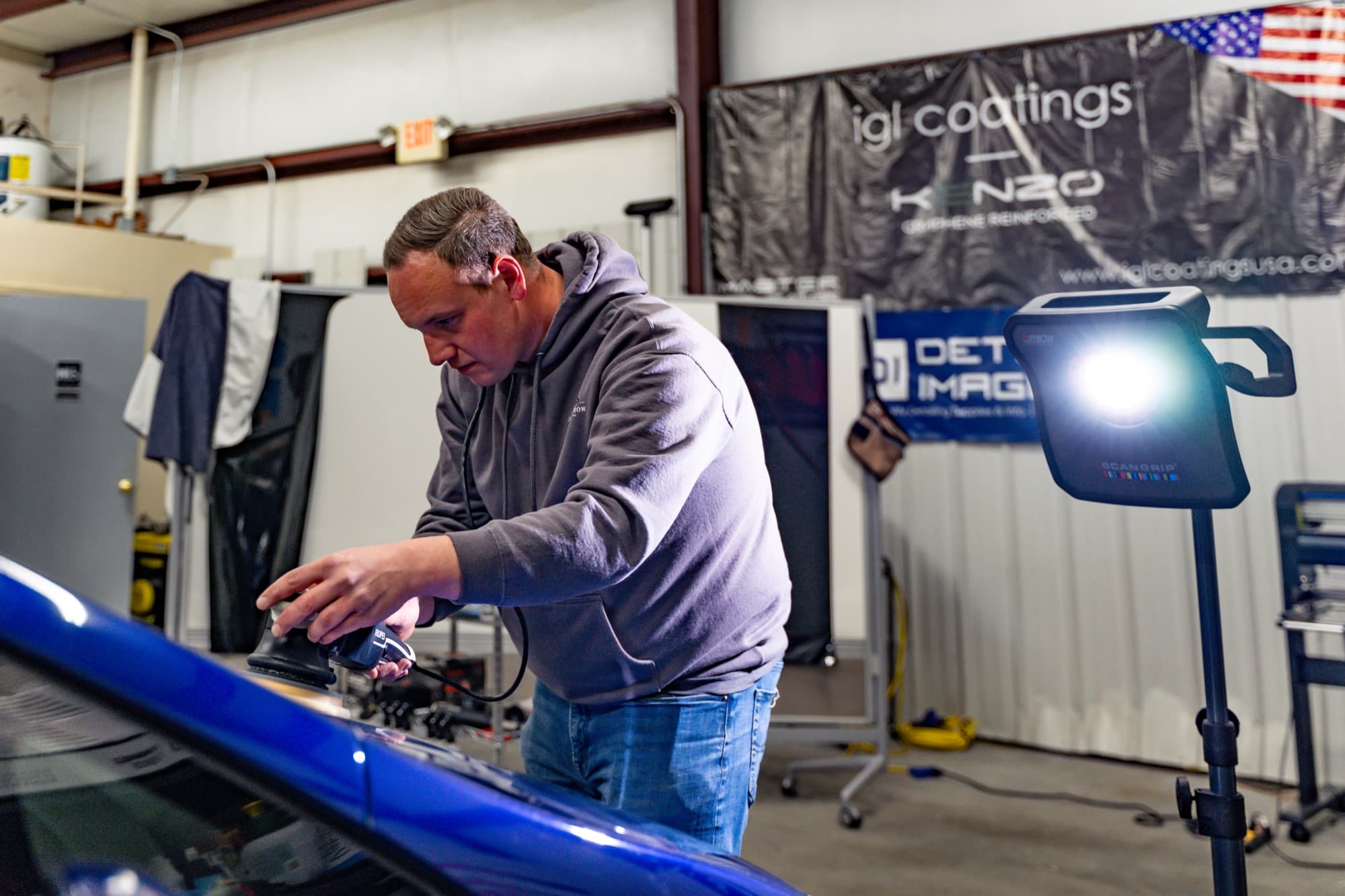
A good polisher starts on a small section with the least aggressive pad and polish likely to work, then steps up only if needed. This finds the right combination for that car instead of guessing.
Soft paint: finish carefully
Soft clears correct quickly but can haze or micro-mar from the cutting step. They usually need a dedicated refining step with a soft pad and fine polish to finish clear.
Hard paint: more cut, more time
Hard clears may need a firmer pad and a stronger compound to remove the same defect, then a refining step that may take more passes to remove the cutting haze.
Measure the clear coat
Either way, the clear coat is finite. A paint gauge maker puts typical factory clear at about 35 to 50 microns and suggests removing no more than about 8 microns. On hard paint, the temptation to keep cutting is greater, and so is the need for a gauge.
Check under the right light
Defects that look gone under shop lights can reappear in sun. Finishing is judged under a strong single-source light on both soft and hard paint.
Coatings
Does a 9H or 10H Coating Make Soft Paint Hard?
No. The H ratings come from the pencil hardness test. The standard for it, ASTM D3363, describes a quick method to rank the film hardness of a coating by pushing pencil leads of known hardness across it. ASTM notes it is useful for relative rankings of coatings with significant differences in hardness, and that caution is needed when comparing coatings of similar hardness. It says nothing about how far a coating can protect the paint underneath.
A ceramic coating is very thin compared with the clear coat. It makes the surface slicker and harder at the very top, so light wash marring is less likely and dirt releases with less rubbing. That genuinely helps soft paint. But a scratch with enough force goes through the coating and into the clear below, and the clear is still soft.
The practical result: a coating on soft paint reduces new wash swirls if you also wash gently, and it makes the car easier to keep clean. Paint protection film is the stronger option where impacts happen, because its thickness absorbs what a coating cannot.
- Coating hardness ratings
- What 8H, 9H and 10H mean and what they do not predict. Hardness ratings explained
At home
How to Tell Which Kind of Paint You Have
- Notice how quickly it swirls: if a gentle hand wash and towel dry leave visible marks, the clear is likely on the soft side.
- Watch how it responds to a finishing polish: if light marks disappear with a few passes of a fine polish, it is soft to medium; if they barely change, it is harder.
- Compare panels: a fender that marks differently from the door next to it may have been repainted.
- Ask your detailer what their test spot showed. It is the most reliable answer you will get.
- Do not rely on brand lists. Clear coats vary by model, plant, year and color.
Care
Care Tips for Soft Paint
If your car has soft paint, the goal is to touch it as little and as gently as possible. Rinse thoroughly before washing, use plenty of slick, pH-neutral shampoo with clean microfiber mitts, and use separate mitts for the lower panels. Dry with forced air first, then blot remaining water with a clean, plush towel.
Avoid friction car washes entirely; on soft paint, a few visits can undo a correction. Keep some protection on the paint, whether a sealant, a coating or film, because a slick surface reduces the friction that causes marring. And if you polish it yourself, start with the gentlest combination, since soft clear removes quickly.
| Trait | Soft clear coat | Hard clear coat |
|---|---|---|
| Light wash marring | Marks easily | Resists light marring |
| Holograms after polishing | Shows them easily | Less prone |
| Correction speed | Fast cut | Slower, needs more cut |
| Finishing | Needs careful refining | Haze from cutting can be stubborn |
| Best everyday care | Very gentle washing, protection | Gentle washing still matters |
Most cars fall somewhere in between. These traits describe tendencies, not fixed categories.
Not sure how your paint will respond?
We inspect your paint, show you what can and cannot be removed, and confirm the right level of correction before we start. Request a quote to get started.
Common questions
Is soft paint a sign of poor quality?
Not necessarily. Softer clear coats can have other strengths, such as good chemical resistance, gloss or flexibility, and they are easier to correct. Carmakers balance many properties when choosing a clear coat, including cost, appearance, environmental rules and how it performs in the paint shop. Soft simply means it needs gentler handling to stay swirl-free.
Does paint get harder as it ages?
Fresh paint, especially a new body shop refinish, continues to cure for a period after it is applied, so it can be softer at first. Over years, sun and weathering change the clear coat further, often making the surface more brittle and oxidized rather than simply harder. Ask your painter how long to wait before polishing, coating or film on fresh paint.
Are some car brands known for soft paint?
Detailers often trade opinions about brands, but clear coats change between models, plants and years, and many makers use more than one paint supplier. That makes brand-wide labels unreliable. A test spot on your specific car tells you far more than a reputation, and it is what a careful polisher will do before choosing pads and polishes.
Is PPF better than a coating for soft paint?
For impact and scratch protection, yes, where it is installed. Film is far thicker than a coating and its self-healing top coat lets light swirls level out with heat. Many owners with soft paint film the front end and high-touch areas, then coat the rest of the car for easier washing. Gentle washing still matters for both.
Sources
- Clearcoats, PPG Automotive OEM Coatings (https://www.ppg.com/en-US/autocoatings/products/clearcoats), accessed October 2026
- Mercedes Benz to Get Scratch Resistant Nanotech Paint, AZoM (https://www.azom.com/news.aspx?newsID=917), accessed October 2026
- ASTM D3363-22, Standard Test Method for Film Hardness by Pencil Test, ASTM International (https://store.astm.org/d3363-22.html), accessed October 2026
- Automotive Paint Detailing, DeFelsko (https://www.defelsko.com/resources/automotive-paint-detailing), accessed October 2026
Prices on this page are The Auto Show’s published starting prices and are confirmed after we inspect the vehicle. Product ratings and warranty terms come from the manufacturers.