
Ceramic Coating & PPF Guide: Get It Done
Paint Correction in Anderson, SC: Prices and Process
Paint correction is machine polishing that removes a thin layer of clear coat to level out swirls, water spots, oxidation and light scratches. It's the only service that actually removes those defects instead of filling or hiding them.
Here's what correction costs at The Auto Show in Anderson, how long your car will be with us, what happens at the inspection and how to book. All prices are published starting prices, confirmed after we see the paint.
The short answer
Paint correction at The Auto Show in Anderson starts at $799.99 for a 1-Step correction, about 2 days in the shop, and $1,399.99 for a 2-Step correction, about 3 days. Every correction includes a 6-month sealant. We inspect the paint first and show you what can and can't be removed, and the final price is confirmed after that inspection.
Key points
- 1-Step Correction: from $799.99, about 2 days, a single machine-polishing stage.
- 2-Step Correction: from $1,399.99, about 3 days, a cutting stage then a refining polish.
- Every correction includes a 6-month sealant; we recommend at least a 1-year coating afterward.
- A scratch you can catch with a fingernail usually goes through the clear coat and may not polish out.
- Results depend on paint condition and safe correction limits; we show you what's possible at inspection.
Options
Our Two Correction Levels
- 1-Step Paint Correctionfrom $799.99, about 2 days
- A single machine-polishing stage that reduces car-wash swirls, hard-water spots, oxidation, light scratches and staining. Right for paint with light to moderate defects, or a newer car that's picked up wash marring.
- 2-Step Paint Correctionfrom $1,399.99, about 3 days
- A cutting stage to remove heavier defects, followed by a refining polish to bring back clarity and gloss. The best preparation for a ceramic coating, and the right choice for heavily swirled or neglected paint. 1-Step vs 2-Step in depth
- Level 3 Detail (machine enhancement)ask for a price
- A Level 2 Detail plus a machine paint enhancement for gloss. It brightens the finish but is not a correction, so don't expect it to remove swirls and scratches. Enhancement vs correction
Starting prices. Final prices are confirmed after inspection.
Limits
Why Correction Has Limits
Correction works by removing clear coat, and there isn't much of it. Gauge maker DeFelsko says factory paint typically totals 4 to 7 mils, about 100 to 180 microns, and that clear coat usually ranges from 1.5 to 2.0 mils. It also notes that most auto manufacturers recommend removing no more than about 0.3 mils of clear coat, to protect the UV blockers in it.
That's why a careful shop doesn't promise to remove everything. A scratch you can catch with a fingernail usually goes through the clear coat, and chasing it can thin the clear too far. We show you what can and can't be removed at inspection, and results depend on paint condition and safe correction limits. Some defects are better left slightly visible than polished at the cost of the paint's future.
What it fixes
What Correction Can and Can't Fix
- Usually improves: car-wash swirls, light scratches in the clear coat, hard-water spots, light oxidation, staining and dullness.
- Often improves partly: deeper water etching, bird-dropping and bug etching, and scratches near the limit of the clear coat.
- Can't fix: rock chips, scratches through to color or primer, peeling or flaking clear coat, dents and failing repaints.
- Not a substitute for protection: correction leaves paint at its best, but new swirls and chips start with the next bad wash or highway trip.
Process
What Happens During a Correction
Inspection in good light
We look at the paint panel by panel, point out swirls, water spots, scratches and any areas of concern, and tell you what the 1-Step or 2-Step can realistically achieve.
Wash and decontamination
The car is washed and decontaminated so grit, iron and tar don't get dragged around by the polisher. Upstate red clay and pollen come off before any machine touches the paint.
Polishing
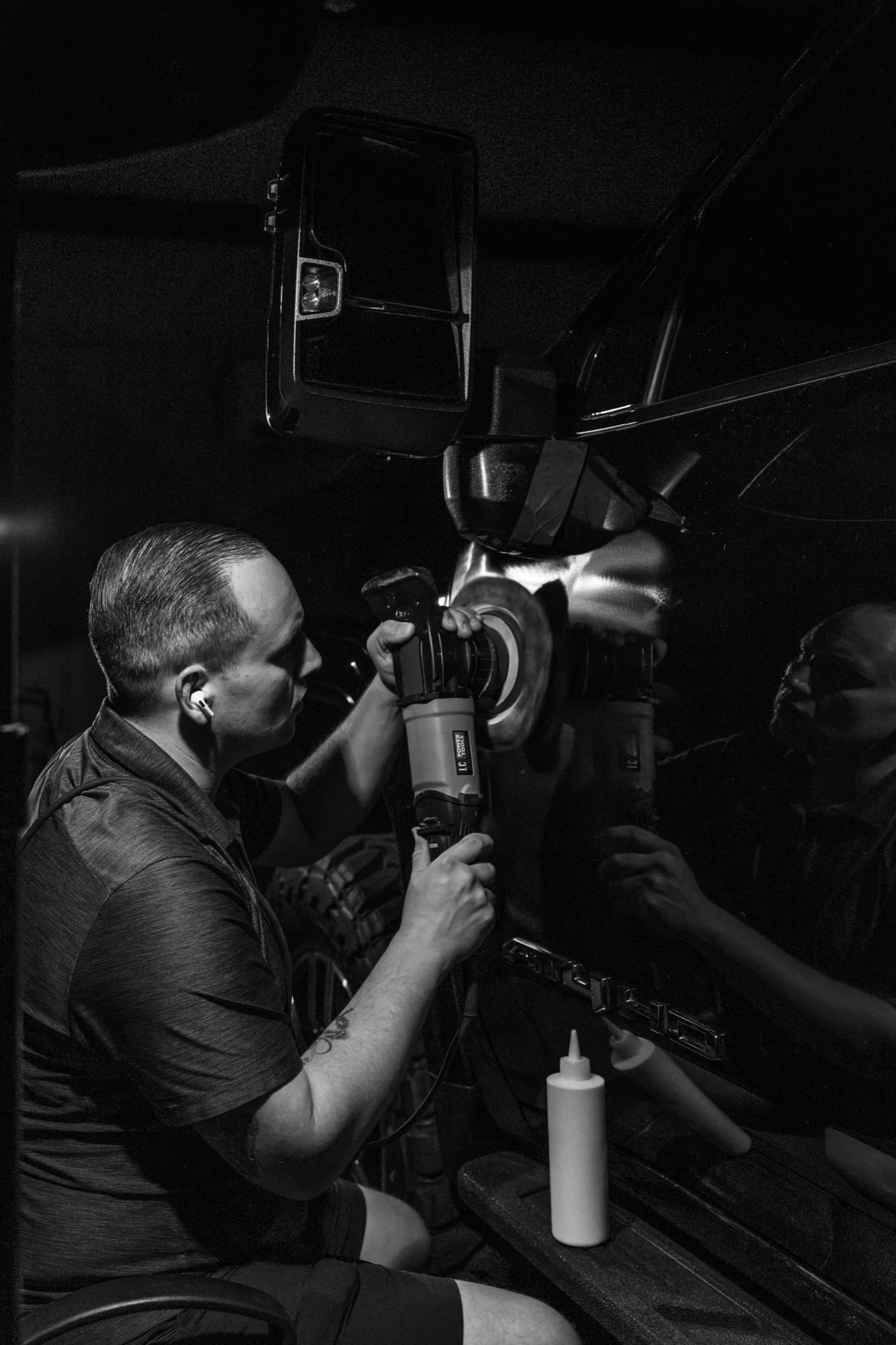
For a 1-Step, one machine-polishing stage. For a 2-Step, a cutting stage followed by a refining polish. Work is checked under light as it goes.
Sealant or coating
Every correction includes a 6-month sealant. If you're adding a ceramic coating, it goes on over the freshly corrected paint instead.
Pickup
Polished vehicles are blown dry. We walk you through the result and how to wash the car so the swirls don't come back.
Which one
Choosing Between 1-Step and 2-Step
Look at the car in direct sun. If you see a fine web of swirls and a few spots but the paint still looks fairly glossy, the 1-Step is usually the sensible choice. It removes most light defects in about 2 days and leaves more clear coat for the future.
If the swirls are heavy, the paint looks hazy or dull even when clean, or you're about to invest in a 3-year or 5-year coating, the 2-Step is worth it. The extra stage removes more and refines the finish so the coating sits on the clearest base possible. We'll recommend one at inspection and explain why.
After
Protecting the Result
Correction removes defects, but it doesn't stop new ones. The fastest way to undo a correction is a brush-style automatic wash or a dirty towel. That's why every correction includes a 6-month sealant and why we recommend at least a 1-year ceramic coating afterward.
IGL's data sheets for its coatings recommend polishing with an abrasive system before application and say the coating's durability depends on how well it bonds to a clean surface. Corrected paint is the ideal base. Our coatings start at $699.98 for a 1-year IGL EZ, $899.98 for a 3-year Quartz+ and $1,299.98 for a 5-year Kenzo on a coupe.
- Hand wash with a pH-neutral shampoo and clean mitts; avoid automatic brush washes.
- Dry with clean microfiber or a blower, never a dirty towel or squeegee.
- Rinse off bird droppings, bugs and sap quickly, especially in summer heat.
- Consider front-end PPF if rock chips are a concern; correction can't fix chips.
Booking
How to Book a Correction
Request a quote
Request a paint correction quote online. We're appointment only, and correction is quoted after we see the paint.
Confirm with a deposit
A deposit confirms the appointment. The cancellation policy is shown when you book.
Plan for 2 to 3 days
Plan on about 2 days for a 1-Step and about 3 days for a 2-Step. There's no waiting area, so arrange a ride.
Drop off
Drop-off after 6 pm can be arranged by phone at (864) 202-6934. We confirm the final price at inspection before starting.
| 1-Step Correction | 2-Step Correction | |
|---|---|---|
| Starting price | $799.99 | $1,399.99 |
| Time in the shop | About 2 days | About 3 days |
| Stages | One machine-polishing stage | Cutting stage, then refining polish |
| Best for | Light to moderate swirls, water spots, light oxidation | Heavy swirls, haze, prep for a long-term coating |
| Included protection | 6-month sealant | 6-month sealant |
| Recommended next step | At least a 1-year coating | At least a 1-year coating |
Starting prices; final prices are confirmed after inspection. Results depend on paint condition and safe correction limits.
See What Your Paint Can Look Like
Request a correction quote. We'll inspect the paint, show you what can and can't be removed, and confirm the price before we start.
Common questions
How much does paint correction cost in Anderson, SC?
At The Auto Show, a 1-Step Paint Correction starts at $799.99 and a 2-Step starts at $1,399.99. Both include a 6-month sealant. The final price depends on the vehicle and the paint's condition, and we confirm it after inspecting the car in person.
Can you remove water spots from my paint?
Many hard-water spots, like the ones sprinklers leave, polish out in a 1-Step correction. Spots that have etched deep into the clear coat may only partly improve within safe limits. We'll look at them at inspection and tell you what to expect before you commit.
Is paint correction safe for my car's clear coat?
Correction removes a small amount of clear coat, so it should be done carefully and not repeated often. Gauge maker DeFelsko notes manufacturers generally recommend removing no more than about 0.3 mils. That's why we don't chase every deep scratch and why protecting the result with a sealant or coating matters.
Can I drive the car right after a correction?
Yes. The included 6-month sealant protects the freshly polished paint, and the car is ready to drive at pickup. If you're adding a ceramic coating, ask about the care steps for the first days while the coating cures. Either way, wash gently from then on.
Do you correct trucks and large SUVs?
Yes. Trucks and large SUVs have more paint, so the final price may be higher than the starting price and we'll confirm it at inspection. Big hoods and tailgates often show heavy wash marring, and a correction followed by a coating makes them much easier to keep clean.
Sources
- Automotive Paint Detailing, DeFelsko (https://www.defelsko.com/resources/automotive-paint-detailing), accessed October 2026
- Technical Data Sheet: IGL Coatings Ecocoat Kenzo (material no. 154303), IGL Coatings (https://iglcoatings.com/wp-content/uploads/2023/09/tds_ecocoat_kenzo_154303.pdf), accessed October 2026
- Technical Data Sheet: IGL Coatings Ecocoat Quartz+ (material no. 154310), IGL Coatings (https://iglcoatings.com/wp-content/uploads/2023/09/tds_ecocoat_quartz_154310.pdf), accessed October 2026
Prices on this page are The Auto Show’s published starting prices and are confirmed after we inspect the vehicle. Product ratings and warranty terms come from the manufacturers.