
Ceramic Coating & PPF Guide: Compare
How Much Does Paint Correction Cost?
Paint correction is one of the few car services where almost the whole price is skilled time. There's very little material in a bottle of polish. What you're paying for is hours of machine polishing, panel by panel, by someone who knows how far the paint can safely go.
That's why prices vary from car to car even at the same shop. This guide explains what moves the number, what a correction can and can't do for the money, and how to keep from paying for it twice.
The short answer
Paint correction cost depends on how many polishing stages the paint needs, the vehicle's size, how damaged and how hard the paint is, and how many hours the result takes. At our shop, a 1-Step Correction starts at $799.99 and takes about 2 days, and a 2-Step Correction starts at $1,399.99 and takes about 3 days. Both include a 6-month sealant, and final prices follow an inspection.
Key points
- Correction is priced by labor: every panel is machine polished, wiped down and inspected.
- A 2-step adds a cutting stage before the refining polish, which roughly adds a day and removes heavier defects.
- Heavily swirled, hard or previously badly polished paint takes longer, so it costs more.
- Scratches deep enough to catch a fingernail usually go through the clear coat and can't be fully polished out.
- Protecting the result with a coating and gentle washing keeps you from paying for correction again.
Why labor
Where the Money Goes in a Correction
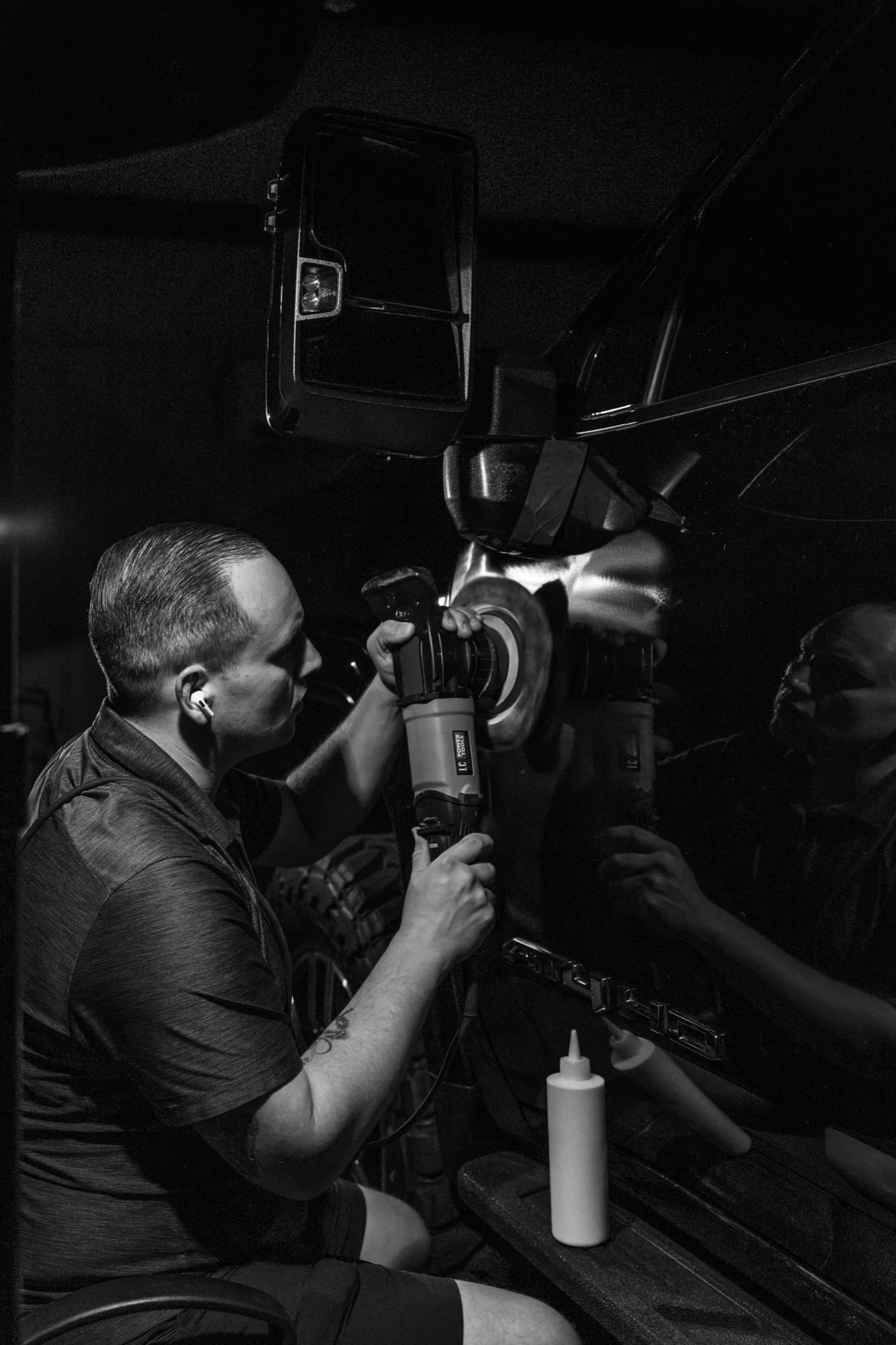
A correction removes a microscopically thin layer of clear coat to level out swirls, light scratches, water spots and oxidation. Doing that safely means working one small section at a time with a machine polisher, then wiping the area clean and checking it under strong light before moving on. A full vehicle is hundreds of those sections.
Before polishing even starts, the car has to be washed and decontaminated so grit doesn't get dragged under the pad, and sensitive trim may need taping. Test spots come first to find the least aggressive pad and polish that gets the job done. The result is a service measured in days, not hours.
This is also why an honest quote needs an inspection. Two cars of the same model can need very different amounts of work depending on how they were washed, where they were parked and whether anyone has polished them before. A photo can hint at the problem, but strong lighting and a paint thickness reading are what show how much correction the paint needs and how much it can safely take.
Stages
1-Step, 2-Step, or an Enhancement
- Level 3 Detail (paint enhancement)About 8 hours, price on request
- Our Level 2 Detail plus a machine paint enhancement for gloss. It improves shine and slightly softens light marring but is not a correction. Ask for a price. Enhancement vs correction
- 1-Step Paint CorrectionFrom $799.99, about 2 days
- A single machine-polishing stage that reduces car-wash swirls, hard-water spots, oxidation, light scratches and staining. Good for paint in fair condition, or as prep on a newer car. 1-step vs 2-step
- 2-Step Paint CorrectionFrom $1,399.99, about 3 days
- A cutting stage to remove heavier defects, then a refining polish to restore clarity and gloss. The best prep for a ceramic coating and the right choice for heavily swirled paint. Correction before coating
Condition
Paint Condition Changes the Hours
- Defect severity: light wash marring takes far less time than deep swirls, etched water spots or years of brush car washes.
- Paint hardness: some clear coats cut easily and finish down slowly; others resist cutting and take more passes. Your detailer learns which from the test spot.
- Previous bad polishing: holograms and buffer trails from careless machine work have to be removed before the real defects can be addressed.
- Paint thickness: factory finishes are only about 90 to 120 microns in total, according to PPG, so thin or repainted areas may limit how far correction can go.
- Damage beyond polishing: a scratch you can catch with a fingernail usually goes through the clear coat; correction can soften it but not remove it.
Size and color
Vehicle Size and Paint Color
More paint means more sections to polish. A full-size truck or 3rd-row SUV has much more surface than a compact sedan, and tall roofs add time on ladders. That's the main reason prices are listed as starting points.
Color plays a role too. Black and other dark colors show every swirl and haze in direct sun, so a finish that looks great on silver may still show faint marks on black. Getting dark paint to its best usually takes more refining time. Light colors hide minor defects but still benefit from correction for clarity and gloss.
Included
What a Correction Includes, and What It Doesn't
Every correction at our shop includes a 6-month sealant, so the paint leaves protected. We show you at inspection what can and cannot be removed; results depend on paint condition and safe correction limits.
- Included: inspection, machine polishing to the agreed stage, and a 6-month sealant.
- Not a fix for: rock chips, scratches through the clear coat, dents, or peeling clear coat. Those need touch-up, paintless dent repair or refinishing.
- Not a forever result: the same washing habits that created the swirls will bring them back.
Protect it
How to Avoid Paying for Correction Twice
Add a coating
We recommend at least a 1-year coating after correction. IGL EZ (1-year) starts at $699.98 for a coupe, IGL Quartz+ (3-year) at $899.98, and IGL Kenzo (5-year) at $1,299.98.
Change how the car is washed
Hand wash with a pH-neutral shampoo, two buckets and clean microfiber. Avoid automatic brush washes, which are a common cause of the swirls you just paid to remove.
Dry without dragging grit
Use a blower or plush towels, and never wipe a dusty car dry.
Consider film on the front
Correction can't fix rock chips. If highway miles are part of your life, film on the front end protects the corrected paint where chips land.
Red flags
Correction Offers to Be Careful With
- A promise to remove every scratch, sight unseen.
- A full multi-stage correction on a heavily swirled car quoted as a same-day job.
- No inspection or test spot before the price is set.
- Glossy results that look great indoors but show holograms in the sun a week later.
- No sealant or protection plan afterward.
| Service | What it does | Time | Starting price |
|---|---|---|---|
| Level 2 Detail | Decontamination wash, clay bar, sealant; no machine polishing | About 6 hours | $249.99 (2-door) |
| Level 3 Detail | Level 2 plus machine enhancement for gloss; not a correction | About 8 hours | Ask for a price |
| 1-Step Correction | One polishing stage; reduces swirls, water spots, oxidation, light scratches | About 2 days | $799.99 |
| 2-Step Correction | Cutting stage then refining polish; heavier defects | About 3 days | $1,399.99 |
Starting prices. Final prices are confirmed after inspection.
Get Your Paint Inspected and Quoted
We'll look at the paint under proper lighting, show you what correction can and can't remove, and recommend the right stage before confirming a price.
Common questions
Why does paint correction take two or three days?
Because it's done by hand, section by section. Each small area is machine polished, wiped clean and inspected under strong light, and a 2-step does that twice with different pads and polishes. Add the wash, decontamination, taping and a final sealant, and a full vehicle easily fills two to three days.
Does paint correction remove clear coat?
Yes, a very small amount. Polishing works by leveling the clear coat around defects, so a careful correction removes only what's needed. That's why it shouldn't be repeated often and why test spots and paint thickness matter. Protecting the paint afterward helps you avoid needing another correction soon.
Is paint correction worth it on a daily driver?
It can be, especially before a ceramic coating or if swirls bother you every time the sun hits the car. A 1-step correction gives a big visual improvement for less than a 2-step. If the car lives in brush car washes, though, the swirls will come back quickly, so change the washing first.
Can paint correction fix faded, oxidized paint?
Often, if the clear coat is still intact. Oxidation on clear coat paint is a dull, hazy surface layer, and polishing removes it to reveal clearer, glossier paint underneath. A 1-step handles light oxidation; heavier cases may need a 2-step. If the clear coat is peeling or flaking, it has failed, and no amount of polishing will bring it back.
Can I pay for correction on just one panel?
Ask us. Our published prices are for full-vehicle correction, but a single panel, such as a hood with water spots or a scratched door, can sometimes be addressed on its own. Keep in mind that one corrected panel can look noticeably glossier than the rest of the car.
Sources
- OEM Film Builds, PPG Refinish (https://www.ppg.com/en-AU/refinish-anz/support/oem-paint-support/oem-film-builds), accessed October 2026
- Ecocoat EZ, IGL Coatings (https://iglcoatings.com/products/ecocoat-ez), accessed October 2026
- Ecocoat Quartz+ Graphene Reinforced, IGL Coatings (https://iglcoatings.com/products/ecocoat-quartz-plus), accessed October 2026
- Ecocoat Kenzo, IGL Coatings (https://iglcoatings.com/ecocoat), accessed October 2026
Prices on this page are The Auto Show’s published starting prices and are confirmed after we inspect the vehicle. Product ratings and warranty terms come from the manufacturers.