
Ceramic Coating & PPF Guide: Get It Done
What Happens at a PPF Appointment
Paint protection film is a physical layer of clear urethane that gets stretched, positioned and pressed onto your paint one panel at a time. It is skilled hand work, and the decisions made before the first piece goes on (which panels, how the edges finish, what the paint looks like underneath) matter as much as the install.
Here is what happens at a PPF appointment in the order it happens. We install LLumar Platinum PPF as authorized LLumar installers; where our exact method for your car is not something we publish, we explain what is standard practice and confirm the specifics when you book.
The short answer
A PPF appointment starts with choosing coverage and inspecting the paint, since film locks in whatever is underneath. The car is then washed, decontaminated and polished where needed, with no wax left on. Film is positioned wet using a slip solution, squeegeed down, trimmed or wrapped at the edges, and heat-set. At pickup you check edges and clarity, then avoid washing for three days, as LLumar recommends.
Key points
- Decide coverage before the day: our packages run from front-end Interstate coverage to Full Car, with exact panels confirmed at inspection.
- Film is clear, so chips, swirls and contamination under it stay visible; prep and any correction happen first.
- LLumar advises against wax or coatings before install because they interfere with adhesion.
- LLumar recommends no washing for 72 hours after install, then hand washing; pressure washers and automatic washes can lift edges.
- LLumar backs Platinum PPF with a 10-year manufacturer's limited warranty, with restrictions spelled out in its warranty terms.
Before the day
Pick the coverage that fits how you drive
Most of the choice comes down to where your car takes hits. Rock chips land on the leading edge: bumper, hood, fenders and mirrors. Gravel roads and lifted tires add the rocker panels. Long highway commutes add the full length of the hood and the headlights.
Our packages map to those patterns. Prices are starting prices, and the final price is confirmed before install, after we have seen the car.
- InterstateFrom $1,199.99
- Front half of the hood, front half of the fenders, front bumper and mirrors. The most-hit areas for everyday driving. Partial vs full hood
- Long Distance DriverFrom $2,199.99
- Full hood, full fenders, headlights, fog lights, mirrors and door edges. No visible film line across the hood.
- Off RoaderCall for a quote
- Full hood, full fenders, headlights, fog lights, mirrors, plus front and rear rocker panels for gravel and tire spray. Rocker panel PPF
- Full CarFrom $5,499.99
- Whole-vehicle coverage; the exact panels are confirmed at inspection. Is full car PPF worth it?
Step 1
Inspection: the paint the film will cover
Film magnifies nothing, but it hides nothing either. Existing chips, swirls and scratches stay visible under a clear film, so the inspection is where we agree on what the paint looks like now and whether anything should be fixed first. Small chips are better touched up before film goes over them.
Repaints matter too. LLumar designs its film for original painted surfaces and says issues with aftermarket or repaired paint are not covered by its warranty. If a panel was recently refinished, LLumar notes that 30 days is the common waiting period for new paint to outgas before film goes on. Tell us about any body work, even if it was years ago.
- Bring up any panel you know has been repainted or repaired.
- Ask whether a chip or scratch should be addressed before film covers it.
- Confirm which panels are included and how the edges will finish on each one.
- Choose your finish: LLumar Platinum comes in gloss, black, matte and extra-thick versions.
Step 2
Prep: clean, bare and smooth
Adhesive needs bare paint. The car gets a thorough wash and decontamination to remove iron, tar, bug residue and bonded grime, and standard practice is to clean each panel again right before its film goes on. If you asked for paint correction, it happens now, before any film goes down, because polishing under film is impossible once it is on.
LLumar's guidance is clear on one thing owners sometimes get wrong: do not wax the car before the appointment. LLumar says waxes and coatings can interfere with the film's adhesion to the paint. If your car already has a ceramic coating on the panels being filmed, tell us at booking so we can plan for it.
Step 3
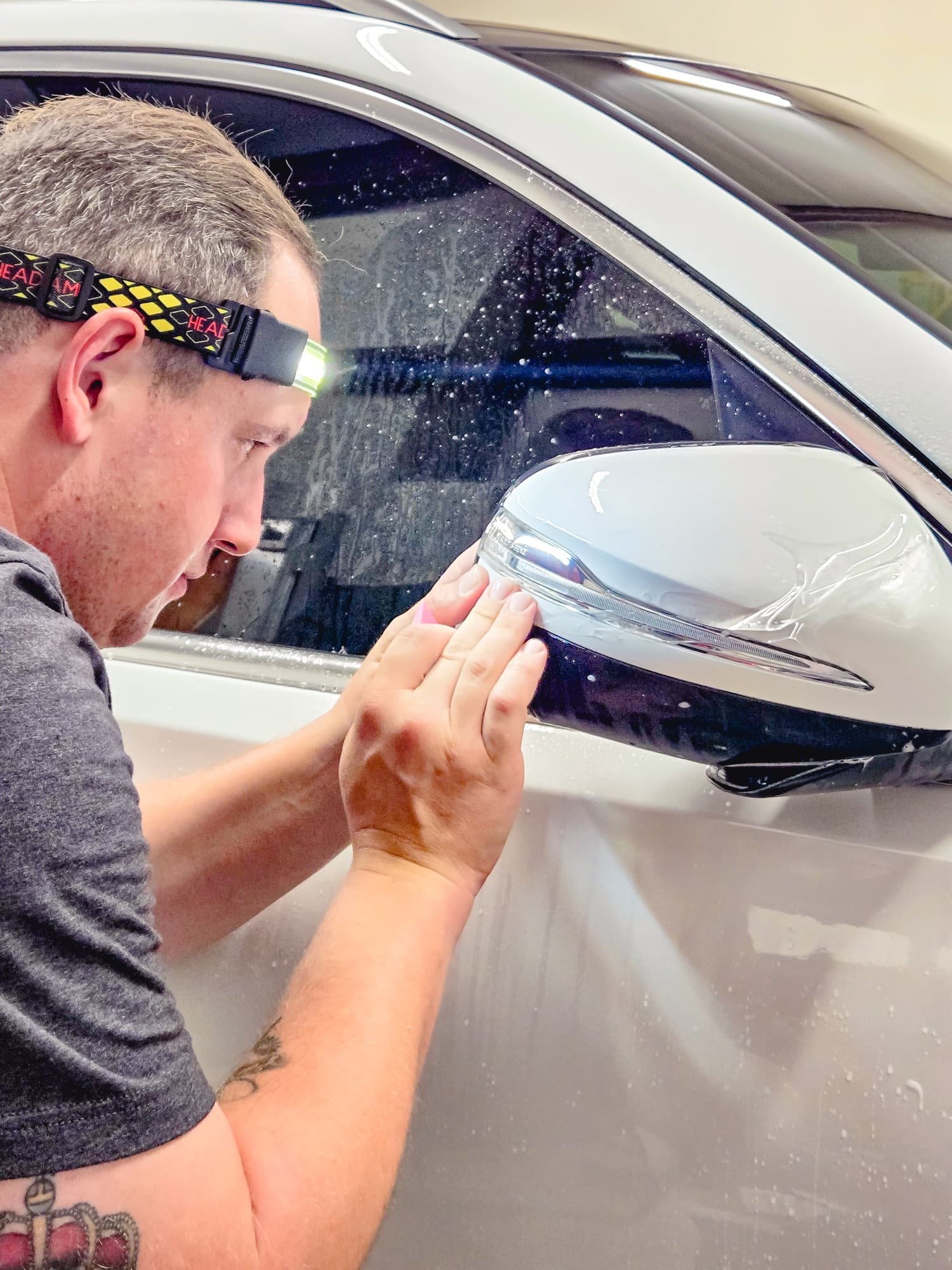
Installing the film
Across the industry, film is installed wet. The installer sprays the paint and the adhesive side of the film with a slip solution so the piece can float and be positioned exactly, then uses a tack solution and a squeegee to push the liquid out from the center toward the edges. Where a panel curves, the film is gently stretched and worked so it lies flat without distortion.
Pieces come either from vehicle-specific patterns cut by a plotter or from bulk film trimmed on the car. Edges are wrapped around the panel where there is room to do it cleanly, and left just short of the edge where wrapping would risk lifting. Small relief cuts help film follow tight shapes like mirror housings and bumper vents. Which approach we use on each panel of your car depends on the vehicle and the coverage; we walk you through it when you book.
Position
The film floats on slip solution so it can be aligned to body lines and panel gaps.
Anchor
One area is set first, usually the center of the panel, so the film cannot drift.
Squeegee
Solution is pushed out toward the edges in overlapping strokes. What is left becomes the small moisture pockets you may see for a few days.
Edges and corners
Edges are wrapped or finished just short of the edge, and corners are worked so they do not lift.
Heat-set
Heat helps film relax into curves and settles the edges and wrapped areas.
Step 4
Post-heat, inspection and an optional coating
After install, the standard practice is to go over the edges and curves with heat to help the adhesive set and the film hold its shape, then inspect each panel under light for lifted corners, trapped debris and stretch marks. A clean install shows even edges, consistent gaps and clear film you only notice when you look for it.
If you want, PPF can be ceramic coated on top. Coating the film makes it slicker, helps it stay cleaner and makes washing easier. Many owners film the front end and coat the whole car, film included. Ask for coating prices for your vehicle when you request the PPF quote.
Step 5
Pickup and the first week
At pickup, walk around the car with us. Look along each edge, check the panels you cared most about and ask about anything you see. Some small water pockets or a faint haze under fresh film are a normal part of a wet install while the remaining moisture works its way out; we tell you what to expect for your car.
LLumar recommends you do not wash the car for three days (72 hours) after install. After that, hand washing with soap, water and a soft, clean cloth is the preferred method. LLumar discourages pressure washing and automatic car washes because they can lift the film, especially at the edges, and that damage is not covered by its limited warranty. Our PPF aftercare article covers the first week in detail.
- Do not pick at edges or press on small bubbles.
- Park in a garage or shade if you can for the first days.
- Remove bird droppings promptly; LLumar lists them as a staining hazard.
- Light swirls in the top coat level out with heat from the sun or warm water. Deep cuts do not.
Warranty
What LLumar's warranty says
LLumar states a 10-year manufacturer's limited warranty for Platinum PPF, including the gloss, matte and extra-thick versions, with the note that certain restrictions apply. LLumar's FAQ adds that carbon fiber and aftermarket or repaired paint are not covered, and that damage from pressure washing or automatic washes is excluded. Those terms come from LLumar, not from us, so read LLumar's warranty document and keep your install paperwork.
| Package | Coverage | Starting price |
|---|---|---|
| Interstate | Front half of hood and fenders, front bumper, mirrors | $1,199.99 |
| Long Distance Driver | Full hood and fenders, headlights, fog lights, mirrors, door edges | $2,199.99 |
| Off Roader | Long Distance Driver areas plus front and rear rocker panels | Call for a quote |
| Full Car | Whole vehicle; panels confirmed at inspection | $5,499.99 |
Final price is confirmed before install. Install timing is confirmed when you book.
Get a PPF quote for your car
Tell us your vehicle, how you drive and which package you are considering. We confirm coverage, finish and the final price before any film goes on.
Common questions
Can I drop my car off for PPF the night before?
Drop-off after 6 pm can be arranged by phone, so an evening drop-off for a next-day install is often possible. Call to set it up when you book. There is no waiting area, so plan a ride for both drop-off and pickup either way.
Do I need to remove my ceramic coating before getting PPF?
On the panels being filmed, the surface has to be bare for the adhesive to bond, and LLumar advises against wax or coatings before install. Tell us at booking if the car is already coated so we can plan the prep. Panels outside the film coverage keep their coating.
Will I see lines where the film ends?
On partial coverage, yes, if you look closely: the edge of the film across the hood or fenders can catch light and collect a little dirt over time. Full-panel coverage avoids lines on those panels because edges sit at panel gaps or wrap around them. The inspection is the time to ask where each edge will fall.
Can PPF go on a car that was just repainted?
LLumar says 30 days is the common waiting period for fresh paint to outgas before film goes on, and that issues with repaired or aftermarket paint are not covered by its warranty. Tell us about the repaint date and the panels involved, and we will advise whether to wait.
Sources
- Paint Protection Film Frequently Asked Questions, LLumar / Eastman Performance Films (https://llumar.com/en/resources/paint-protection-film-frequently-asked-questions/), accessed October 2026
- Platinum Gloss Paint Protection Film, LLumar (https://llumar.com/en/paint-protection-film/platinum-gloss/), accessed October 2026
- Platinum Matte Paint Protection Film, LLumar (https://llumar.com/en/paint-protection-film/platinum-matte/), accessed October 2026
- Platinum Extra Paint Protection Film, LLumar (https://llumar.com/en/paint-protection-film/platinum-extra/), accessed October 2026
- Paint Protection Film, LLumar (https://llumar.com/en/paint-protection-film/), accessed October 2026
Prices on this page are The Auto Show’s published starting prices and are confirmed after we inspect the vehicle. Product ratings and warranty terms come from the manufacturers.