
Ceramic Coating & PPF Guide: Understand
Red Clay, Dust and Gravel Roads: Keeping Upstate Cars Clean
Anyone who has driven a white car down a freshly graded driveway in Anderson County knows the color. Upstate red clay rides home on rocker panels, packs into wheel wells, tints the lower doors orange and works its way into every textured plastic surface it touches.
Clay dust is not the most dangerous thing your paint will meet, but it is one of the most persistent, and the way most people try to get it off (a quick wipe, a gas station brush) does more harm than the clay itself. This guide covers why it sticks, how to remove it safely, and how to keep the low parts of the car protected.
The short answer
Red clay sticks because it is extremely fine and sticky when wet, so it packs into wheel wells, seams and textured trim and can tint light paint and porous plastics. Remove it with plenty of water first: pre-rinse and soak the lower panels, wash wheels and wheel wells separately, then hand wash with a fresh mitt. Never dry-wipe clay dust. A ceramic coating helps it release, and film on the rockers stops gravel and grit wear.
Key points
- The red layer of Piedmont soil is a fine, sticky clay that shows up wherever topsoil has been scraped away: construction sites, road cuts and gravel drives.
- Clay dust is abrasive when it is dragged across paint, so rinse and soak before anything touches the surface.
- Wheels, wheel wells and lower panels get their own tools and their own water, separate from the upper body.
- Light paint, unpainted textured trim and old film edges are the surfaces most likely to hold a red tint.
- A slick protective layer makes clay release with a rinse; rocker-panel film handles the gravel that comes with it.
The soil
Why the Upstate's dirt is red and so sticky
Much of the Upstate sits on Piedmont soils like the Cecil series, which the USDA maps across the Piedmont from Virginia to Alabama, South Carolina included. The USDA's official description of Cecil soil is telling: a sandy loam topsoil over a deep subsoil described as red clay that is firm, sticky and plastic. The same description notes that where the land has eroded, the surface itself becomes clay loam.
In practice, you meet that red subsoil wherever the topsoil has been pushed aside: new subdivisions, road widening, utility trenches, unpaved driveways and the shoulders of country roads. When it is wet, it clings like paste. When it dries, it turns into a fine powder that the wind and every passing truck carry onto your car.
That fine particle size is the problem. Coarse sand rinses off. Fine clay settles into the microscopic texture of plastic trim, into panel seams and into the edges of anything with a gap, and it holds water, so the lower panels of a car that drives through it stay damp and dirty longer.
Where it collects
The parts of the car clay goes after
Look underneath, too. A thick layer of packed clay holds moisture against the frame, brake lines and suspension parts, and keeps those areas damp long after the rest of the car has dried.
- Rocker panels and the lower 12 inches of the doors, where tire spray hits first.
- Wheel wells, inner fender liners and the backs of bumpers, where mud packs in and stays wet.
- Mud flaps, running boards and side steps on trucks and SUVs.
- Unpainted textured black trim, which can take on a reddish cast that does not rinse off.
- Door jambs, the tailgate seam and the bed of a pickup.
- Light-colored paint, especially white, silver and pearl, where an orange film shows clearly.
- Floor mats and carpet, which carry it into the cabin on every pair of shoes.
The real risk
Why the wipe-off is worse than the clay
Dry clay dust on paint is a layer of very fine abrasive. Wiping it with a towel, a duster or your sleeve drags that abrasive across the clear coat and leaves fine scratches and swirls, which show most clearly on dark paint in the sun. The same goes for the spinning brushes at many automatic washes, which carry grit from the previous muddy truck onto your car.
The safe rule is simple: water first, contact second. The more of the dirt you remove before a mitt touches the paint, the fewer scratches you put in. That matters even more on a car with a fresh polish or a new coating, because a coating is thin and swirls you add on top of it are still swirls.
Washing
How to wash off red clay without scratching the paint
Rinse from a distance, bottom up
Start with a strong rinse aimed at the wheel wells, rockers and lower doors. Let the water do the work and knock the heavy mud loose before you touch anything. Rinse under the bumpers and behind the wheels where clay packs in.
Soak the lower panels
Cover the bottom third of the car with car wash foam or soapy water and let it dwell a few minutes in the shade so dried clay softens. Do not let it dry on the panel. Rinse again.
Clean wheels and wheel wells with separate tools
Use a dedicated bucket, brushes and mitt for wheels, tires and wells. IGL Coatings recommends starting at the wheels and using separate cloths for the grittier lower sections, so you do not drag that grit onto the upper body.
Wash the body top down with a fresh mitt
Use the two-bucket method with a pH-neutral car shampoo. Wash the roof, glass and upper panels first and save the lower panels for last, ideally with a second mitt. Rinse the mitt often and retire it if it turns gray or orange.
Detail the seams and jambs
Open the doors, tailgate and fuel door and rinse or wipe the jambs with a damp microfiber. A soft brush gets clay out of badges, grilles and trim texture without scratching.
Dry and inspect
Dry with clean microfiber or a blower, then look at the lower panels in good light. A faint orange haze that survived the wash usually means the surface needs decontamination, not harder scrubbing.
Decontamination
When washing is not enough: stains, film and bonded grit
On light paint that spends time on dirt roads, fine clay and road grime can bond to the surface and leave the lower panels feeling rough and looking faintly tinted. A detailing clay bar (a different thing entirely from the dirt) lifts bonded contamination off the clear coat with a lubricant. Iron removers target embedded metal particles from brake dust and rail dust, not soil, so do not expect one to dissolve a clay stain.
Textured black trim is harder. Fine clay works into the grain and can leave a reddish cast. A dedicated plastic cleaner and a soft brush usually lift it; a trim restorer or trim coating afterward seals the surface so it does not grab the next round of dust as easily. On older or faded trim, the stain is often the dirt that the dried-out plastic is holding onto.
If light paint still shows a tint after a proper wash, clay bar and polish, do not keep scrubbing. Have it looked at in good lighting so you know whether you are dealing with a surface stain or something in the paint itself.
Gravel roads
Dust is only half of it: gravel, chips and the lower panels
Unpaved roads bring grit and gravel along with the dust. Your own tires throw stones back at the rocker panels, lower doors and rear fenders, and every car ahead of you throws them at your hood and windshield. Over time, the lower panels can end up sandblasted: a dull, pitted finish behind each wheel that no polish fully restores.
Mud flaps or splash guards cut down on what your tires throw at your own paint. Slowing down on gravel helps both your car and the one behind you. And if you drive a gravel road every day, the lower panels are a good candidate for paint protection film, which takes the hits instead of the paint.
Protection
Which protection actually helps with clay and gravel
- Ceramic coatingEasier release
- A slick, hydrophobic surface gives clay less to grab, so more of it comes off in the rinse and less force is needed to wash. It does not stop gravel chips or sandblasting. What a coating won't do
- Rocker panel PPFPhysical barrier
- Clear film on the rockers and lower doors absorbs grit and stone impacts from your own tires. It is the most direct fix for sandblasted lower panels. Rocker panel PPF
- Coated wheelsFaster cleanup
- A coating on wheel faces helps brake dust and clay rinse off with less scrubbing, which matters if you clean them every week. Coating wheels
- Interior protectionMats and carpet
- Rubber floor liners catch clay before it reaches the carpet. Once red clay is ground into carpet fibers, hot-water or steam extraction is usually what gets it out. Interior coatings
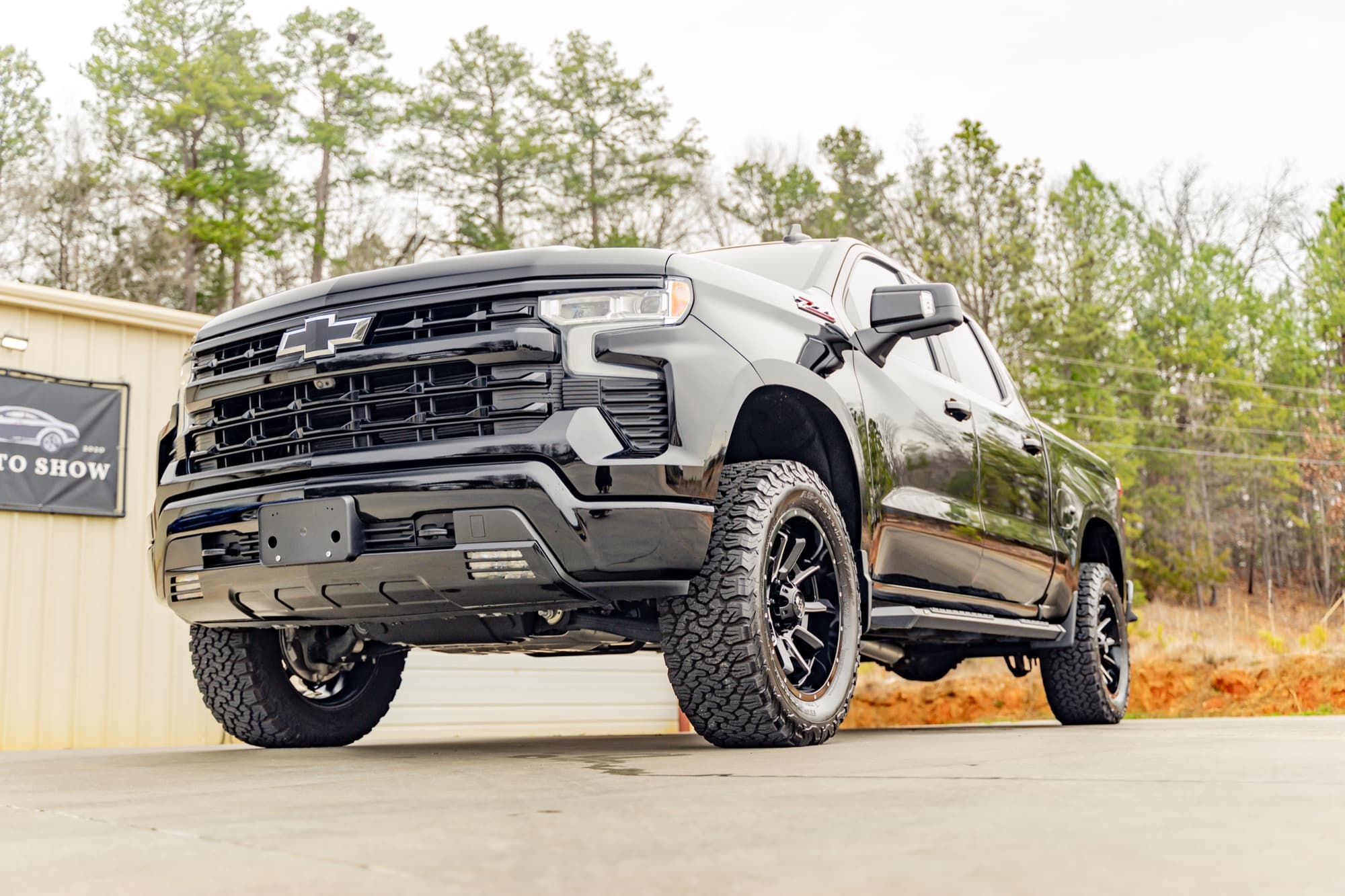
For trucks and Jeeps that see dirt roads regularly, The Auto Show's Off Roader film package covers the hood, fenders, headlights, fog lights, mirrors and front and rear rocker panels; call for a quote.
Lower panels taking a beating?
Bring the truck or car by and we will show you where the clay and gravel are doing damage, and whether a detail, a coating or rocker film makes the most sense.
Common questions
Can red clay stain white car paint for good?
On healthy, protected clear coat, a red film almost always comes off with a proper wash, a clay bar and, if needed, a light polish. Staining that will not come out is more likely on oxidized or porous paint, on unpainted textured trim, and on old or neglected film. The longer it sits, especially wet, the harder it is to remove, so rinse it off soon after a dirt-road drive.
Is it OK to take a muddy car through an automatic car wash?
It is better than leaving thick mud on the car, but brush washes can drag grit from your car, and from the muddy vehicles before you, across the paint. If you can, rinse the heavy mud off the lower panels and wheel wells with a hose or a self-serve wand first. A touchless wash avoids the brushes but uses stronger chemicals.
How do I get red clay out of car carpet?
Let mud dry completely, then vacuum thoroughly to remove as much loose clay as possible, because wet clay smears deeper into the fibers. Treat what remains with a carpet cleaner and blot rather than rub. Stubborn, ground-in clay usually needs hot-water or steam extraction. Rubber floor liners are the best prevention if you live on a dirt road.
How often should I rinse the undercarriage if I drive on dirt roads?
Rinse it whenever you can see packed mud in the wheel wells or along the frame, and at least every couple of weeks during wet months. Packed clay holds moisture against metal parts. A garden hose with an angled wand or a self-serve wash with an undercarriage setting both work.
Sources
- Official Series Description: Cecil Series, USDA Natural Resources Conservation Service (https://soilseries.sc.egov.usda.gov/OSD_Docs/C/CECIL.html), accessed October 2026
- Ceramic Coating Wash Techniques, IGL Coatings (https://blog.iglcoatings.com/ceramic-coating-wash-techniques/), accessed October 2026
- Just got a Ceramic Coating Done and you're not sure how to maintain it?, IGL Coatings (https://blog.iglcoatings.com/how-to-maintain-ceramic-coatings/), accessed October 2026
- Paint Protection Film Frequently Asked Questions, LLumar (https://llumar.com/en/resources/paint-protection-film-frequently-asked-questions/), accessed October 2026
- AAA: Salt and Chemical De-Icers Cost Drivers $3 Billion Annually, AAA Oregon/Idaho (https://info.oregon.aaa.com/aaa-salt-and-chemical-de-icers-cost-drivers-3-billion-annually/), accessed October 2026
Prices on this page are The Auto Show’s published starting prices and are confirmed after we inspect the vehicle. Product ratings and warranty terms come from the manufacturers.