
Ceramic Coating & PPF Guide: Compare
Is PPF Worth It? An Honest Answer
Paint protection film is the only product in this guide that physically takes a rock hit for your paint. It is also the most expensive way to protect a car, and nobody needs it on every panel.
Whether it is worth it comes down to three things: how much highway and gravel driving you do, how long you will keep the car, and how much a chipped front end actually bothers you. Here is how to weigh each one honestly.
The short answer
PPF is worth it if you drive a lot of highway miles, keep cars for several years, or own a car whose paint would be expensive or hard to match if repainted. Covering just the front end gets most of the benefit for a fraction of full-car cost. It is usually not worth it on a car you will sell soon or one that rarely leaves town roads.
Key points
- Film absorbs small rock and debris impacts that would chip paint; a coating cannot do that.
- Most chips land on the front bumper, hood leading edge, mirrors and headlights, so partial coverage captures most of the value.
- Fixing chips well is harder than it sounds: touch-up paint rarely disappears, and a respray can mean blending into neighboring panels.
- The longer you keep the car and the more interstate miles you drive, the better the math gets.
- Film is not a force field: large rocks, deep cuts and collisions can still damage it and the paint underneath.
What it does
What You Get for the Money
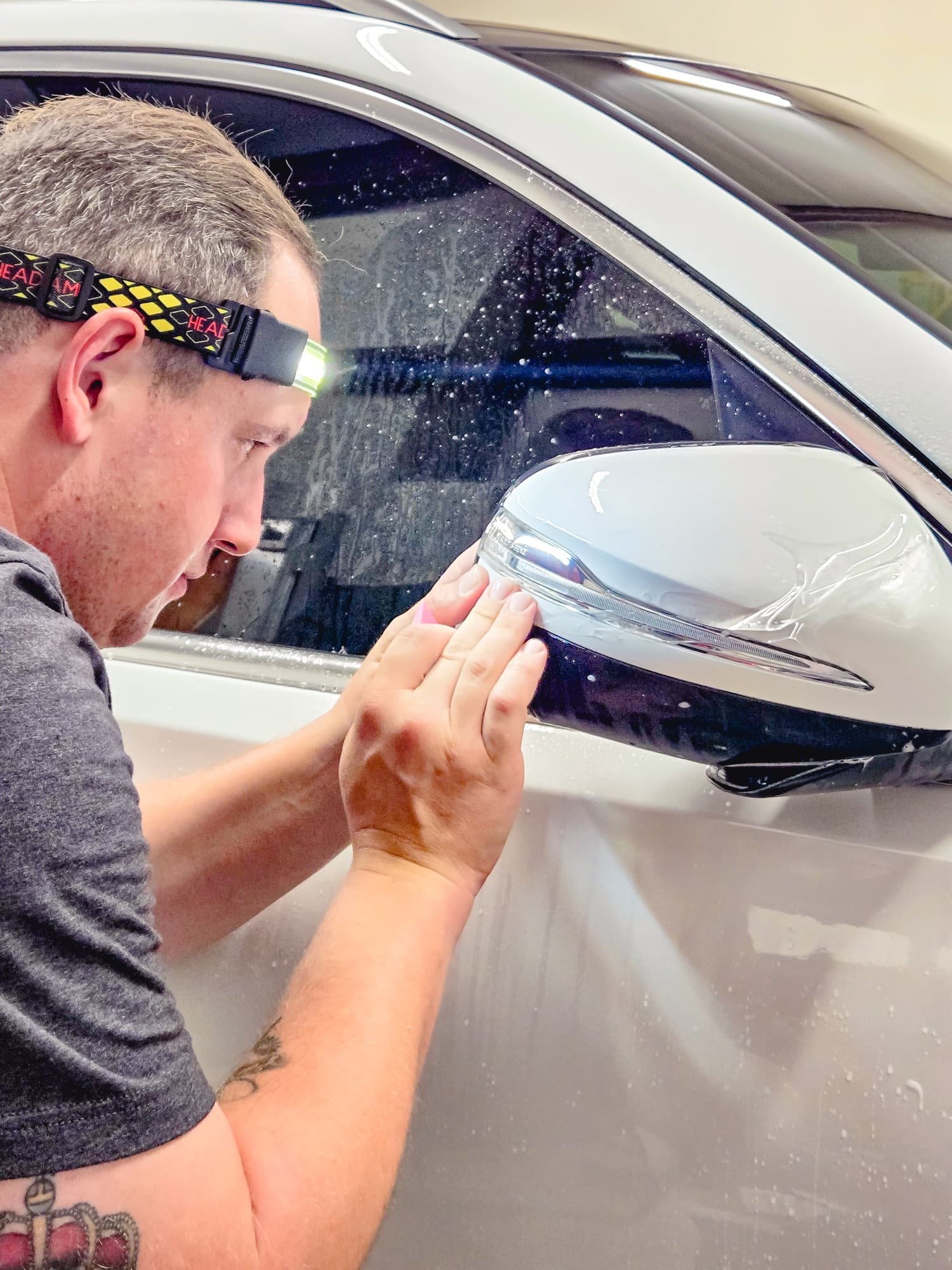
PPF is a clear urethane film, much thicker than any coating, applied over the paint like a skin. When a pebble flicked off a truck tire hits the front bumper, the film dents or scuffs instead of the paint chipping down to primer. LLumar describes its Platinum film as having a self-healing surface that uses heat from the engine or sunlight to reduce swirl marks and minor scratches.
That is the core value: chips that would have happened to the paint happen to the film, and light marring in the film often levels out on a warm day. Deep cuts do not heal, and a big enough rock can still push through. But for the everyday sandblasting a front end takes on the interstate, film is the one product that actually prevents the damage instead of just making the car easier to wash.
Film also guards against the stuff that etches paint: bug splatter, bird droppings and tree sap sit on the film's top coat instead of the clear coat. You still need to clean them off promptly, but the film gives you more margin.
The alternative
The Real Cost of Not Having Film
The honest comparison is not film versus nothing. It is film versus what you would do about the chips later. A few chips on a hood can be dabbed with touch-up paint, which seals the spot but almost never disappears; up close you will see the blob. A proper fix means repainting the panel, and a body shop will often blend fresh color into the neighboring panels so the repair doesn't show. Get a quote from a body shop for your car if you want a real number; it varies widely by color and panel.
There is also the factory finish itself. Some buyers and appraisers carry a paint thickness gauge to look for repainted panels. Factory paint is typically 4 to 7 mils thick in total, according to gauge maker DeFelsko, so a refinished panel often reads differently from its neighbors. Keeping the original paint intact is part of what film protects.
Chips that reach bare metal also invite corrosion if left open. That is a reason to seal any chip quickly whether you have film or not, and another reason the front edge of a hood is the first place worth covering.
Good fit
When PPF Is Clearly Worth It
- You commute on I-85, US-76 or US-29 daily, or drive long highway trips often. Following trucks and work zones is where most front-end chips come from.
- You plan to keep the car five years or more. The film keeps working the whole time while chips would otherwise keep adding up.
- The car is new or the paint has just been corrected. Film preserves paint at its best; it's less useful over paint already full of chips.
- The color is hard to match: tri-coat whites, deep metallics and some reds are the hardest to repaint invisibly.
- You drive gravel or dirt roads, tow, or take a truck to lake ramps. Rocker panels and the lower doors take a beating from tire spray.
- Chips genuinely bother you. If every new chip ruins your week, film is the only fix for that feeling.
Poor fit
When It Probably Isn't
- You'll sell or trade the car within a year or two. Few buyers pay extra for film, and appraisers rarely price it in.
- The car mostly does short in-town trips at low speed. Chips are much less frequent.
- The front end is already peppered with chips. Film over chips locks them in. Repair first, or accept them and protect the rest.
- It's a lease with lenient wear rules. Ford Credit's published lease guidelines, for example, allow up to 15 paint chips per panel with no charge at turn-in. Check your own lease before buying film for this reason.
- Your main goal is easier washing and gloss. That's a coating's job, at lower cost.
Coverage
How Much Coverage Gives the Best Value
- Partial front (Interstate package)from $1,199.99
- Front half of the hood, front half of the fenders, front bumper and mirrors. Covers the highest-impact zones. The trade-off is a film edge across the hood that you may notice up close. Partial vs full hood
- Full front (Long Distance Driver package)from $2,199.99
- Full hood, full fenders, headlights, fog lights, mirrors and door edges. No visible line on the hood, and the headlights get protection too. The sweet spot for heavy highway drivers. All coverage options
- Off-road coverage (Off Roader package)call for a quote
- Full front coverage plus front and rear rocker panels, for trucks, Jeeps and anything that sees gravel. Rocker panel PPF
- Full carfrom $5,499.99
- Whole-vehicle coverage, exact panels confirmed at inspection. Worth it for rare, high-value or hard-to-repaint cars, or owners who want every panel guarded against door dings and scuffs. Is full car PPF worth it?
Starting prices from The Auto Show's published packages; the final price is confirmed before install.
Do the math
A Simple Way to Judge the Value
Count the chips you have now
Look at the hood edge and bumper of your current car in low sun. That's roughly what the next few years will do to the new one if your driving stays the same.
Decide what you'd do about them
Live with them, touch them up, or repaint. If you'd live with them, film is a comfort purchase. If you'd repaint, compare a body shop quote with the film price.
Match coverage to your roads
Mostly interstate: full front. Mixed driving: partial front. Gravel and towing: add rockers. Collector or very high-value car: consider full coverage.
Spread it across your years
Divide the package price by the years you'll keep the car. Film that lasts the whole ownership gets cheaper per year the longer you keep it.
Limits
What PPF Won't Do
Film reduces chips; it does not make a car immune to them. A large rock at highway speed can tear film or crack the paint under it, and sharp debris can cut it. Film also won't stop dents from hail or door impacts, and the edges of partial coverage can collect dirt and wax residue if they aren't cleaned gently.
Film is also a product with a life span. LLumar backs its Platinum films with a 10-year manufacturer's limited warranty, with restrictions explained by the dealer; check the warranty document for what it covers, which is typically product defects rather than impact damage. Treat the film as protection you maintain, not something you forget about.
| Question | With front-end PPF | Without film |
|---|---|---|
| Small rock hits on the bumper and hood | Film takes the hit; paint usually untouched | Chips through to primer or metal |
| Light swirls on the protected panels | Often level out with heat | Need polishing |
| Bug and bird etching | Lands on the film's top coat | Lands on the clear coat |
| Original factory paint at trade-in | Preserved under the film | Touch-ups or a respray likely on a high-mileage car |
| Upfront cost | From $1,199.99 for partial front | None now; repair costs later |
Not Sure How Much Film You Need?
Tell us how you drive and how long you'll keep the car. We'll look at the paint, show you where chips are likely, and quote the coverage that makes sense, even if it's the smallest package.
Common questions
Is PPF worth it on a used car?
It can be, if the paint is still in good shape and you plan to keep the car. The front end of a used car usually has some chips already, and film over chips seals them in place. Have the paint inspected first, repair or touch up what matters, and then protect it. On a car with a heavily chipped front, the value drops.
Is PPF worth it on a white or silver car?
Light colors hide swirls but not chips: a chip shows as a dark spot of primer against a light finish. Pearl and tri-coat whites are also some of the harder colors to repaint so the repair blends in. If you drive highway miles, front-end film is just as useful on a white car as a dark one.
Is it better to get PPF or a ceramic coating first?
Film goes on first, then a coating can go over the film and the rest of the car. That order lets the installer work on clean, bare paint, and the coating then makes the film easier to wash. If you can only afford one now, choose based on your biggest worry: chips point to film, washing and gloss point to a coating.
Does PPF hurt resale value?
Quality film that is removed properly shouldn't harm factory paint. Problems usually come from poor installs, cuts made into the paint during installation, or very old film removed carelessly. If you sell with film on, keep the paperwork so the next owner knows what it is and who installed it.
Can I put PPF on just the parts that get chipped?
Yes. That's exactly what partial and full front packages do. The bumper, hood edge, mirrors and headlights take most of the hits on a typical car. Rocker panels matter more on trucks, Jeeps and cars driven on gravel. Covering those areas captures most of the protection for much less than full coverage.
Sources
- Platinum Gloss Paint Protection Film, LLumar (https://llumar.com/na/en/automotive/paint-protection-film/platinum-gloss), accessed October 2026
- Platinum Extra Paint Protection Film, LLumar (https://llumar.com/na/en/automotive/paint-protection-film/platinum-extra/), accessed October 2026
- Automotive Paint Detailing, DeFelsko (https://www.defelsko.com/resources/automotive-paint-detailing), accessed October 2026
- Wear and Use Evaluator Card & Guidelines, Ford Credit (https://www.ford.com/finance/content/dam/ford64/us/pdf/lease-end/wear_use_evaluator_card.pdf), accessed October 2026
Prices on this page are The Auto Show’s published starting prices and are confirmed after we inspect the vehicle. Product ratings and warranty terms come from the manufacturers.